
- Capture, purify and enrich in as little as 15 minutes to obtain high concentrations of fully functional protein.
- Process small sample volumes in a reproducible, high throughput, automated format.
- Elution volumes as low as 10 μL, producing enrichment factors as high as 50 fold, with concentrations of purified protein of up to 10 mg/mL.
Introduction
The PhyTip® columns are innovative purification tools that radically simplify the capture, purification and enrichment of proteins from a variety of sources. Key to the success of these purification tools is the design of the mechanism to retain the affinity resin bed, with minimum dead volume and maximum capture potential. Existing Biotage products include PhyTip columns affinity media for the purification of antibodies and tagged proteins, as well as conventional chromatography media for ion exchange, SEC (size exclusion chromatography) and hydrophobic separations.
One area with an immediate need for high throughput, automated sample preparation is antibody leads screening. Using the Tecan Freedom EVO® in conjunction with PhyTip columns containing Protein G resin, 96 hybridoma supernatants can be purified in as little as 15 minutes. The yield, purity, and reliability of this procedure make it the ideal platform for sample preparation prior to high throughput assays.
The IgG purification process is streamlined for ease of use. PhyTip columns are loaded onto the Tecan Freedom EVO and undergo an equilibration step. The PhyTip columns are then ready for capture of sample.
Following a rapid wash step, purified antibodies are easily eluted with commonly used low pH buffer. This technique allows for exceptionally high yields of IgG, depending
on various conditions and provides for highly selective purification. PhyTip columns have extremely high binding capacity and can efficiently recover antibodies from samples of as low as 200 ng/mL. In this Technical Note, the use of PhyTip Protein G columns will be processed by the Tecan Freedom EVO. Applications with this process include purification of mouse and rat hybridomas. When combined with the flexibility of the suite of PhyTip column products and reliability of the Tecan Freedom EVO, this combination of technologies can be the base platform for any drug development process.
Materials and methods
Samples and reagents
All methods were developed at Biotage, USA. All 0.5 mL samples were processed with 1 mL PhyTip columns containing 20 μL of Protein G resin. Samples were made using known amounts of human immunoglobulin G (hIgG) standard protein (Sigma, I4506) spiked into PBS buffer containing 0.05% Tween 20 (Sigma, 63158). The following buffers were used to process the PhyTip columns:
Equilibration buffer
PBS
Wash buffer 1
PBS
Wash solution 2
140mM NaCl
Enrichment buffer
200mM sodium phosphate pH 2.5, 140 mM NaCl
Neutralization solution
1 M Tris pH 9.0
Sample processing
Operation of the samples and PhyTip® columns were carried out on the Tecan Freedom EVO Workstation using the LiHa arm and Freedom EVOware® 2.3. The following procedures were followed:
- Equilibration: PhyTip columns were washed by passing the 1 mL PBS buffer over the resin bed with 1 aspirate and dispense cycle at a flow rate of 8.3 μL/second and a pause of 20 seconds after each aspirate and each dispense step.
- Capture: Antibody was captured by passing the 0.5 mL sample over the resin bed with four aspirate and dispense cycles at a flow rate of 4.0 μL/second and a pause of 20 seconds after each aspirate and each dispense step.
- Purify: PhyTip columns were first washed in 1 mL PBS buffer with 1 aspirate and dispense cycle at a flow rate of 8.3 μL/ second and a pause of 20 seconds after each aspirate and each dispense step. This was followed by a second wash with 1 mL 140mM NaCl using the same procedure.
- Enrich: Antibody was eluted by passing 60 or 80 μL Enrichment buffer over the resin bed with 4 aspirate and dispense cycles at a flow rate of 4 μL/second and a pause of 20 seconds after each aspirate and each dispense step. Once eluted, 15 μL (for 60 μL elution procedures) or 25 μL (for 80 μL elution procedures) 1M Tris pH 9.0 neutralization buffer was added.
Quantitation procedure
Residual hIgG remaining in the sample post PhyTip column capture and final eluted hIgG were analyzed by either quantitative HPLC or UV absorbance using a NanoDrop UV spectrometer. For HPLC analysis, 10 μL of eluted antibody sample was diluted with 110 μL PBS, 0.05% Tween-20. 80 μL was injected into a nonporous polystyrene divinylbenzene reverse phase column using an HP 1050 HPLC system. A gradient of 15% to 85% between solvent A (0.1% TFA in water) and solvent B (0.075% TFA in ACN) was used for 10 minutes. Detection: UV at 214 nm. Antibody peaks eluted around seven min. The area under this peak was integrated and corresponding peak area was recorded at 214 nm. Antibody standard under identical reaction condition was loaded into the column and used as an input or standard for recovery calculation.
Results
Achieving equilibrium binding
Biotage PhyTip columns are processed through a unique method in which samples; wash and elution buffers are aspirated and dispensed back-and-forth through the resin bed. Manipulation of the flow rate, pauses and the number of cycles allows fine control of the PhyTip columns, and these data are capable of determining scale up purification conditions. A Tecan Freedom EVO processed a 1 mL PhyTip column containing 20 μL ProteinG agarose resin as described in Materials and Methods. During Sample capture, 2.2 μL was withdrawn after each cycle and analyzed by the NanoDrop UV spectrometer. The absorbance at 280 nm was recorded and the amount of captured antibody was recorded. Maximum capture of the antibody was achieved at 15 minutes (6 capture cycles) (Figure 1). Increasing the number of capture cycles resulted in no detectable advantage indicating that the Protein G-hIgG binding interaction had reached equilibrium.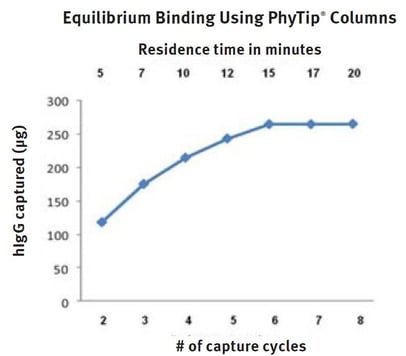 Figure 1. Equilibrium binding is achieved through back-and-forth flow. Using the Tecan Freedom EVO, a 1 mL PhyTip® column containing 20 μL Protein G was used to capture the hIgG spiked into a 500 μL PBS, 0.05% Tween 20. Sample was processed using a flow rate of 4 μL/sec and a 20 second delay after each aspirate and dispense step. After each back-and- forth cycle, a 2.2 μL aliquot was removed and analyzed by a NanoDrop UV spectrometer.
Reproducibility
To demonstrate reproducibility, each channel of the Tecan LiHa arm processed an identical 500 μL sample. The recovered sample was quantified by HPLC and the experiment resulted in a CV of 3, indicating the utility of using the PhyTip® columns in a completely automated format (Table 1).
Table 1. PhyTip® Tecan 100 + 20 µL ProG reproducibility testing.
|
Volume (µL) |
|
Total Mass Recovered (µg) |
|
PhyTip column 1 |
100 |
16.7 |
|
PhyTip column 2 |
100 |
18.1 |
|
PhyTip column 3 |
100 |
17.9 |
|
PhyTip column 4 |
100 |
17.1 |
|
PhyTip column 5 |
100 |
17.6 |
|
PhyTip column 6 |
100 |
17.9 |
|
PhyTip column 7 |
100 |
18.2 |
|
PhyTip column 8 |
100 |
17.9 |
|
Average |
100 |
17.7 |
|
SD |
100 |
0.5 |
|
CV |
100 |
3 |
Capacity as a function of starting sample concentration
The expected recovery and yield from a PhyTip column is highly dependent upon the concentration of the target molecule in the starting sample. hIgG was spiked into 500 μL PBS, 0.05% Tween 20 buffer to final concentrations of 0.01 mg/mL, 0.17 mg/mL, 0.46 mg/mL and 1.04 mg/mL. The Tecan LiHa and 1 mL PhyTip columns containing 20 μL of Protein G resin were used to recover the hIgG (Figure 2). The relationship between recovery and starting sample concentration is typical of conventional chromatography methods.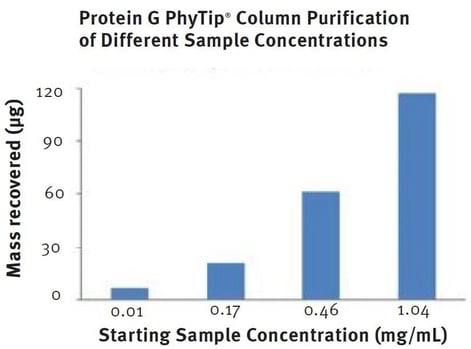
Figure 2. Recovery of hIgG from different sample concentrations. Using the Tecan Freedom EVO®, a 1 mL PhyTip® column containing 20 μL Protein G was used to capture the hIgG spiked into a 500 μL PBS, 0.05% Tween 20. Sample was processed using a flow rate of 4 μL/sec and a 20 second delay after each aspirate and dispense step. After elution, samples were analyzed by quantitative HPLC.
Conclusions
- The Tecan Freedom EVO is suitable for processing PhyTip® columns for complete automation of sample preparation and protein purification
- PhyTip columns perform best using back-and-forth aspirate and dispense cycles for optimal capture, wash and elution of target proteins.
- PhyTip columns used in conjunction with the Tecan Freedom EVO is capable of achieving equilibrium binding allowing process development and predictable scale-up procedures.
Acknowledgement
We express our acknowledgements to Lee Hoang and Christopher Sue from Biotage for performing the experiments and providing their data for this application note.
Literature Number: AN133
