
 For this customer case, we interviewed Mr. Takahiro Shimizu, Section Chief, and Mr. Yuichi Tanaka, Researcher, from the Research and Analytical Technology Section of Fuji Pharma Co., Ltd. The company's Research & Development Division began automating analytical sample pre-treatment for biological samples analysis as a way to address the challenges associated with pharmaceutical R&D. By using Biotage® Extrahera™ LV-200, an automated workstation dedicated to sample preparation, the company was able to not only shorten the time required for sample preparation, but also significantly reduce the training period for new employees.
First of all, could you tell us about the company and the nature of your work?
Shimizu: Our business involves the development, manufac- turing, and marketing of pharmaceutical products, with our focus areas being women's health care and acute medical care. Through the development of new drugs, bio-similars, and generics, we have a broad product portfolio to meet the diverse needs of the medical community.
Our section is responsible for developing analytical methods for pharmaceutical quality and specific analyses (e.g. trace impurity analysis), and, particularly in the area of biological samples, we are responsible for all inhouse projects. For this bioanalysis work, we make use of the automated sample preparation system, the Biotage® Extrahera™ LV-200.
There must be a lot of work involved in the development of analytical methods especially for your special projects in-house. Does this have something to do with the reason why you’ve decided to use the Extrahera™ LV-200?
Shimizu: We have long focused on the development of injectable drugs, but have recently extended our R&D efforts to solid dosage forms such as tablets. Tablets require detailed tracking of pharmacokinetics in the body, which requires a very different approach than injectable drugs, and thus the number of analytes to be processed tends to increase. In addition, difficulties in securing and training personnel with specialized knowledge and skills has posed a major challenge.
What were the main deciding factors for you to adopt our Extrahera LV-200 among the other systems on the market?
Shimizu: Firstly, it is very simple and flexible to create and edit methods; the ability to use various pretreatment methods with a single system was an important factor for us, as we have many development projects going on at the same time. The user can easily program methods as needed, the system is flexible enough to accommodate frequent changes, and the intuitive user interface (UI) makes it very easy to use. The fact that the system uses positive rather than negative pressure processing, which is prone to clogging and variation, is another attractive feature.
Tanaka: The operator of the system only has to select and execute a fixed method, and the simple interface meant that I was able to learn how to use the system right away.
Shimizu: Furthermore, in terms of cost, we made a cost comparison between outsourcing the analysis work and doing it in-house utilizing the Extrahera™ LV-200 for automated sample pre-treatment and we calculated the payback period. This comparison study revealed that processing samples in-house with automation was more cost-effective than outsourcing, which was a powerful persuasive factor.
The implementation of the Extrahera® LV-200 system in our workflow proved to be highly cost-effective, as it also reduced recruitment and training costs, in addition to increasing the maximum number of samples that can be analyzed.
Overall, we chose this system because it combined simplicity and small footprint, had all the key features that we needed, low installation costs, as well as full support by Biotage. Figure 1. Mr. Takahiro Shimizu, Section Chief, Research and Analytical Technology Section, Research & Development Division
Could you elaborate on why you chose the low-volume Extrahera models?
Shimizu: The selection of the LV-200 model was based on the latest advances in technology for analytical chemistry and the need to reduce the burden on subjects in clinical trials.
In recent years, technological advances in analytical instru- ments have reduced the volume of biological samples required for analysis from approximately 200 μL to less than 50 μL. This change has led to a decrease in the amount of blood collected from subjects in clinical trials, contributing to a significant reduction in the burden on subjects. In situations where blood is drawn from a subject at more than 10 times per day, easing the burden is extremely important.
Furthermore, with the advancement of solid phase extrac- tion methods, scaling down sample and solvent volumes is progressing around the world. This has reduced the amount of solvent used for washing and elution from the traditional 1000 μL to about 50 μL. The Extrahera™ LV-200, as the name suggests, is specialized for such low volume aliquoting and perfectly suited to our needs. In addition, Biotage Japan’s personalized and indepth support provided us with great peace of mind in our decision to implement it.
For these reasons, we found the LV-200 to be the ideal choice for our sample pre-treatment automation.
What is the Biotage® Extrahera™ LV-200 being used for and what results have you attained?
Shimizu: We use the Extrahera™ LV-200 in combination with the ISOLUTE® Filter+ filtration plates from Biotage to automate the protein removal process for biological samples. Previously, this deproteinization process was performed manually, requiring six months or more of on-the-job training to master the technique. This was because it was necessary to become proficient in order to prevent contamination while maintaining high throughput, accuracy, and integrity. However, the automation of the process with the Extrahera™ LV-200 has greatly reduced the amount of human intervention and shortened the on-the-job training period from six months or more to about one to two months.
In a recent clinical study, relatively new members of the team who had only been with the company for 1.5 years and 6 months was put in charge of analysis, but they were able to process a large number of samples at a high throughput. This proved that the system facilitated their acquisition of the required skills for sample preparation even within a short period.
That’s excellent! How has the Extrahera™ LV-200 impacted your sample throughput?
Shimizu: In consideration of the processing speed of the analyt- ical systems that we have, we are currently only processing 2 plates per day with the Extrahera™ LV-200. However, if we disregard the speed restrictions due to the analytical systems bottleneck, we believe it is possible to process up to 4 plates per day per person.
Prior to the introduction of the new system, sample pre-treat- ment could not keep up with the speed of analysis, but now we have more time to perform it.
Do you have any final remarks?
Shimizu: We believe it is important to find the right automation strategy for our company, and the Extrahera™ LV-200 has greatly increased the efficiency of our analytical process and the technical learning of our new staff, which has greatly contrib- uted to the quality and speed of our R&D work.
Thank you and we look forward to working with you in the future!
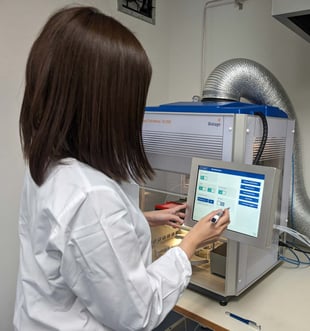 Figure 2. Operator running the Biotage® Extrahera™ LV-200 system at Fuji Pharma
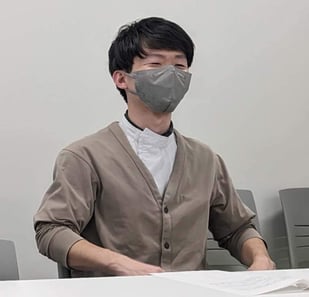 Figure 3. Mr. Yuichi Tanaka, Researcher
Acknowledgements
We would like to thank Fuji Pharma Co., Ltd. for the valuable opinions and their continued support for the Biotage products.
Founded in 1965, Fuji Pharma Co., Ltd. help people lead healthy lives by offering excellent pharmaceuticals. Aspiring to offer significant value in medical care, our key mission is to work together to continuously address challenges and achieve what only we can do in order to gain strong trust and support from medical professionals, and to make greater contributions. Our corporate growth is proportional to our personal growth. We value bringing happiness to society. The top priority in our corporate management is to continue creating opportunities and situations for further growth by working together to make drugs for medical care.
Literature Number: PPS754
