Biotage recently introduced the newly launched Biotage® Selekt Enkel flash purification system to the College of Charleston. Biotage® Selekt with its two column channels is a well-established leader in the flash purification world. Selekt Enkel is the one-channel little sister system, designed to be a sturdy companion in the lab. Assistant Professor Mike Giuliano and his lab group at the College of Charleston in South Carolina.
Two lab groups at the College of Charleston were given the opportunity to try out Biotage® Selekt Enkel over the summer for their projects. We met again after their work was complete to discuss their thoughts.
Over the last few weeks, how much time were you able to spend on Selekt Enkel?
Assistant Professor Mike Giuliano: I have one student, Gabby Molloseau, who used it a lot over the last six weeks. With the majority of her time, we were working through some quite shallow gradients, but she also used it about 10–12 times in a project to scale up a reaction from 50 mg to 500 mg. Our original goal was for Gabby to complete one of her four projects. But because of the time savings of Selekt Enkel, we were able to complete all four of those projects in the allotted time frame.
Student Dallas Crowder – Biochem/Chemistry Senior: I was a heavy user of Selekt Enkel this summer. I used it more at the beginning of the summer at the start of my project and help me purify the reactions I completed. My project is developing addition reactions to aziridines.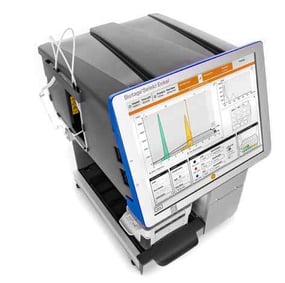 Biotage® Selekt Enkel is the one-channel little sister system, designed to be a sturdy companion in the lab.
Have you ever used an automated flash system before? What did Selekt Enkel enable you to do? How was your productivity impacted?
Student Phia Gierszal – BioChem/Chemistry Senior: With my project on the benzylation of epoxides I was able to use Selekt Enkel to take a manual purification which normally takes three to four hours, and complete it in one hour. It was great for saving solvent as well. You’re able to change the gradients on the fly, on a manual column I might do 200 mg, but with Enkel you can move the bar to adjust the gradient slope as you see compounds coming off the instrument.
Student Ellie Kraichely – Chemistry Junior: The biggest impact for me was the ability to speed up my purification time. I was comfortable with leaving the column/instrument and go do other things for my project. My project is working on developing new alkylboron reagents for synthesis and from the efficiency of Selekt Enkel I could keep optimizing other reactions.
Did it take you long to learn how to use Selekt Enkel? Was it easy to make it “work for you”?
Mike Giuliano: I have earlier experience with a Biotage Isolera flash purification system and I could see noticeable improve- ments with Selekt Enkel. I was on autopilot from my previous instrument use and was able to teach my student Gabby in one session. She was then comfortable enough to use it on her own. Gabby is working on lipid analogs. She’s isolating specific materials and making new molecules for a drug confirma-
tion project. The purity and throughput she observed was outstanding compared to previous manual column purifications.
Phia Gierszal: I felt like the instrument was intuitive. We had the one training from a Biotage representative and I was able to use it efficiently. The software has a help screen on it that I used a couple times whenever I had questions. Otherwise, the system was very easy to use. The intuitiveness on Selekt® Enkel allowed the students to run it comfortably after only one training session.
After I had our initial chat including the students, the two professors and I talked more about their experience with Selekt Enkel flash purification system. Particularly how it affected the students from a learning perspective and why these educators enjoyed having it in their lab for the students to learn from and utilize.
What are your thoughts on automated flash systems for students to learn from and work with?
Associate Professor Tim Barker – Chemistry: I want them to learn how chromatography works both manually and from an instrument perspective. It’s key that they understand the core of how chromatography works and to also be able to use instru- ments effectively. Through the use of Selekt Enkel they gained real-world experience which will be helpful when they leave the comfort of our university lab.
Mike Giuliano: I agree with Professor Barker, the students gained an understanding of the chemistry by starting with manual columns. Now with the instrument, they’re able to utilize the Selekt Enkel’s full capability. We’ve got a lot of projects that have been sitting on the back burner that now we can bring back to the front of the list because students will be able to be complete them quicker and more efficiently with Enkel. The instrument is an extremely valuable teaching tool.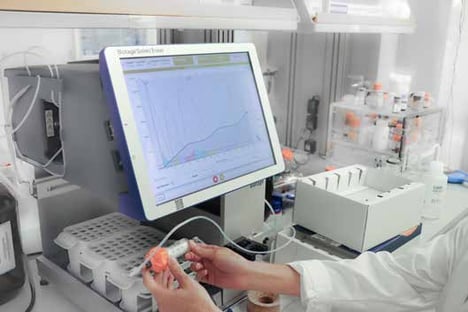
This generation that your students are a part of has such a familiarity with technology, such as iPhones, renting electronic scooters around town, computers, etc., how does the student’s adaptability impact this utilizing this newer technology?
Mike Giuliano: My student Gabby was on the instrument the most and she was able to learn quickly and completed more of her projects because of that.
Tim Barker: The TLC to Gradient application on Selekt Enkel was a great starting point for the students. It helped them zero-in on where to start their column purifications. The ability to reinforce techniques learned earlier in the lab, like TLC, is a huge selling point for me.
What would be the most important factor for you in choosing the automated flash system for your lab?
Tim Barker: Consumable cost annually and what that would look like for our lab. We can work out how to reuse columns that will be key in a potential future purchase of the Enkel.
Mike Giuliano: I agree with Professor Barker. We loved the instrument and can easily see ourselves purchasing it in the future, but the consumables will be key in our decision-making process.
Information on column re-use can be found on our blog.
Literature Number: PPS664
