
Introduction
Evaporative Light-Scattering Detection, or ELSD, is utilized in flash chromatography to identify non-UV absorbing compounds. The ELSD is typically an optional accessory integrated with the flash system by the manufacturer, but in some cases, it is a modular solution that can be added to the flash chromatog- raphy system later.
Carbohydrates, lipids, and polymers are typically thought of as the main application areas for ELSD. Yet, many small molecules can be detected more efficiently with the help of ELSD, even if they are UV absorbent. Sometimes, their UV absorption is masked by the purification solvents, such as ethyl acetate, acetone, and toluene and ELS detectors can help to detect these molecules.
One of the most popular flash chromatography solvents is ethyl acetate (EtOAc), which is typically used with either hexane or heptane. While hexane and heptane are UV transparent, EtOAc is not and absorbs UV light between 200 and 252 nm with a UV maximum of 220 nm (Figure 1.)
This application note will show how using both UV and ELSD detection simultaneously can reveal more reaction products and byproducts.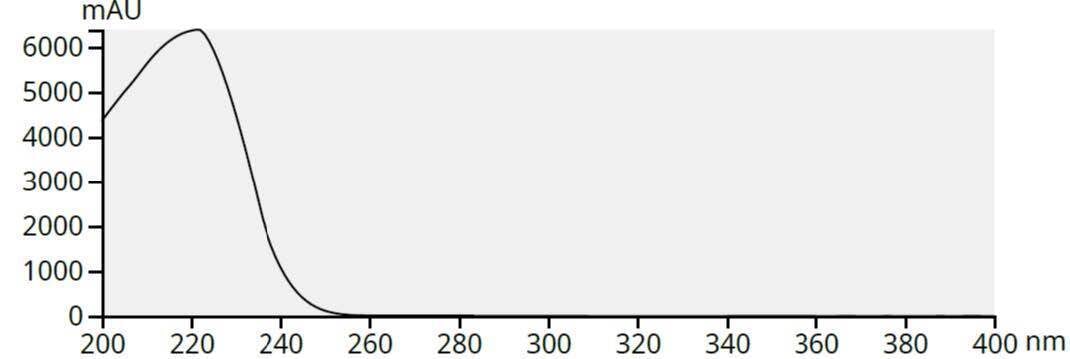 Figure 1. Ethyl acetate UV spectrum shows absorbance from 200 to >250 nm.
Materials and methods
|
Synthesis |
|
|
System: |
Biotage® Initiator+ microwave reactor |
|
Vial: |
2-5 mL |
|
Solvent: |
Reaction dependent |
|
Scale: |
Reaction dependent |
|
Purification |
|
|
System: |
Biotage® Selekt with Biotage® Selekt ELSD |
|
Normal phase |
|
|
Column: |
Biotage® Sfär HC silica (10 g) |
|
Solvent A: |
Heptane |
|
Solvent B: |
Ethyl acetate |
|
Gradient: |
0-100% B over 10 CV |
|
Reversed phase |
|
|
Column: |
Biotage® Sfär C18 (30 g) |
|
Solvent A: |
Water |
|
Solvent B: |
Methanol |
|
Gradient: |
25-75% B over 10 CV with step to 100% B for 7.2 CV |
|
UV: |
λ-all 200-400 nm, 200 nm, 205 nm |
|
ELSD: |
Acetone, 36 °C, 1.5 bar N2 |
Many synthetic compounds, even aromatic compounds, absorb UV most strongly in the 200 to 254 nm range. When EtOAc is being used as the chromatography solvent, these compounds are often difficult to detect, because EtOAc absorbs UV at wavelengths below 252 nm.
For example, the Diels-Alder reaction of maleic anhydride and 1,3-cyclohexadiene was used to create an anhydride, which was then used to create an imide.
The Diels-Alder synthesis was performed in acetonitrile allowing the reaction mixture to be purified using reversed phase flash chromatography with a water/methanol gradient and UV detec- tion. The reactants and final product contain at least one double bond and were detected using UV (Figure 2.). Figure 2. Reversed phase flash chromatography of the Diels-Alder reaction using only UV indicated a poor product yield.
However, the product peak had a relatively low molar absorp- tivity, indicating a low synthetic yield. Since the product is a solid when dry, the reaction mixture was purified using the same column and method but with ELS detection added (Figure 3.). Figure 3. Diels-Alder reaction purification with ELS detection improved target product and byproduct detection.
Though the anhydride product converted to an acid in the aqueous mobile phase, the resulting acid was isolated and used as the starting material for the imide reaction. The ELSD triggered product fractions were dried, dissolved in a dichloromethane/acetonitrile mix, and reacted with cyclohexylamine to create the desired imide (2-cyclohexyl-3a,4,7,7a-tetrahydro- 1H-4,7-ethanoisoindole-1,3(2H)-dione). This reaction created a yellowish slurry which was found to be methanol soluble.
Reversed phase flash failed to provide a suitable purification so normal phase was used with a hexane/ethyl acetate gradient. As discussed above, EtOAc absorbs UV at wavelengths below 252 nm and with the product containing a single double bond, UV detection alone likely would fail to adequately detect the product in this mobile phase, so ELS detection was used to provide enhanced sensitivity (Figure 4.). Figure 4. Imide reaction mixture flash purification with a heptane/ethyl acetate gradient and ELS detection improved product detection versus UV.
As the data shows, only the ELSD provided adequate detection of the reaction product.
Conclusion
Adding an ELSD to your flash chromatography system will enhance the detection sensitivity of compounds with no, or poor chromophores.
Part Number: AN996
