
Introduction
Synthesis workflow incorporates many steps including the chemical reaction, its work-up, evaporation, and purification. In many labs this workflow is slowed by the lack of instrumentation, either for synthesis, work-up, evaporation, and/ or purification. When combined, use of all this automated instrumentation can reduce synthesis workflow from days to hours.
This paper highlights the use of an expedited organic synthesis workflow incorporating a Biotage® Initiator+ microwave reactor, a Biotage® V-10 Touch high-speed evaporator for solvent evaporation/chromatography sample prep, and automated flash chromatography with a Biotage® Selekt for purification.
Experimentation
A 2-step reaction consisting of a Diels-Alder reaction followed by an acylation reaction was used to highlight the time savings achievable using the automated lab equipment mentioned in Figure 1.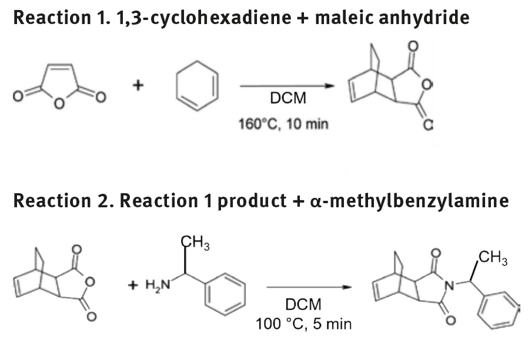 Figure 1.
Diels-Alder reaction
To a 2–5 mL microwave reaction vessel maleic anhydride (135 mg), approximately 3 mL of dichloromethane (DCM) and 1,3-cyclohexadiene (200 µL, 169 mg) were added. The reaction was performed at 160 °C for 10 minutes using a Biotage® Initiator+ microwave reactor, Figure 2.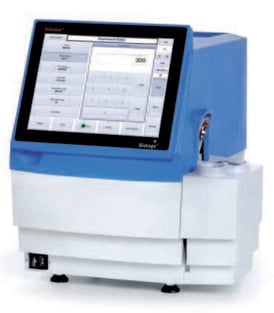 Figure 2. Biotage® Initiator+ microwave reactor.
Performing synthesis with a microwave allows reactions to complete faster than with either hot plates or heated baths. This is possible because microwave energy heats reaction mixtures efficiently from the inside out rather than the outside in. The capped vials allow reaction temperatures above the solvent boiling point (up to 300 °C) to be used and pressure to build up to 30 bar, also helping speed reactions. In fact, according to the Arrhenius equation, reaction rates approximately double for every 10 °C increase in reaction temperature, Equation 1.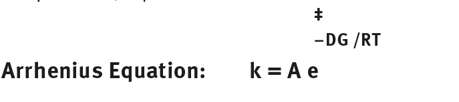 Equation 1.
For example, instead of a reaction at 23 °C requiring 12 hours, a microwave reactor performs the same synthesis in 5 minutes at 100 °C. Likewise, a conventionally heated reaction at 70 °C needing 16 hours can be completed in 5 minutes when performed with a microwave at 150 °C1.
Work-up
Post synthesis, minimal work-up was needed. The crude reaction product was transferred to a tared 20- mL scintillation vial, dried using a Biotage® V-10 Touch rapid solvent evaporator to remove both the DCM reaction solvent (BP 39.6 °C) and the excess cyclohexadiene (BP 81 °C), and weighed to obtain the crude yield (233 mg); evaporation time = 11 min.
No purification was needed. Total workflow time: 21 minutes.
If performed via conventional reaction methods, this reaction would likely be performed at 90 °C and require about 12 hours2.
Acylation reaction
The dried crude reaction product was redissolved in 3 mL of DCM and transferred to a 2–5 mL microwave reaction vial. To this solution, 160 mg (1.3 mM) of α-methylbenzylamine was added. The vial was capped and the mixture heated for 5 minutes at 100 °C with the Initiator+ microwave reactor.
Work-up
The reaction mixture was transferred to a tared 20-mL scintillation vial and evaporated with the Biotage® V-10 Touch in 4 minutes providing a crude yield of 405 mg.
To purify the crude reaction product, reversed-phase flash chromatography with a Biotage® Selekt system was used. To ensure optimal purification performance, dry
loading was used to load the flash chromatography column (Biotage® Sfär C18).
To prepare the dry load, 1.6 grams of Biotage® KP-C18-HS media was added to the dried reaction product which was dissolved 5 mL of methanol. This mixture was evaporated on the V-10 touch and the dried contents transferred to a 10-gram Biotage Sfär DLV (dry load vessel).
The purification was performed at 30 mL/min using a 40–75% water-methanol linear gradient with a total method length of 20 column volumes (CV) or 340 mL. The purification required 11 minutes, Figure 3. Figure 3. Reversed-phase purification of the acylation reaction product required 11 minutes to purify 405 mg.
The purified product was collected in fractions 4 and 5 (43 mL total volume). The product fractions were evaporated into a tared 20-mL scintillation vial using the V-10 Touch in 60 minutes yielding 262 mg of a white solid.
Total workflow time for the acylation reaction: 1.3 hours.
The acylation reaction, if performed without microwave, would take an hour at 25 °C. Work-up, including evaporation with a rotavap and purification by prep HPLC, would require an additional 13.6 hours3 for a total time of 14.6 hours.
For the two-step reaction, the automated workflow required only 1.8 hours while the manual workflow would need over 27 hours to complete, a savings of more than 25 hours using automation, Table 1.
Table 1. Workflow time comparison.
|
Workflow |
Total Manual |
Total Automated |
|
Synthesis |
13 hours |
15 minutes |
|
RxN Monitoring |
10 minutes |
0 minutes |
|
Evaporate |
60 minutes |
15 minutes |
|
Redissolve |
1 minutes |
1 minutes |
|
Total RxN time |
14.2 hours |
31 minutes |
|
Redissolve |
1 minutes |
1 minutes |
|
Prep dry load |
0 minutes |
7 minutes |
|
Prep HPLC/RP flash |
60 minutes |
11 minutes |
|
Evaporate/lyophilize |
12 hours |
60 minutes |
|
Total purification time |
13 hours |
1.3 hours |
|
Total workflow time |
27.2 hours |
1.8 hours |
Conclusion
The benefits of an automated synthesis lab are many and include:
- Faster reactions
- Faster evaporation, especially of high boiling point solvents and reversed-phase chromatography fractions
- Faster reaction purification
References
- Documents Archive (biotage.com)
- Internal Data
- Internal Data
Literature Number: PPS706
