
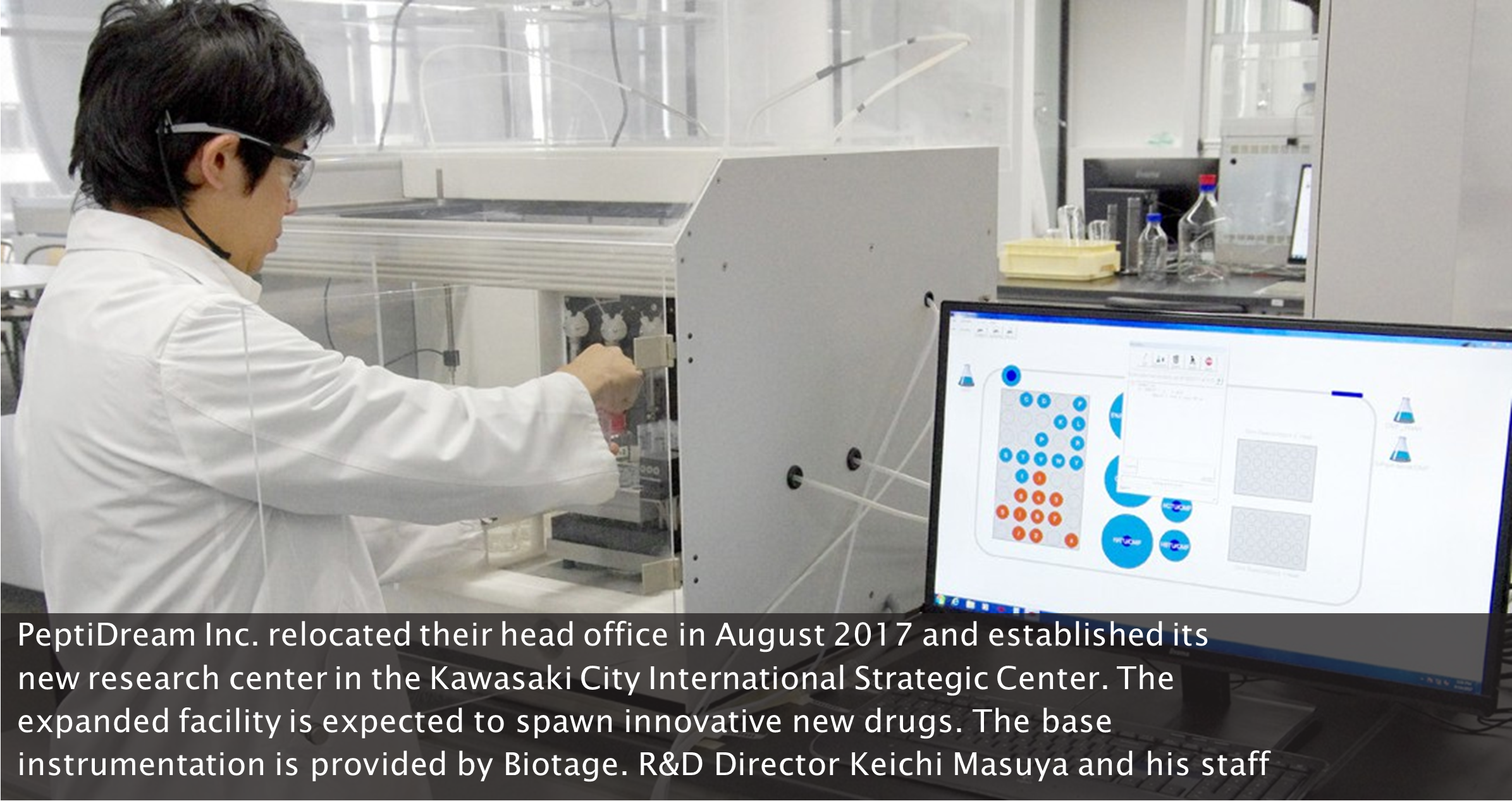
Figure 1: PeptiDream Inc. relocated their head office in August 2017 and established its new research centre in the Kawasaki City International Strategic Centre. The expanded facility is expected to spawn innovative new drugs. The base instrumentation is provided by Biotage. R&D Director Keichi Masuya and his staff elaborate on the development.
We interviewed you three years ago. Could you give us an update of your company?
Masuya: PeptiDream Inc. was founded to create the world’s first new drugs from Japan. As a global leader in drug discovery using non-standard peptides, we are deeply engaged in research and development to contribute to a better society.
Using our unique drug discovery search system PDPS (Peptide Discovery Platform System), we synthesize trillions of non-standard peptides, enabling high-speed evaluation. It is characterized in drug discovery by creating hit compounds, selecting leads and understanding pharmacophore in a simple and efficient manner.
The head office and laboratories were relocated in August. What did this mean for PeptiDream?
Masuya: This new building gives us the space we need. At the former head office within the Research Centre for Advanced Science and Technology at the University of Tokyo, space limitations made it impossible to hire new staff or install new equipment. With an increasing number of strategic collaborations with customers and some in-house projects ongoing, we have nearly three times the number of projects we had three years ago. Still, this is just the first stage.
The big difference is the increasing number of strategic collabo- rations. This is not merely research contracts, but rather aims to match the technologies of our company and the other parties, to work on the whole, and to produce results that cannot be obtained elsewhere. We are already doing research together with several companies, and we promote technology transfer and work in an all-around manner to deliver innovative new drugs to patients. We are based only in Japan, but currently 70% of our business is overseas, and I am really proud to work in such global context.
With the relocation you installed additional Biotage equipment for your workflow. How did you decide on which tools to use?
Nishimaru: With the increasing number of alliance partners, we needed to expand our equipment to the fullest extent.
For concentration, we chose the new model Biotage® V-10 Touch. There are other equipment available to remove non-volatile solvent such as DMSO (dimethyl sulfoxide), but we chose the V-10 for its speed. Moreover, we have been using the Syro peptide synthesizer for many years, and decided straight away to acquire the new heating blocks that we have been waiting for.
Fukuda: The heating block doesn’t change how we use the Syro, but it greatly helps us to expand the variety of peptides we can make. Coupling efficiency is improved by a great deal when heat is applied, so it is very handy. Some amino acids are required
to couple at room temperature for as long as an hour, but when the temperature is raised to 75 °C, the coupling takes only about 10 minutes, which definitely contributes to the shortening of synthesis time.
Nishimaru: For flash purification, we compared the Isolera™ with other manufacturers, and some new people in our group had previously used the instrument, which is why we selected it.
Matsui: Isolera is surprisingly compact and saves us a lot of bench space. The new office building is bigger so it does not matter as much, but it is still a very nice characteristic.
Moreover, with the optional Spektra function, when there are weak UV absorbers at a particular wavelength, it’s reassuring to know that it’s always looking at all wavelengths and not missing important compounds.
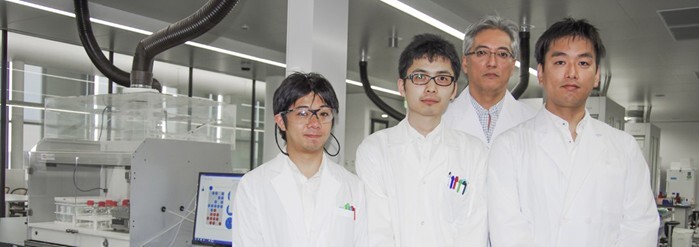
Figure 2: The PeptiDream team. From left to right: Synthesis Group Scientists Keita Fukuda and Katsuma Matsui; Board Director and R&D Director Keichi Masuya; Synthesis Program Leader Takahiro Nishimaru.
You also installed an Initiator+. What were the key reasons for your selection?
Matsui: The microwave heating is very quick, and if a reaction does not work under classical conditions, we will immediately try it with the Biotage® Initiator+. We installed it after moving to this place because it is absolutely necessary for certain reactions.
Which advantages do you see with the Syro peptide synthesizer?
Fukuda: With the heating blocks, Syro can synthesize peptides with sequences that were difficult without using a microwave synthesizer. Depending on the conditions, microwaves may give better yields, but Syro is a great asset because it can synthesize many peptides in parallel at the same time.
What does the touch panel system mean for the V-10 evaporator?
Fukuda: A touch panel does not make a great difference regarding the operability, but it is certain that the screen is large and easy to see. It works well with gloves too.
With your increasing number of researchers, how do they get used to operating the Syro?
Fukuda: I think that since Syro is not so complicated, once you have learnt the standard operation, you can use it right away. It’s necessary to get accustomed, but easy to remember. With the equipment I used before there were also times where nitrogen leaked and caused the instrument to stop over the weekend. I personally feel better with the Syro which does not require nitrogen pressure to operate.
As with Isolera, it automatically switches to cleaning mode after a run to avoid contamination and valve clogging.
Nishimaru: Certainly, we only need to train new users on operation. And since we talk about robustness of instruments, I believe that this is also one of the benefits of the Syro.
Fukuda: Yes, Syro is very robust.
Currently, 5 and 10 mL reactor blocks are most used. Are you interested in increasing the volume, such as 20 mL, or the number of positions?
Nishimaru: I think that both would be useful. Large scale projects are increasing. Apart from that, I would like to see enhancements to small-scale parallel positions. With the newly installed Syro II, we are considering 48 simultaneous peptides in 2 mL syringes. So, we actually need both. We look forward to heating blocks dealing specifically with 2 mL/48 syringes.
PeptiDream Inc.
Leader in the field of peptide pharmaceuticals, aiming to help people suffering from diseases around the world by creating and developing innovative pharmaceuticals. Established in July 2006 by Professor Hiroaki Suga, Tokyo University. Specialized in
research and development of new drug candidates utilizing PDPS (Peptide Discovery Platform System), a proprietary drug discovery development platform based on Flexizyme (an artificial ribozyme), developed by Hiroaki Suga. Listed on Tokyo Stock Exchange Mothers.
Featured Products
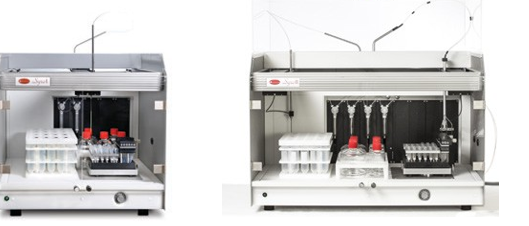
Figure 3: SYRO I and SYRO II fully automated parallel peptide synthesizers
Figure 4: Biotage® Initiator+ Microwave Synthesizer
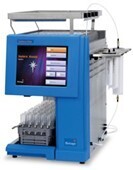
Figure 5: IsoleraTM Spektra Systems with ACI Assist
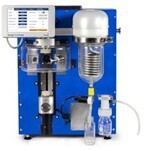
Figure 6: Biotage® V-10 Touch high boiling point solvent evaporation system
Literature number: PPS498
