
Abstract
This study tested automated protein purification using Biotage PhyTip® columns on the Dynamic Devices Lynx™ platform with a Verified Volume Pipetting (VVP) head. Pressure and liquid transfer settings were optimized using columns containing 20 µL or 160 µL of resin, with water and 30% glycerol as test liquids. Human IgG (hIgG) and His-tagged eGFP were then purified together in one run using 20 µL ProPlus and IMAC columns, respectively. The run processed 23 replicates in approximately 35 minutes. Average protein recoveries were 78.3% for hIgG and 85.4% for eGFP. Recovery varied little between replicates, with coefficients of variation (CVs) of 2.7% and 4.3%, respectively. Both sample types used the same liquid handling settings without additional adjustments for liquid properties. These results support reproducible automated purification using different protein-binding chemistries and sample types.
Introduction
The demand for high-throughput solutions to accelerate life science research and development continues to grow. A critical component of this effort is the ability to purify biomolecules rapidly, reproducibly, and with minimal hands-on time. PhyTip® columns were developed to address this need by providing an automation-friendly purification platform that combines high binding capacity, low dead volume, and excellent reproducibility.
A key advantage of PhyTip technology is its seamless integration with liquid handling systems without requiring additional modules or accessories. PhyTip® columns consist of commercially available purification resins packed at the end of pipette tips compatible with a variety of industry-leading liquid handlers. This design enables automated purification of 96 samples simultaneously and supports applications ranging from antibody and recombinant protein purification to adeno-associated virus (AAV) purification, among others.
Recent work has focused on validating the use of PhyTip® columns on the Dynamic Devices Lynx liquid handling platform equipped with the Verified Volume Pipetting (VVP) head. The VVP head utilizes vacuum and positive pressure-based pipetting technology that enables independent volume control across all channels. Individual sensors monitor the pressure differential across a known flow restriction, allowing the system to measure volumetric flow rate during aspiration and dispense steps in real time, and control liquid transfer on a channel-by-channel basis. This approach enables reliable liquid handling across samples with differing viscosities and physical properties without the need for predefined liquid classes.
PhyTip® columns are pressurized tips that introduce a set flow resistance that differs from standard pipetting, which can trigger the clog detection functionality of the VVP head. To ensure reliable operation, optimization studies were conducted with varying resin bed volumes and liquid viscosities to define pressure settings and processing parameters suitable for PhyTip® column use on the Lynx VVP platform. The optimized settings are summarized in table 2.
Using these optimized operating conditions 1, 20 μL ProPlus PhyTip® columns (P/N: PTX-91-20-07) and 20 µL IMAC PhyTip® columns (PTX-91-20-03) were evaluated for the automated purification of human IgG (hIgG) and his-tagged eGFP, respectively. This application note demonstrates the compatibility of PhyTip technology with the Dynamic Devices Lynx VVP platform and highlights its suitability for high-throughput automated purification workflows.
Materials and methods
VVP pressure testing
VVP operating parameters were evaluated using PhyTip® columns containing 20 µL or 160 µL resin beds. Water and 30% glycerol were used as representative low- and higher viscosity test solutions, respectively. Pressure settings between 30 and 100 mbar were evaluated, and the resulting aspiration and dispense flow rates were recorded by the Lynx VVP system.
Liquid transfer was assessed based on measured flow rate, completion of aspiration and dispense steps, system timeouts, and liquid retained within the PhyTip® columns. Aspiration dispense delay time and dispense blowout volume were also evaluated as needed to achieve complete liquid transfer. Optimized delay, vent times, and dispense blowout conditions were incorporated into the purification methods described in table 1.
Sample preparation and purification
A known amount of lyophilized hIgG (Sigma-Aldrich, I4506) was brought into solution using 1X Biotage Pro A Capture Buffer (10 mM Sodium Phosphate, 140 mM NaCl, pH 7.4) and further diluted to a concentration of 0.7 mg/mL at a target volume of 300 µL per PhyTip® column.
His-tagged eGFP was expressed in BL21 E. Coli cells following IPTG induction of the lac promoter. Cells were chemically lysed and centrifuged at 10,000 × g for 10 minutes, and the SUP was filtered using a 0.45 µm filter. Clarified cell lysate was adjusted with IMAC Capture Buffer (10 mM Sodium Phosphate, 5 mM Imidazole, 300 mM NaCl, pH 7.4) to an eGFP target load concentration of 1 mg/mL at 1 mL volume for a total eGFP load of 1 mg per PhyTip® column.
Purifications used the pressure parameters for a 20 µL resin bed in table 2 and processing parameters in table 1. A total of 23 replicate purifications were performed in approximately 35 minutes. The VVP head has a 96-sample capacity; however, we only processed 23 samples.
Table 1. Cycle numbers and buffer conditions for PhyTip® column purifications
|
|
Process Step |
Number of Cycles |
Volume (µL) |
Buffer |
|
ProPlus |
Equilibration |
2 |
1000 |
10 mM Sodium Phosphate, 140 mM NaCl, pH 7.4 |
|
Capture |
8 |
300 |
10 mM Sodium Phosphate, 140 mM NaCl, pH 7.4 |
|
|
Wash |
2 |
1000 |
10 mM Sodium Phosphate, 140 mM NaCl, pH 7.4 |
|
|
Elution |
4 |
60 |
200 mM Phosphate, 140 mM NaCl, pH 2.5 |
|
|
Neutralization |
|
15 |
1 M Tris-HCl, pH 9 |
|
|
IMAC |
Equilibration |
2 |
1000 |
10 mM Sodium Phosphate, 300 mM NaCl, 5 mM Imidazole, pH 7.4 |
|
Capture |
8 |
1000 |
10 mM Sodium Phosphate, 300 mM NaCl, 5 mM Imidazole, pH 7.4 |
|
|
Wash |
2 |
1000 |
10 mM Sodium Phosphate, 300 mM NaCl, 100 mM Imidazole, pH 7.4 |
|
|
Elution |
4 |
60 |
10 mM Sodium Phosphate, 140 mM NaCl 250 mM Imidazole, pH 7.4 |
Analysis
Human IgG concentrations were determined using a NanoDrop UV spectrophotometer by measuring absorbance at 280 nm and using the NanoDrop protein quantification method. eGFP concentration was determined from 488 nm absorbance on the NanoDrop using the extinction coefficient for eGFP and Beer’s law. The instrument was blanked with corresponding capture and elution buffers. The concentration values were used to calculate the total amount of IgG and eGFP present in the load and elution by multiplying by the volumes of each. Recovery was calculated as the total mass of protein recovered in the elution divided by the total mass of protein loaded onto the PhyTip® column, converted to a percentage.
Results
Optimization of VVP parameters
The Lynx VVP head uses pressure-based pipetting and independently measures aspiration and dispense flow rates, which are then reported by the system. Because PhyTip® columns have a packed resin bed, the flow resistance can vary depending on resin bed size and the properties of the liquid being used. A range of pressures from 30 mbar to 100 mbar were therefore tested with 20 µL and 160 µL resin beds to determine corresponding flow rates, confirm complete processing of sample, and ensure no timeouts occurred.
Using water as the test liquid, increasing the applied pressure resulted in increased flow rates for both resin bed volumes. At 100 mbar, a 20 µL resin bed exhibited aspiration and dispense flow rates of approximately 122 and 105 µL/s, respectively. The corresponding flow rates for a 160 µL resin bed were approximately 57 and 60 µL/s. These results demonstrate increased flow resistance associated with the larger resin bed.
Liquid viscosity also affected the measured flow rate. Using 30% glycerol as a higher-viscosity test solution, flow rates were reduced relative to water at equivalent pressure and resin bed sizes. At 100 mbar with a 160 µL resin bed, aspiration and dispense flow rates were approximately 23 and 24 µL/s, respectively, compared with 57 and 60 µL/s for water.
Based on these measurements and subsequent purification testing, a pressure setting of 50 mbar was selected for 20 µL resin-bed columns and 100 mbar for 160 µL resin-bed columns. Additional optimization of delay time and blowout volume was performed to ensure complete liquid transfer. Under the optimized conditions, no residual liquid was observed following dispense.
Table 2. Optimized pressure settings for PhyTip® columns with water and VVP head
| Resin bed volume (µL) | Optimized pressure setting (mbar) | Observed flow rate |
| 10-40 | 50 | ~25-60 µL/sec |
| 80-160 | 100 | ~20-60 µL/sec |
Automated HlgG purification using ProPlus PhyTip® columns
Human IgG purifications were performed using 20 µL ProPlus PhyTip® columns with optimized Lynx VVP parameters. PhyTip® columns are processed using dual flow chromatography (DFC) in which the mobile phase is aspirated and dispensed multiple times across the resin bed to allow for efficient binding, washing, and elution of sample. For these purifications, cycle parameters included delays after each aspiration and dispense and venting to alleviate pressure built up in the tip. The number of cycles performed is defined in table 1. Blowouts were performed after capture, wash, and elution steps to ensure all liquid was expelled from the tips.
Table 3. hlgG recovery and CV
| Replicate | Recovery (%) |
| PhyTip® Column 1 | 79.1 |
| PhyTip® Column 2 | 80.5 |
| PhyTip® Column 3 | 75.8 |
| PhyTip® Column 4 | 80.0 |
| PhyTip® Column 5 | 76.6 |
| PhyTip® Column 6 | 80.5 |
| PhyTip® Column 7 | 81.2 |
| PhyTip® Column 8 | 76.6 |
| PhyTip® Column 9 | 78.1 |
| PhyTip® Column 10 | 75.7 |
| PhyTip® Column 11 | 79.0 |
| PhyTip® Column 12 | 76.9 |
| Average | 78.3 |
| CV% | 2.7 |
Across 12 parallel purifications, recoveries ranged from 75.7% to 81.2% with an average recovery of 78.3% and a CV% of 2.7 (table 3). These results highlight the high recovery and reproducibility of PhyTip® columns and confirm operation of PhyTip® columns with the VVP head does not negatively impact purification consistency.
Automated his-tagged eGFP purification using IMAC PhyTip® columns
His-tagged eGFP was purified using 20 µL IMAC PhyTip® columns on the Lynx liquid handler in parallel with the hlgG samples. The same procedure that was performed with the hlgG purification was followed here except for the neutralization step.
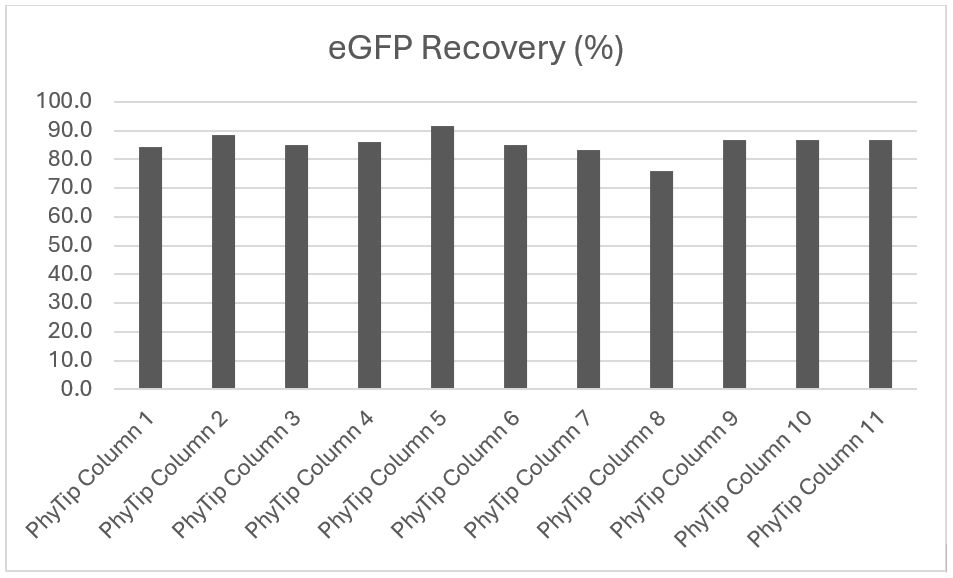
Figure 1. Recovery of his-tagged eGFP
eGFP recoveries ranged from approximately 76% to 92%, with strong agreement across all replicate purifications (figure 1). The average recovery was 85.4% with a CV of 4.3%, demonstrating good reproducibility across replicates. These results indicate that the optimized Lynx VVP operating parameters are compatible with IMAC purification workflows in addition to Protein A affinity capture, highlighting the flexibility of the platform across multiple purification chemistries.
Both hIgG and his-tagged eGFP purifications were performed in parallel within a single run using the same liquid handling parameters. Even though they come from different sample matrices, with hIgG present in a purified spiked sample and his-tagged eGFP from a clarified cell lysate, no additional liquid class optimization was required. This demonstrates the ability of the VVP head to accommodate different sample types while maintaining consistent processing conditions and reducing process variation between sample types.
Conclusion
-
PhyTip® columns were successfully operated with the Dynamic Devices Lynx liquid handling platform equipped with the Verified Volume Pipetting (VVP) head.
-
VVP pressure and processing parameters were characterized for PhyTip® columns with different resin bed volumes and liquid properties, providing operating conditions optimized for automated PhyTip® column processing.
-
Reliable and reproducible purification of human IgG was demonstrated using ProPlus PhyTip® columns on the Lynx VVP system.
-
Successful purification of His-tagged eGFP using IMAC PhyTip® columns highlights the versatility of the platform across multiple affinity purification chemistries and sample types.
-
The combination of Lynx VVP technology and PhyTip® columns provides a flexible, automation-friendly solution for high-throughput biomolecule purification workflows.
References
- The optimized method package file is available from the Sales or Application Support teams at Biotage or Dynamic Devices.
Acknowledgements
We thank Cory Sevald and the Dynamic Devices Application team for their collaboration and technical assistance in developing the optimized method package file for processing PhyTip® Columns on the Lynx VVP head.
Literature number: AN1039
