
This application note will outline optimized methods for the extraction of hormones from water as outlined in EPA Method 539 using Biotage automated or manual SPE solutions. The first section will highlight the use of the Biotage® Horizon 5000 fully automated extraction system and the method used for this application. Additionally, there will be an Application Modification section that will highlight the use of the Biotage® Horizon 4790 and Biotage® VacMaster™ Disk for this application.
Introduction
Hormones are a group of biologically active compounds that are of concern because of their negative effects in living organisms, such as fish and aquatic species. These biologically active compounds can enter surface waters from point and non-point sources such as municipal wastewater treatment plant (WWTP) discharges, industrial discharges, urban runoff and animal feeding operations. Therefore, natural and synthetic hormones are usually detected in waters receiving wastewater discharge.
The Environmental Protection Agency (EPA) published a Candidate Contaminant List (CCL3) which included some of the most important emerging contaminants in the environment. In this work, the solid phase extraction (SPE) method for some of the hormones included in this list was developed for use in EPA Method 539.
Instrumentation
» Biotage® Horizon 5000 Automated Extraction System
» Atlantic® C18 SPE Disk
» Turbovap® Automated Solvent Evaporator
Method summary
- Purge the Biotage® Horizon 5000 system using the generic method shown in Table 1.
- Obtain water samples. No additional additives or filtration needed.
- Spike any control or matrix spike samples with spiking mixture containing 8 labelled hormones (D8-diethylstilbestrol, D2-epiestriol, 13C6-estradiol,
13C6-estrone, D4-ethynylestradiol, D3-medroxyprogesterone,
D4-mestranol, D3-nandrolone) at a concentration of 5–10 ng/L. - Attach the sample bottle to the water inlet valve and then place it onto the extractor.
- Extract water samples using the Biotage® Horizon 5000 system with the method shown in Table 2.
- Upon completion collect the sample extract.
- Clean up the methanol extracts on Florisil cartridges and evaporate to dryness under a stream of nitrogen.
a. Derivatize the extracts to their trimethylsilyl esters using N-methyl-N-trimethylsilyltrifluoroacetamide according to the USGS method detailed in ‘Determination of Steroid Hormones and Related Compounds in Filtered and Unfiltered Water by Solid-Phase Extraction, Derivatization, and Gas Chromatography with Tandem Mass Spectrometry’ (https://pubs.usgs.gov/tm/5b9/) - Analyze the extracts via GC/MS/MS utilizing the parameters outlined in the sample analysis section below.
Sample analysis
Helium was used as a carrier with a flow rate of 1 millilitre per minute (mL/min) with the injection port maintained at 275 °C. The gas chromatograph was programmed on a variable temperature gradient from 100 °C to 310 °C. For each target compound, the most abundant diagnostic ion in the full-scan spectrum was selected as a precursor and appropriate conditions were selected to maximize the signal for three precursor-product transitions. The recoveries for all 8 hormones were obtained by comparing the chromatographic areas to an external labelled standard. The other hormones were quantified relative to the isotopic dilution standard (IDS) using a quantification procedure that automatically corrects for losses in the reported chemical concentration based on the absolute method recovery of the IDS.
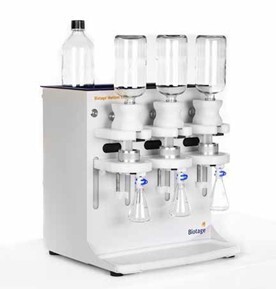
Figure 1: Biotage® Horizon 5000.
Acknowledgements
Biotage would like to thank E. Michael Thurman and Imma Ferrer of the Center for Environmental Mass Spectrometry at the University of Colorado in Boulder for their assistance in developing this method.
|
Step |
Select Solvent |
Volume (mL) |
Purge (s) |
Vacuum |
Saturate (s) |
Soak (s) |
Drain/ Elute (s) |
Sample Delay (s) |
|
Condition SPE Disk |
Reagent water |
20 |
60 |
2 |
1 |
0 |
30 |
|
|
Condition SPE Disk |
Methanol |
20 |
60 |
2 |
1 |
0 |
30 |
|
|
Wash Sample Container |
Reagent water |
20 |
15 |
2 |
1 |
0 |
30 |
|
|
Elute Sample Container |
Methanol |
20 |
15 |
6 |
1 |
0 |
30 |
|
|
Step |
Select Solvent |
Volume (mL) |
Purge (s) |
Vacuum |
Saturate (s) |
Soak (s) |
Drain/ Elute (s) |
Sample Delay (s) |
|
Condition SPE Disk |
Methanol |
11 |
60 |
2 |
1 |
120 |
30 |
|
|
Condition SPE Disk |
Methanol |
11 |
60 |
2 |
1 |
120 |
5 |
|
|
Condition SPE Disk |
Reagent water |
15 |
60 |
2 |
1 |
60 |
5 |
|
|
Load Sample |
|
|
|
2 |
|
|
|
45 |
|
Air Dry Disk |
|
|
|
6 |
|
|
600 |
|
|
Elute Sample Container |
Methanol |
8 |
15 |
2 |
1 |
90 |
30 |
|
|
Elute Sample Container |
Methanol |
8 |
15 |
6 |
1 |
90 |
120 |
|
Application modifications
Biotage® Horizon 4790 method summary
- Surface water samples were taken from Boulder Creek (Boulder, CO) upstream and downstream of a WWTP.
- A spiking mixture containing 8 labelled hormones (D8-diethylstilbestrol, D2-epiestriol, 13C6-estradiol, 13C6-estrone, D4-ethynylestradiol, D3-medroxyprogesterone, D4-mestranol, D3-nandrolone) was used to spike water samples at a concentration of 5–10 ng/L.
- No additives were added to water samples, and no filtration of samples was needed.
- The Biotage® Horizon 4790 system was purged using the generic method shown in Table 3.
Step
Solvent
Soak Time (s)
Dry Time (s)
Prewet 1
Reagent Water
0
15
Prewet 2
Methanol
0
15
Wash 1
Reagent Water
0
15
Wash 2
Methanol
0
15
- Water samples were extracted using the Biotage® Horizon 4790 system with the method shown in Table 4.
Step
Solvent
Soak Time (s)
Dry Time (s)
Prewet 1
Methanol
120
15
Prewet 2
Reagent Water
60
5
Sample Process
Wash 1
Reagent Water
60
15
Air Dry
900
Rinse 1
Methanol
90
15
Rinse 2
Methanol
90
60
- The methanol extracts were cleaned up on Florisil cartridges and evaporated to dryness under a stream of nitrogen.
- Derivatize the extracts to their trimethylsilyl esters using N-methyl-N-trimethylsilyltrifluoroacetamide according to the USGS method.
- Analyze extracts via GC/MS/MS utilizing the parameters outlined in the sample analysis section above.
Biotage® Horizon 4790 results and conclusions
The recoveries for the labelled hormone compounds are presented in Table 5. In general, acceptable recoveries were obtained for the compounds studied. Also, the recoveries were very consistent in the three different water matrices studied, showing that the SPE procedure is reliable and reproducible.
Three surface water samples (upstream, downstream, and near a wastewater source) were analyzed with the methodology described in this work and several hormones were successfully identified. Results are shown in Table 6.
The results demonstrated that the Biotage® Horizon 4790 using Atlantic® C18 disks can effectively extract hormone compounds from 1 L water samples in approximately 40 minutes. This system allows you to use the original sample bottle rinsing it with all the extraction solvents before the final elution step. This rinsing step ensures that all the compounds are rinsed off the glass and retained on the disk.
|
|
Recoveries (%) |
||
|
Compound |
Surface Water Upstream |
Surface Water Downstream |
Canyon Water Site |
|
D8-diethylstilbestrol |
47 |
66 |
49 |
|
D2-epiestriol |
54 |
57 |
50 |
|
13C6-estradiol |
60 |
59 |
54 |
|
13C6-estrone |
72 |
80 |
63 |
|
D4-ethynylestradiol |
64 |
70 |
57 |
|
D3-medroxyprogesterone |
65 |
75 |
61 |
|
D4-mestranol |
72 |
74 |
63 |
|
D3-nandrolone |
71 |
73 |
65 |
|
Compound |
Surface Water Upstream |
Surface Water Downstream |
Canyon Water Site |
|---|---|---|---|
|
17-a-Estradiol |
-- |
-- |
31.6 |
|
17-a-Ethynyl Estradiol |
-- |
0.2 |
27.4 |
|
17-b-Estradiol |
-- |
0.5 |
30.2 |
|
cis-androsterone |
-- |
-- |
25.8 |
|
Dihydrotestosterone |
-- |
-- |
23.9 |
|
Diethylstilbestrol |
-- |
-- |
24.3 |
|
Epitestosterone |
0.2 |
-- |
26.2 |
|
Estriol |
-- |
-- |
26 |
|
Estrone |
0.6 |
9.5 |
28.6 |
|
11-ketotestosterone |
-- |
-- |
29.1 |
|
Mestranol |
-- |
-- |
27.6 |
|
Norethindrone |
-- |
-- |
29 |
|
Progesterone |
-- |
-- |
31.6 |
|
Testosterone |
-- |
-- |
25.2 |
Biotage® VacMaster™ Disk method summary
- Repeat the following steps for each active Biotage® VacMaster™ Disk station.
- Setup the VacMaster Disk manifolds ensuring all waste lines and vacuum lines are attached. Set the vacuum pump to -24”Hg.
- Prepare the disk holder assembly (47 mm): ensure the support screen is flat in the centre of the disk holder. Place the Atlantic® C18 Disk on top of the support screen with the ripples of the disk on top and add any prefilters on top of the disk. Place the disk holder assembly on the VacMaster Disk ensuring there is a tight seal with the luer fitting.
- If using the multifunnel, place onto the disk holder assembly. If not using the multifunnel, omit those directions throughout the method.
- Condition the SPE Disk.
- Guide for each conditioning step in Table 7 below:
- Measure the appropriate VOLUME of SOLVENT into a graduated cylinder and pour into the disk holder assembly.
- Using a Nalgene Wash Bottle (phthalate free), rinse the multifunnel and disk holder in a circle for about 3 seconds using the same SOLVENT (approximately 5 additional mL).
- SATURATE the disk for the time indicated (in SECONDS). (Saturate means: quickly turn the knob to the appropriate waste destination and back to the “OFF” position. This brings the solvent into the disk media bed).
- SOAK the disk for the time indicated (in SECONDS).
- DRAIN to the appropriate waste destination for the time indicated (in SECONDS). Switch to the “OFF” position.
Solvent
Volume (mL)
Saturate (sec.)
Soak (sec.)
Waste Destination
Drain (sec.)
Methanol
11
1
120
Organic
30
Methanol
11
1
120
Organic
5
Reagent
15
1
60
Organic
5
- Guide for each conditioning step in Table 7 below:
- Load the Sample:
- For multifunnel: quickly and efficiently angle the bottle to rest on the multifunnel upside-down.
- For no multifunnel: pour a portion of the sample into the disk holder.
- Adjust the vacuum between -10”Hg and -15”Hg for sample load (please note, if the sample is flowing too slowly, the vacuum can be increased). Drain the sample to “AQUEOUS” waste. Continue to pour the sample into the disk holder ensuring the disk does not go dry or overflow for the duration of sample load.
- Air Dry the SPE Disk:
- Return the vacuum to -24”Hg and continue to air dry the SPE disk to “AQUEOUS” waste for an additional 600 SECONDS. Switch to the “OFF” position.
- Remove the sample bottle from the multifunnel if it was used.
- Elute the SPE Disk: (Please note: the elution solvent will go into the collection flask inside the chamber, not to waste containers).
- Place a clean 125mL 24/40 tapered Erlenmeyer flask or 40 mL VOA vial using the VOA vial insert into the VacMaster Disk collection chamber. Place the cover on the chamber. Remove the disk holder assembly and place the disk holder assembly into the Luer fitting on top of the collection chamber. Attach the Luer fitting of the collection chamber assembly onto the manifold.
- Guide for each elution step in Table 8 below:
- Measure the appropriate VOLUME of SOLVENT into a graduated cylinder, pour into the sample bottle, and swirl around. Pour the solvent in the sample bottle into the disk holder assembly.
- Using a Nalgene Wash Bottle (phthalate free), rinse the multifunnel and disk holder in a circle for about 3 seconds using the same SOLVENT (approximately 5 additional mL).
- SATURATE the disk for the time indicated (in SECONDS) to “ORGANIC”.
- SOAK the disk for the time indicated (in SECONDS).
- DRAIN to “ORGANIC” for the time indicated (in SECONDS). Switch to the “OFF” position.
- Remove the chamber lid to release the vacuum from inside the chamber.
|
Solvent |
Volume (mL) |
Saturate (sec.) |
Soak (sec.) |
Waste Destination |
Elute (sec.) |
|
Methanol |
8 |
1 |
90 |
Organic |
30 |
|
Methanol |
8 |
1 |
90 |
Organic |
120 |
Literature number: AN079-HOR
