
Scope
This application note will outline optimized methods for the extraction of carbaryl from drinking water utilizing the Atlantic® C18 SPE disk processed using Biotage automated or manual SPE solutions. The first section will highlight the use of the Biotage® Horizon 5000 fully automated extraction system and the method used for this application. Additionally, there will be an Application Modification section that will highlight the use of the Biotage® Horizon 4790 and Biotage® VacMaster™ Disk vacuum manifold for this application.
Introduction
Carbaryl, a commonly used insecticide for the past 20 years, has become a significant environmental concern throughout the world. Also known through its trademarked name Sevin, it is a cholinesterase inhibitor and can be toxic to humans, causing problems in the blood, nervous, and reproductive systems.
Although the compound is still in use throughout the United States, it is now illegal in many countries including the United Kingdom, Austria, Germany and Denmark. Although Carbaryl has not been found in many drinking water supply areas, agencies such as the Chinese Government and the US EPA have set methods with strict detection limits on the compound. The methods these agencies set describe a liquid-liquid extraction (LLE) that is costly and time consuming. To reduce time, labour, and money, automated solid phase extraction (SPE) can be used as an alternative.
The use of SPE disks eliminates many of the problems that can occur during the extraction step. SPE involves passing the liquid sample through a solid phase disk containing a sorbent such as C18. This eliminates problematic emulsions by replacing the shaking of water and solvent in LLE with the filtration and retention methods of the disk. SPE therefore, eliminates the chemicals needed to break these emulsions down.
SPE can be automated and performed in a single extraction step with the Biotage® Horizon 5000, which eliminates much of the time and labour associated with LLE. Automated systems have an economic benefit when compared to LLE because they reduce solvent volume and operator time as the process is simplified. Automation also improves the accuracy and consistency of results by eliminating operator error. Once the compounds are retained on the Atlantic® C18 Disk, appropriate solvents can be selected to elute these compounds, such as methanol, which interrupt the retention that takes place between the disk and Carbaryl compounds, and allow for proper elution of the compounds.
Instrumentation
Biotage instruments
» Biotage® Horizon 5000 automated extraction system
» Atlantic® C18 SPE Disk
» HPLC with UV detector
Method summary
- Obtain 1 L HPLC water samples and add approximately 1.0 mL of HCl to adjust the pH to 2.
- Spike samples with 100 µg of Carbaryl stock standard solution made up in acetone.
- Place the sample bottle on the Biotage® Horizon 5000 Extraction system and place the Atlantic® C18 disk in the disk holder.
- Place the 40 mL VOA sample collection vial on the extractor.
- Load and execute the Carbaryl Method outlined in table 1 and collect the final extract when done.
- Dilute final extract to 50 mL with methanol.
- Analyse by HPLC with UV detector.
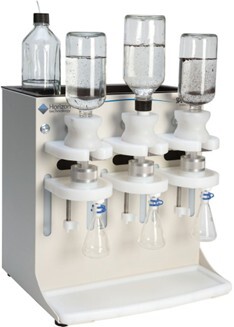
Figure 1: Biotage® Horizon 5000 Extraction system
|
Step |
Select Solvent |
Volume (mL) |
Purge (s) |
Vacuum |
Saturate (s) |
Soak (s) |
Drain/ Elute (s) |
Sample Delay (s) |
|
Condition SPE Disk |
Dichloromethane |
15 |
60 |
2 |
1 |
30 |
40 |
|
|
Condition SPE Disk |
Methanol |
11 |
60 |
2 |
1 |
30 |
5 |
|
|
Condition SPE Disk |
Reagent water |
15 |
60 |
2 |
1 |
5 |
8 |
|
|
Condition SPE Disk |
Reagent water |
15 |
60 |
2 |
1 |
5 |
5 |
|
|
Load Sample |
|
|
|
2 |
|
|
|
45 |
|
Air Dry Disk |
|
|
|
6 |
|
|
240 |
|
|
Elute Sample Container |
Acetone |
8 |
15 |
2 |
1 |
120 |
40 |
|
|
Elute Sample Container |
Acetone |
8 |
15 |
2 |
1 |
30 |
40 |
|
|
Elute Sample Container |
Dichloromethane |
8 |
15 |
2 |
1 |
30 |
40 |
|
|
Elute Sample Container |
Dichloromethane |
8 |
15 |
6 |
1 |
30 |
120 |
|
Acknowledgements
Biotage would like to thank GaoMi Water Industry Co., No.177, Renmin Avenue, GaoMi, Shandong 261500 China, for their assistance with the development of this extraction method.
Application modifications
Biotage® Horizon 4790 method summary
- Obtain 1 L HPLC water samples and add approximately 1.0 mL of HCl to adjust the pH to 2.
- Samples were spiked with 100 µg of Carbaryl stock standard solution made up in acetone.
- Place the sample bottle on the Biotage® Horizon 4790 Extractor and place the Atlantic® C18 disk in the disk holder.
- Place the sample collection vial on the extractor.
- Load the Carbaryl Method shown in table 2 into the Envision Controller.
- After extraction completion collect the final elution.
- Dilute final extract to 50 mL of methanol.
- Analyze by HPLC with UV detector.
|
Step |
Solvent |
Soak time (s) |
Dry time (s) |
|
Prewet 1 |
Dichloromethane |
30 |
20 |
|
Prewet 2 |
Methanol |
30 |
2 |
|
Prewet 3 |
Reagent water |
5 |
2 |
|
Prewet 4 |
Reagent water |
5 |
2 |
|
Sample Process |
|
|
|
|
Air Dry |
|
|
120 |
|
Rinse 1 |
Acetone |
120 |
20 |
|
Rinse 2 |
Acetone |
30 |
20 |
|
Rinse 3 |
Dichloromethane |
30 |
20 |
|
Rinse 4 |
Dichloromethane |
30 |
60 |
Biotage® Horizon 4790 Results and Conclusions One litre of DI Water was spiked with Carbaryl standard made up in acetone at a theoretical amount of 100 µg (100 ppb). The results in table 3 show that the Atlantic C18 SPE recoveries averaged 96.9% with and RSD of 1.5%. A typical chromatogram for this compound is included below (Figure 1).
This data demonstrates that the Biotage® Horizon 4790 extraction system coupled with the Atlantic® C18 SPE disk is capable of fully automating SPE for Carbaryl, resulting in accurate and precise data. The use of the Biotage® Horizon 4790 Automated Extraction System will allow for a reduction in analyst labour, solvent usage, and turn-around-time all while increase the productivity, accuracy, and precision of a laboratory.
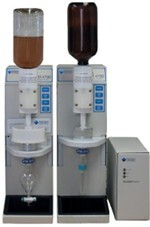
Figure 2: Biotage® Horizon 4790
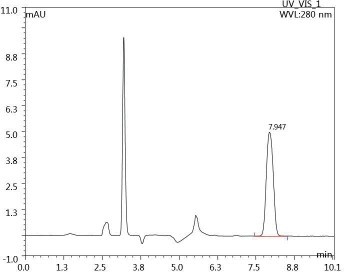
Figure 3: Typical HPLC-UV chromatogram for carbaryl
|
Sample |
Amount µg/mL) |
Recovery (%) |
|
Standard |
2.140 |
- |
|
Sample 1 |
2.096 |
98.00 |
|
Sample 2 |
2.087 |
97.50 |
|
Sample 3 |
2.036 |
95.10 |
|
Average (%) |
96.90 |
|
|
RSD |
1.50 |
|
Biotage® VacMaster™ Disk method summary
- Repeat the following steps for each active Biotage® VacMaster™ Disk station.
- Setup the Biotage® VacMaster™ Disk manifolds ensuring all waste lines and vacuum lines are attached. Set the vacuum pump to -24”Hg.
- Prepare the disk holder assembly (47 mm): ensure the support screen is flat in the centre of the disk holder. Place the Atlantic® C18 Disk on top of the support screen with the ripples of the disk on top and add any prefilters on top of the disk. Place the disk holder assembly on the VacMaster Disk manifold ensuring there is a tight seal with the luer fitting.
- If using the multifunnel, place onto the disk holder assembly. If not using the multifunnel, omit those directions throughout the method.
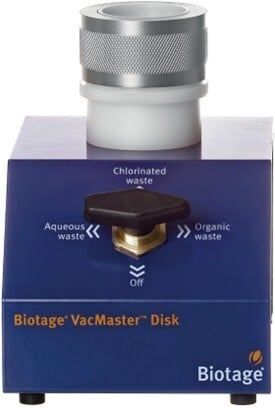
Figure 4: Biotage® VacMaster™ Disk
5. Condition the SPE Disk:
a. Guide for each conditioning step in table 4:
- Measure the appropriate VOLUME of SOLVENT into a graduated cylinder and pour into the disk holder assembly.
- Using a Nalgene Wash Bottle (phthalate free), rinse the multifunnel and disk holder in a circle for about 3 seconds using the same SOLVENT (approximately 5 additional mL).
- SATURATE the disk for the time indicated (in SECONDS). (Saturate means: quickly turn the knob to the appropriate waste destination and back to the “OFF” position. This brings the solvent into the disk media bed).
- SOAK the disk for the time indicated (in SECONDS).
- DRAIN to the appropriate waste destination for the time indicated (in SECONDS). Switch to the “OFF” position.
|
Solvent |
Vol (mL) |
Saturate (sec.) |
Soak (sec.) |
Waste Destination |
Drain (sec.) |
|
Methylene |
15 |
1 |
30 |
Chlorinated |
40 |
|
Methanol |
11 |
1 |
30 |
Organic |
5 |
|
Reagent Water |
15 |
1 |
5 |
Organic |
8 |
|
Reagent Water |
15 |
1 |
5 |
Aqueous |
5 |
6. Load the Sample:
- For multifunnel: quickly and efficiently angle the bottle to rest on the multifunnel upside-down.
- For no multifunnel: pour a portion of the sample into the disk holder.
- Adjust the vacuum between -10”Hg and -15”Hg for sample load (please note, if the sample is flowing too slowly,
the vacuum can be increased). Drain the sample to “AQUEOUS” waste. Continue to pour the sample into the disk holder ensuring the disk does not go dry or overflow for the duration of sample load.
7. Air Dry the SPE Disk:
- Return the vacuum to -24”Hg and continue to air dry the SPE disk to “AQUEOUS” waste for an additional 240 SECONDS. Switch to the “OFF” position.
- Remove the sample bottle from the multifunnel if it was used.
8. Elute the SPE Disk: (Please note: the elution solvents will go into the collection flask inside the chamber, not to waste containers)
a. Place a clean 125 mL 24/40 tapered Erlenmeyer flask into the Biotage® VacMaster™ Disk collection chamber. Place the cover on the chamber. Remove the disk holder assembly and place the disk holder assembly into the lurer fitting on top of the collection chamber. Attach the luer fitting of the collection chamber assembly onto the manifold.
b. Guide for each elution step in table 5 below:
- Measure the appropriate VOLUME of SOLVENT into a graduated cylinder, pour into the sample bottle, and swirl around. Pour the solvent in the sample bottle into the disk holder assembly.
- Using a Nalgene Wash Bottle (phthalate free), rinse the multifunnel and disk holder in a circle for about 3 seconds using the same SOLVENT (approximately 5 additional mL).
- SATURATE the disk for the time indicated (in SECONDS) to “ORGANIC”.
- SOAK the disk for the time indicated (in SECONDS).
- DRAIN to “ORGANIC” for the time indicated (in SECONDS). Switch to the “OFF” position.
- Remove the chamber lid to release the vacuum from inside the chamber.
|
Solvent |
Vol (mL) |
Saturate (sec.) |
Soak (sec.) |
Waste Destination |
Elute (sec.) |
|
Acetone |
8 |
1 |
120 |
Organic |
40 |
|
Acetone |
8 |
1 |
30 |
Organic |
40 |
|
Methylene |
8 |
1 |
30 |
Organic |
40 |
|
Methylene |
8 |
1 |
30 |
Organic |
120 |
Literature number: AN053
