
Organophosphorous pesticides using automated SPE according to EPA method 8141B
Scope
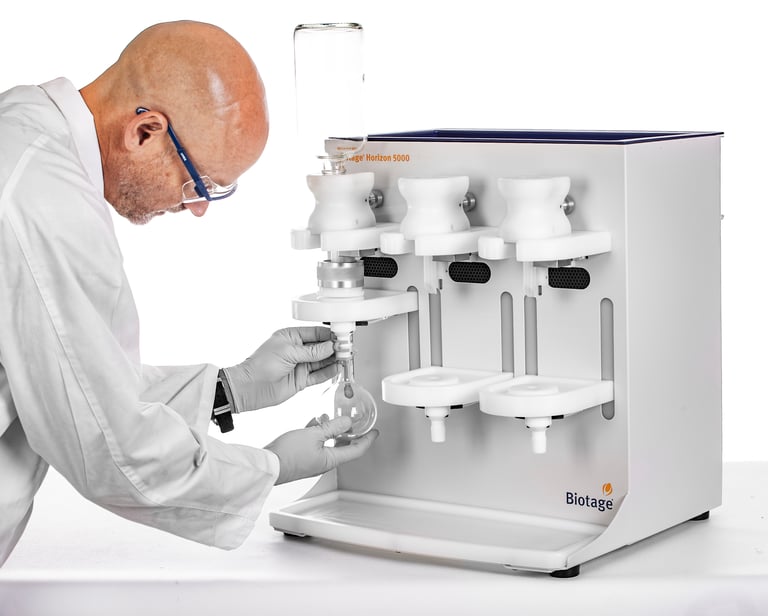
This application note will outline appropriate methods for the extraction of organophosphorus pesticides from ground water as outlined in EPA method 8141B using the Atlantic® C18 SPE disk processed using Biotage automated or manual SPE solutions and DryVap® Concentrator System. The first section will highlight the use of the Biotage® Horizon 5000 fully automated extraction system and the method used for this application. Additionally, there will be an Application Modification section that will highlight the use of the Biotage® VacMaster™ Disk vacuum manifold for this application.
Introduction
EPA Method 8141B describes the performance-based procedure for determination of low ppb levels of organophosphorus (OP) pesticides in ground water. The primary extraction solvent is hexane which in turn eliminates the need to perform a solvent exchange.
Organophosphorus pesticides are the most widely used pesticides in the world. They are readily hydrolyzed and therefore do not persist in the environment for very long nor accumulate in the body fat of humans or other animals. The ubiquitous nature of the OP pesticides results in routine exposure for humans through the consumption of fresh and processed vegetables, contact with pesticide-contaminated surfaces, breathing air near pesticide applications, and drinking pesticide contaminated water. OP pesticides interfere with the nervous system of both insects and humans. In humans, these compounds block the production of cholinesterase. The main target organs in humans are the nervous system, respiratory tract, and cardiovascular system. The EPA classifies most OP compounds as toxicity class I (highly toxic) or toxicity class II (moderately toxic).
The OP pesticides are extracted using solid phase extraction (SPE) using Atlantic® C18 disks, based on the procedure outlined in Method 3535A for OP pesticides by Method 8141. The analysis is performed with capillary GC using an FPD (flame photometric detector) utilizing a splitless injection technique.
Instrumentation
- Biotage Instruments:
» Biotage® Horizon 5000 Automated Extraction System
» DryVap™* Concentrator System
» DryDisk® Separation Membranes
» Atlantic™ C18 Disks (47 mm) - Agilent 6890 GC with dual FPDs
- J&W Cartridges
» Cartridge A: DB-1701, 30 m x 0.320 mm x 0.25 µm
» Cartridge B: DB-5ms, 30 m x 0.250 mm x 0.5 µm
*The DryVap™ system has been discontinued, we recommend using a TurboVap®.
Method summary
- IPR samples: Four replicates are prepared using 500 mL of DI water at pH 5.0–9.0, spiked at 5.00 µg/L.
- MDL samples: Seven replicates are prepared using 500 mL of DI water at pH 5.0–9.0 and spiked at 1.25 µg/L for each pesticide. (Must be performed over 3 days)
- Place the sample bottle on the Biotage® Horizon 5000 Extraction System and place the Atlantic® C18 disk in the standard 47 mm disk holder. Attach collection vessels to the system
- Extract the samples using the method in table 1 and collect the final sample extract.
- Upon completion of the extraction, dry and concentrate the final sample extracts to 1.0 mL.
- Extracts are analyzed by GC/dual FPD detectors and the conditions are listed in table 2.
|
Step
|
Select Solvent
|
Volume (mL)
|
Purge (s)
|
Vacuum
|
Saturate (s)
|
Soak (s)
|
Drain/ Elute (s) |
Sample Delay (s) |
|
|
Condition SPE Disk |
Acetone |
11 |
60 |
2 |
1 |
60 |
180 |
|
|
|
Condition SPE Disk |
Methanol |
11 |
60 |
2 |
1 |
60 |
5 |
|
|
|
Condition SPE Disk |
Reagent water |
15 |
60 |
2 |
1 |
60 |
5 |
|
|
|
Load Sample |
|
|
|
2 |
|
|
|
45 |
|
|
Air Dry Disk |
|
|
|
6 |
|
|
360 |
|
|
|
Elute Sample Container |
Acetone |
8 |
15 |
2 |
1 |
60 |
120 |
|
|
|
Elute Sample Container |
Hexane |
8 |
15 |
2 |
1 |
60 |
120 |
|
|
|
Elute Sample Container |
Hexane |
8 |
15 |
2 |
1 |
90 |
240 |
|
|
|
Elute Sample Container |
Hexane |
8 |
15 |
6 |
1 |
90 |
240 |
|
|
|
GC Conditions
|
Oven Temperature |
Program |
|||
|
Inlet A Temperature |
225 °C |
Initial Temperature |
80 °C |
||
|
Detector A Temperature |
250 °C |
Initial Time |
0.00 min |
||
|
Detector B Temperature |
250 °C |
Level |
Ramp (C/min) |
Temp (°C) |
Final Time(min) |
|
Constant Pressure |
25.0 psi |
1 |
20 |
170 |
0.00 |
|
Carrier Gas |
He |
2 (A) |
10 |
280 |
5.53 |
|
Detector Gas |
He, H, Air |
3 (B) |
0 |
0 |
0 |
Acknowledgements
Biotage would like to thank Sheldon Murray at the City of Ft. Worth, TX for his help in producing this method.
Application modifications
Biotage® VacMaster™ Disk method summary
- Repeat the following steps for each active Biotage® VacMaster™ Disk station.
- Setup the VacMaster Disk manifolds ensuring all waste lines and vacuum lines are attached. Set the vacuum pump to -24”Hg.
- Prepare the disk holder assembly (47mm): ensure the support screen is flat in the centre of the disk holder. Place the Atlantic® C18 Disk on top of the support screen with the ripples of the disk on top and add any prefilters on top of the disk. Place the disk holder assembly on the VacMaster™ Disk manifold ensuring there is a tight seal with the luer fitting.
- If using the multifunnel, place onto the disk holder assembly. If not using the multifunnel, omit those directions throughout the method.
- Condition the SPE Disk:
- Guide for each conditioning step in table 3 below:
- Measure the appropriate VOLUME of SOLVENT into a graduated cylinder and pour into the disk holder assembly.
- Using a Nalgene Wash Bottle (phthalate free), rinse the multifunnel and disk holder in a circle for about 3 seconds using the same SOLVENT (approximately 5 additional mL).
- SATURATE the disk for the time indicated (in SECONDS). (Saturate means: quickly turn the knob to the appropriate waste destination and back to the “OFF” position. This brings the solvent into the disk media bed).
- SOAK the disk for the time indicated (in SECONDS).
- DRAIN to the appropriate waste destination for the time indicated (in SECONDS). Switch to the “OFF” position.
- Guide for each conditioning step in table 3 below:
- Load the Sample:
- For multifunnel: quickly and efficiently angle the bottle to rest on the multifunnel upside-down.
- For no multifunnel: pour a portion of the sample into the disk holder.
- Adjust the vacuum between -10”Hg and -15”Hg for sample load (please note, if the sample is flowing too slowly, the vacuum can be increased). Drain the sample to “AQUEOUS” waste. Continue to pour the sample into the disk holder ensuring the disk does not go dry or overflow for the duration of sample load.
- Air Dry the SPE Disk:
- Return the vacuum to -24”Hg and continue to air dry the SPE disk to “AQUEOUS” waste for an additional 360 SECONDS. Switch to the “OFF” position.
- Remove the sample bottle from the multifunnel if it was used.
- Elute the SPE Disk: (Please note: the elution solvents will go into the collection flask inside the chamber, not to waste containers).
- Place a clean 125 mL 24/40 tapered Erlenmeyer flask into the VacMaster™ Disk collection chamber. Place the cover on the chamber. Remove the disk holder assembly and place the disk holder assembly into the luer fitting on top of the collection chamber. Attach the luer fitting of the collection chamber assembly onto the manifold.
- Guide for each elution step in table 4 below:
- Measure the appropriate VOLUME of SOLVENT into a graduated cylinder, pour into the sample bottle, and swirl around. Pour the solvent in the sample bottle into the disk holder assembly.
- Using a Nalgene Wash Bottle (phthalate free), rinse the multifunnel and disk holder in a circle for about 3 seconds using the same SOLVENT (approximately 5 additional mL).
- SATURATE the disk for the time indicated (in SECONDS) to “ORGANIC”.
- SOAK the disk for the time indicated (in SECONDS).
- DRAIN to “ORGANIC” for the time indicated (in SECONDS). Switch to the “OFF” position.
- Remove the chamber lid to release the vacuum from inside the chamber.
|
Solvent |
Vol. (mL) |
Saturate (sec.) |
Soak (sec.) |
Waste Destination |
Drain (sec.) |
|
Acetone |
11 |
1 |
60 |
Organic |
180 |
|
MeOH |
11 |
1 |
60 |
Organic |
5 |
|
Reagent Water |
15 |
1 |
60 |
Organic |
5 |
|
Solvent |
Vol. (mL) |
Saturate (sec.) |
Soak (sec.) |
Waste Destination |
Elute (sec.) |
|
Acetone |
8 |
1 |
60 |
Organic |
120 |
|
Hexane |
8 |
1 |
60 |
Organic |
120 |
|
Hexane |
8 |
1 |
90 |
Organic |
240 |
|
Hexane |
8 |
1 |
90 |
Organic |
240 |
Literature number: AN034
