

Introduction
Per- and polyfluoroalkyl substances (PFAS) continue to receive significant environmental and regulatory attention due to their persistence, bioaccumulation potential, and widespread occurrence in environmental and industrial matrices. The DIN EN 17892 standard provides a framework for determining selected PFAS compounds to support monitoring and compliance.
This application note presents a fully automated workflow for water samples using Biotage® EVOLUTE PFAS+ SPE cartridges, aligned with DIN EN 17892. The method, executed on the Biotage® PrepXpert-8 system with post-extraction concentration via TurboVap® LV, automates conditioning, loading, washing, and elution, minimizing manual handling and variability while enhancing reproducibility, throughput, and contamination control. In addition to the DIN EN 17892 targets, our research highlights additional PFAS compounds of relevance, expanding the scope for laboratories seeking consistent, traceable performance across a broader analyte list.
Analytes
Table 1: Access here.
Ammonia/methanol solution preparation
- Add 400 μL of ammonium hydroxide (NH4OH) for every 99.6 mL of methanol (MeOH) to a clean beaker.
- Agitate to homogenize.
- Prepare new solution daily.
Sample preparation procedure
- Clean the automated extractor system using the technique given in Appendix A. If the cleanliness of a particular channel is suspect, it is recommended that the cleaning method be run multiple times and that the cleanliness be verified by extracting blanks.
- Set up and fill new sample containers with water; 200 mL are typical for this method.
- Adjust the 200 mL water samples to a pH of 3 using glacial acetic acid.
- Spike internal standard into each sample that corresponds to a mid-range concentration of your curve.
- If statistical evaluation is required, spike a known amount of PFAS target standard into the water samples to achieve the desired concentration.
- Attach each prepared water sample to the sample bottle caps on the Biotage® PrepXpert-8 system and ensure that the sip tube is angled correctly with the ability to drain all liquid from the sample bottle.
- Attach the EVOLUTE® PFAS+ cartridges onto the cartridge adapters of the Biotage® PrepXpert-8 system.
- Load 15 mL centrifuge tubes onto the collection vessel rack and ensure that it is installed on the Biotage® PrepXpert-8 automated tray.
- Program in the method parameters for the extraction of samples by DIN EN 17892 given in Table 2 and run it. The protocol will result in an approximately 8 mL extract.
- Determine the initial sample volume by either using a graduated cylinder and filling the sample container to the original mark or by taking an additional weight of the container.
- Transfer the centrifuge tubes to the TurboVap® LV system and concentrate the samples to just under 1 mL using nitrogen according to the parameters in Table 3.
- Bring the final extract to 1 mL using methanol and transfer to an autosampler vial.
- Load the extract onto a calibrated LC-MS/MS system and process using the conditions given in the below sections.
|
Operation |
Amount (mL) |
Input |
Output |
Flow (mL/min) |
|
Condition |
5 |
0.1% NH4OH in MeOH |
Solvent waste |
5 |
|
Condition |
5 |
MeOH |
Solvent waste |
5 |
|
Condition |
5 |
Water |
Water waste |
5 |
|
Load |
225 |
Sample |
Water waste |
5 |
|
Wash |
3 |
Water |
Water waste |
5 |
|
Purge |
3 |
Air |
Water waste |
10 |
|
Dry* |
20 min |
Nitrogen |
Water waste |
- |
|
Rinse |
6 |
MeOH |
Sample rinse |
60 |
|
Wait 15 sec |
||||
|
Elute |
10 |
Sample |
Vial B |
2 |
|
Elute |
5 |
0.1% NH4OH in MeOH |
Vial B |
2 |
|
Purge |
5 |
Nitrogen |
Vial B |
10 |
*N2 purge pressure for drying was increased from 1 bar to 1.5 bar to ensure complete drying of the adsorbent bed.
|
Bath temperature |
40 ˚C |
|
Evaporation mode |
Method (Ramp gradient) |
|
Manifold setup |
48 positions |
|
Rack row height |
120 mm* |
|
Step 1 |
1.2 L/min for 15 min |
|
Step 2 |
3.0 L/min for 15 min |
|
Step 3 |
3.5 L/min for 40 min |
*The nozzle position was adjusted such that it was as far to the right as possible to give the user a clear view of the vortex within the tube.
LC-MS/MS conditions
Agilent 1290 Infinity II LC system:
- 1290 Infinity II Multicolumn Thermostat, G7116B
- 1290 Infinity II Multi sampler, G7167B
- 1290 Infinity II High Speed Pump, G7120A
Columns:
- InfinityLab PFC Delay Column, 4.6 x 30 mm, p/n 5062-8100
- ZORBAX RRHD Eclipse Plus C18, 95 Å, 2.1 x 50 mm, 1.8 µm, p/n 959757-902
Mobile phases:
A: 20 mM ammonium acetate in water B: Methanol
Table below is the LC gradient
|
Time (min) |
%A |
%B |
|
0.00 |
90 |
10 |
|
0.50 |
90 |
10 |
|
2.00 |
60 |
40 |
|
7.50 |
0 |
100 |
|
9.00 |
0 |
100 |
|
9.10 |
90 |
10 |
|
10.00 |
90 |
10 |
- Flow rate: 0.4 mL/min
- Injection volume: 5 μL
- Column temperature: 50 ˚C
Agilent 6470 MS/MS, G6470B
- Gas temperature: 230 ˚C
- Gas flow: 4 L/min
- Nebulizer: 20 psi
- Sheath gas temperature: 375 ˚C
- Sheath gas flow: 12 L/min
- Capillary voltage (positive): 3500 V
- Capillary voltage (negative): 3500 V
- Nozzle voltage (Positive): 500 V
- Nozzle voltage (Negative): 0 V
Results
System calibration
For the work being done here, a total of five points were used in the calibration covering a range of 0.1-20 ppt. The curve was forced through zero and achieved excellent R2 values.
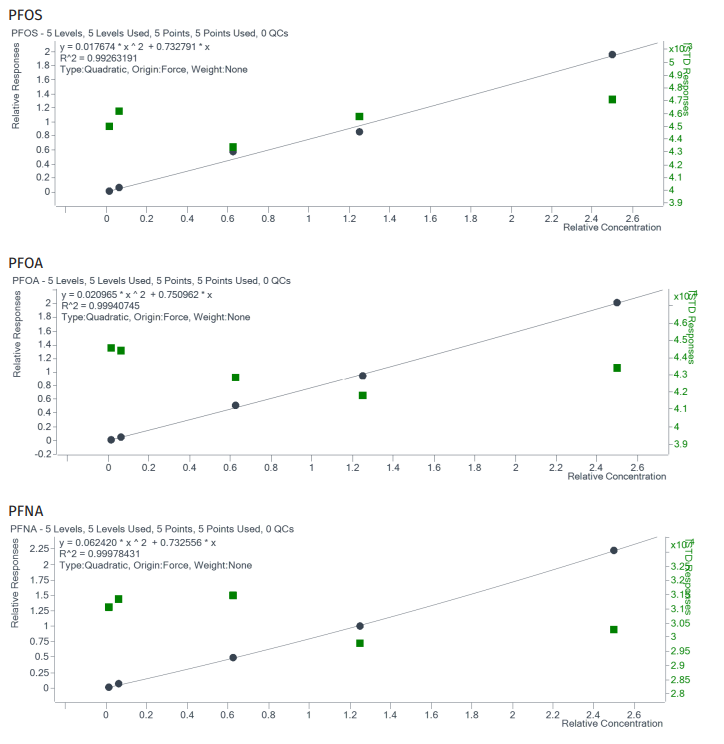
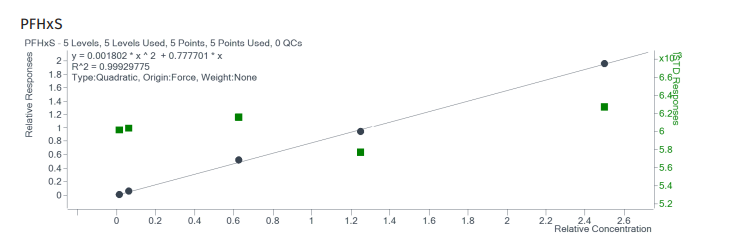 Figure 1. Calibration curves for PFOS, PFOA, PFNA, and PFHxS, with the internal standard (ISTD) shown on the secondary Y-axis. Calibration curves for the remaining target analytes in Table 1 are shown in Appendix C.
Determination of the minimum reporting level (MRL) and detection limits (DL)
A target MRL of 1 ng/L was selected and at least seven replicate laboratory fortified blanks (LFBs) were created and ran at that concentration, with at least nine data points being selected for each compound. Figure 2 below illustrates the results of this test; the calculated detection limit (DL) for all DIN target compounds ranged from 0.09 ng/L (N-EtFOSAA) to 0.51 ng/L (PFTrDS) with 87% of the calculated DL being lower than 1/3 the concentration of the MRL. The total sum of the calculated DL for the select longer-chain target compounds such as PFOA, PFNA, PFHxS, and PFOS is less than 1 ng/L at 0.94 ng/L. The additional monitored compounds also performed reasonably well and achieved calculated DL ranging from 0.16 ng/L (8:2 FTUCA) to 0.60 ng/L (PFOcDA).
 Figure 2. MRL and DL recoveries. Those compounds with an asterisk were used in salt form.
The data for individual compounds is shown in Appendix D.
Initial demonstration of precision and accuracy (IDP, IDA)
The LFBs used to calculate the detection limit were also used to determine the precision and accuracy of the sample preparation process. Figure 3 illustrates the accuracy, while Figure 4 shows the precision. All target compounds, excluding two of the additional monitored compounds, recovered greater than 89% of the spiked amount and had calculated coefficient of variation (CV) less than 17%, which are in line with those observed in method DIN EN 17892. The additional monitored compounds FOSAA and PFOcDA were the only two targets that recovered less than 89% with recoveries of 50% and 80% respectively
at high calculated CV values. These compounds, as well as many of the later eluting compounds, have been observed to behave more inconsistently in the presence of residual water and consistency can be improved by increasing the column dry time or pressure if they are of particular concern.
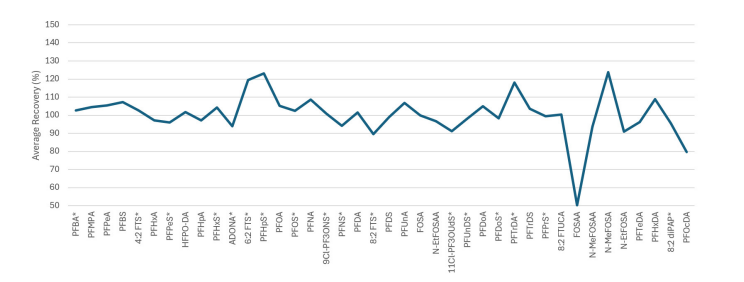 Figure 3. Initial demonstration of accuracy (1 ng/L, n=10). Those compounds with an asterisk were used in salt form.
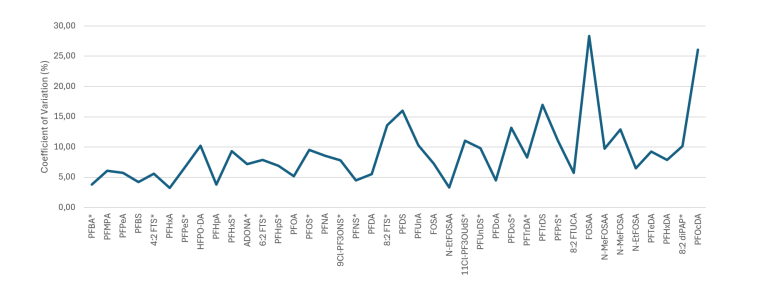 Figure 4. Initial demonstration of precision (1 ng/L, n=10). Those compounds with an asterisk were used in salt form. The data for individual compounds is shown in Appendix E.
Demonstration of low system background
A study was conducted to investigate each part of the extraction process and any their potential contribution to PFAS background. This sequential process is visualized below and highlights each component of the full extraction process as they are screened for PFAS background contribution before finally being combined into a single process when extracting the reagent water blank samples.
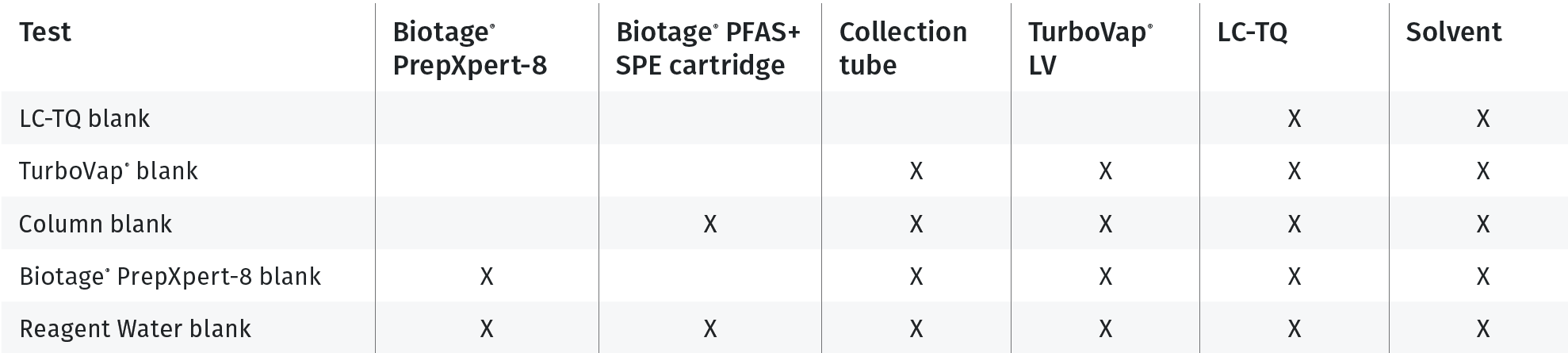
The results of these tests are given in Appendix F, and selected data are shown below in Figures 5-8.
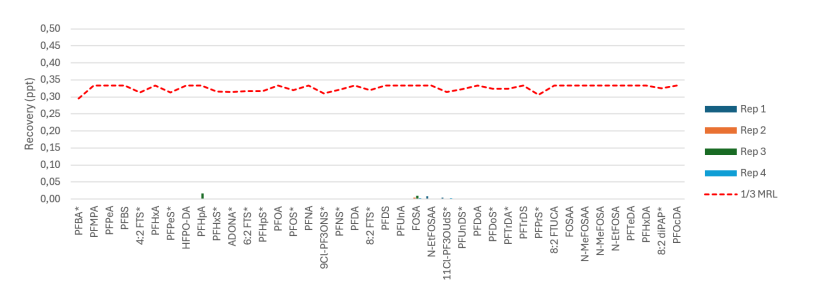 Figure 5. Contribution of the TurboVap® LV to the PFAS background. Those compounds with an asterisk were used in salt form.
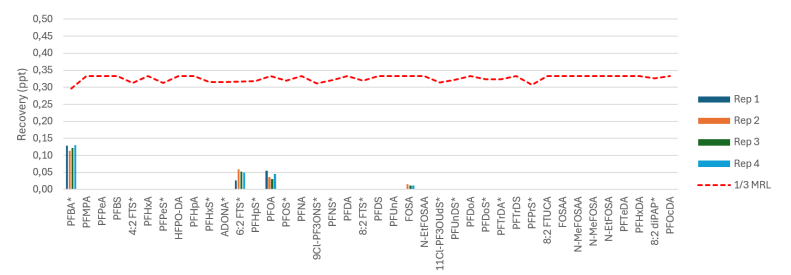 Figure 6. Contribution of the EVOLUTE® PFAS+ SPE cartridges to the PFAS background. Those compounds with an asterisk were used in salt form.
 Figure 7. Contribution of the Biotage® PrepXpert-8 to the PFAS background. Those compounds with an asterisk were used in salt form.
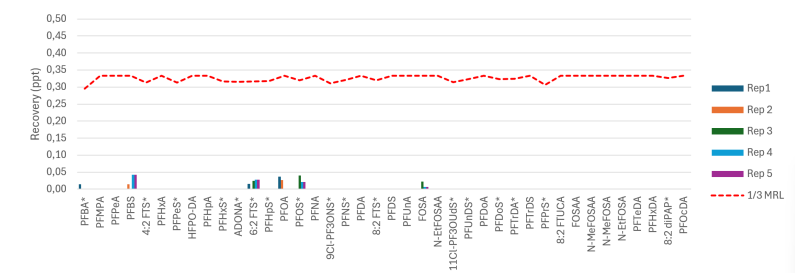 Figure 8. PFAS background for full LRB extraction using EVOLUTE® PFAS+ SPE cartridges. Those compounds with an asterisk were used in salt form.
For those results which were generated using only the analytical system, all target analytes were N.D. (unable to be separated from the noise in the baseline) and so were not listed out in the previous tables.
When examining the data resulting for all blank tests and the full laboratory reagent blank (LRB) tests (which includes the Biotage® PrepXpert-8, the EVOLUTE® PFAS+ SPE cartridges, and the TurboVap® LV) there are clear indications of the presence of a PFAS background.
However, even at the highest concentrations detected, all levels are much lower than the 1/3 MRL limit indicating that the background is acceptable and will not interfere with future sample runs. Specifically, PFBA can be seen in the background contribution from the EVOLUTE® PFAS+ SPE cartridges, however any background is flushed out during the conditioning steps of the extraction method, as indicated by the LRB resulting in non-detect levels of PFBA.
Examination of system carryover
To simulate an influent sample, four LFB samples were created with concentrations which were more than two times greater than the highest point on the calibration curve. These samples were extracted, and the clean up procedure given in Appendix A was run three times. To ensure that the system background was adequately reduced, a set of four LRB samples were extracted immediately after the cleaning procedure and analysed. The LRB data obtained from this study is presented in Appendix G.
The trace levels of PFAS targets that were observed were non-detect for all compounds. These results show that the cleaning method given in Appendix A is sufficient to clean the PrepXpert-8 system; however, if higher than desired concentrations of any PFAS compounds remain, it is suggested to run additional cleaning methods to help re-establish the system background.
Conclusion
This study confirms that the Biotage® PrepXpert-8 system, combined with the TurboVap® LV, delivers a robust and efficient platform for PFAS extraction in accordance with DIN EN 17892. The system was verified to be PFAS-free, eliminating concerns of background contamination, and demonstrated full capability in extracting both the regulated compounds in DIN EN 17892 and an extended panel of additional PFAS targets.
By automating extraction and cleaning steps, the workflow reduces operator workload, enhances reproducibility, and supports scalable, traceable performance, offering a dependable solution for laboratories aiming to streamline PFAS sample preparation without compromising analytical quality.
Download appendix A to F here.
Literature number: AN1017
