
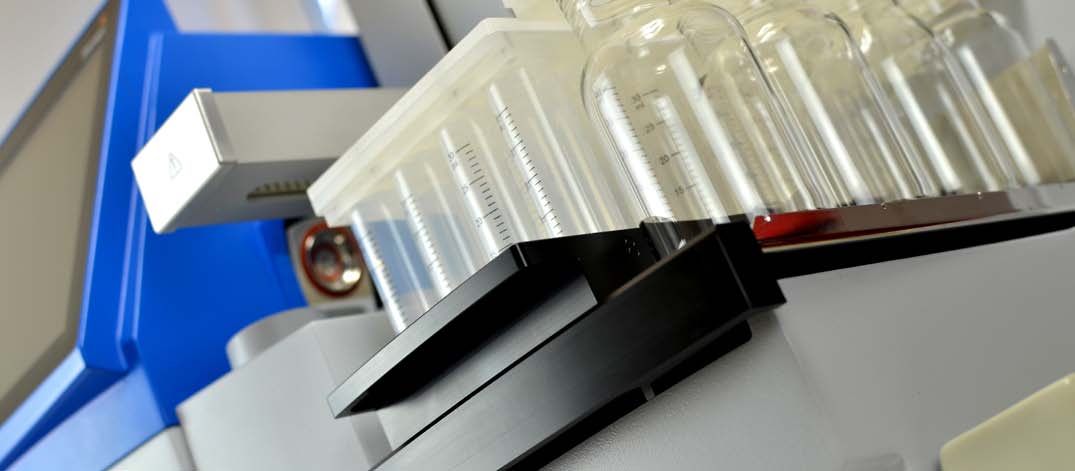
 This application shows how the β-amyloid (1-42) peptide was successfully synthesized in 0.1 mmol scale on a Biotage® Initiator+ Alstra™ fully automated microwave peptide synthesizer.
Introduction
The human β-amyloid (1-42), H-DAEFRHDSGYEVHHQKLVFFAEDVGSNKGAIIGLMVGGVVIA NH2 (1), sequence is a well known difficult sequence to synthesize.1,2 This is due to its high hydrophobicity at the C-terminus and on-resin aggregation. The peptide is known to be one of the main constituents in amyloid plaques in the brain of Alzheimer’s patients. Synthetic amyloid peptides are essential research tools to study the molecular mechanisms of neurodegenerative diseases, however, their solid-phase assembly is non-trivial.
Here we demonstrate the synthesis of the β-amyloid (1-42) peptide on the new Biotage® Initiator+ Alstra™ fully automated microwave peptide synthesizer.
Experimental
Materials
All materials were obtained from commercial suppliers; Sigma-Aldrich (diisopropyl carbodiimide (DIC), piperidine, trifluoroacetic acid (TFA), triisopropylsilane (TIS) and formic acid), Iris Biotech GmbH (Fmoc-amino acids), Fisher Scientific (NMP, and acetonitrile), Novabiochem, Merck Millipore (Oxyma Pure) and Biotage AB (ChemMatrix rink amide resin, 0.52 mmol/g). Milli-Q (Merck Millipore) water was used for LC-MS analysis. Nα-9-fluorenylmethoxycarbonyl (Fmoc) amino acids contained the following side-chain protecting groups: Asn(Trt), Lys(Boc), Ser(tBu), Asp(OtBu), Glu(OtBu), Gln(Trt), His(Trt), and Arg(Pbf).
Peptide synthesis and analysis
The β-amyloid (1-42) (1) peptide was synthesized on a 0.1 mmol scale (10 ml reactor vial) using ChemMatrix® rink amide resin (loading 0.52 mmol/g, 192 mg). Nα-Fmoc deprotection was performed at room temperature (RT) in two stages by treating the resin with 20% piperidine/ NMP for 3 min (4 ml) followed by 20% piperidine/NMP for 10 min (4 ml). The resin was then washed with NMP (4 x 4.5 ml). The peptide (1) was synthesized using Nα Fmoc amino acids (5.0 eq., 0.5 M in NMP), employing the coupling protocol shown below:
» 0.1 mmol scale - DIC (5.0 eq., 0.5 M in NMP),
Oxyma Pure (5.0 eq., 0.5 M in NMP)
.png?width=1246&height=502&name=biotage-an069-figure1-RP-HPLC-chromatogram-ESI-MS-0_1mmol-scale-synthesis-%CE%B2-amyloid-(1-42).png) Figure 1: RP-HPLC chromatogram and ESI-MS of 0.1 mmol scale synthesis of β-amyloid (1-42) (1)
Figure 1: RP-HPLC chromatogram and ESI-MS of 0.1 mmol scale synthesis of β-amyloid (1-42) (1)
All couplings using microwave irradiation were performed at 75 °C for 5 minutes, except for Asp(OtBu), His(Trt), and Arg(Pbf) couplings which were performed at room temperature for 60 minutes. After each coupling step, the resin was washed with NMP (4 × 4.5 ml). After the synthesis of the peptide sequence and final Nα-Fmoc deprotection was completed, the resin was successively washed with NMP (3 × 4.5 ml), DCM (2 × 4.5 ml) and dried thoroughly. The peptide was cleaved from the solid support by treatment with TFA-TIS-H2O (95:2.5:2.5) for 2 hours. The resin was then separated by filtration and the cleavage cocktail was collected and diluted with 60% acetonitrile/water to set the final concentration of TFA to 30% (v/v). This was directly injected into the HPLC.2 Analytical HPLC was performed on an Agilent 1100. The peptide was analysed on a Biotage® Resolux™ 200 Å C4 column (4.5 μm, 150 × 2.1 mm) with a flow rate of 1.0 mL/min.
The following solvent system was used: solvent A, water containing 0.1% formic acid; solvent B, acetonitrile containing 0.1% formic acid. The column was eluted using a linear gradient from 10% buffer B to 60% buffer B over 10 minutes. Identification was carried out by ESI-MS (Agilent Technologies 6120 Quadrupole LC/MS).
Results & discussion
The β-amyloid (1-42) peptide (1) was successfully synthesized using microwave heating with a crude purity of 77% and confirmed by ESI-MS (Figure 1), calculated average isotopic composition for C203H312N56O59S, 4513.054, Da. Found: m/z 1129.1 [M+4H]4+, 903.4 [M+5H]5+, 753.1 [M+6H]6+.
Conclusion
The β-amyloid (1-42) peptide (1) was successfully synthesized in 0.1 mmol scale on a Biotage® Initiator+ Alstra™ fully automated microwave peptide synthesizer. Standard pre-installed methods were used with all couplings using microwave heating performed at 75 °C for 5 minutes. except for Asp(OtBu), His(Trt), and Arg(Pbf) which were performed at room temperature for 60 minutes to afford the desired peptide in excellent crude purity.
References
- Clippingale, A. B.; Wade, J. D.; Barrow, C. J.; J. Pept. Sci. 2001, 7, 227–249.
- Zarándi, M; Soós, K; Fülöp, L; Bozsó, Z; Datki, Z; Tóth, G. K; Penke, B.; J. Pept. Sci. 2007, 13, 94-99.
Literature number: AN069
