
Oligonucleotides are short strands of DNA or RNA with wide-ranging applications across biology, chemistry and medicine. The current gold standard method of choice for the chemical synthesis of oligonucleotides is automated solid phase synthesis using specially functionalized nucleoside monomers as building blocks. Each nucleotide is added sequentially using phosphoramidite chemistry in the key coupling step. Additional oxidation, capping and deprotection steps complete the synthesis cycle. This is a highly optimized process and with carefully tailored conditions it is possible to obtain close to 100% yield in each step. Even so, the linear nature of the synthesis places a practical limitation of about 200 nucleotides on the length of oligonucleotides that can be obtained. Above this limit the yield of the full length product becomes impractically low and separation of the full length product from the large number of structurally similar failure sequences becomes unfeasible. ATDBio, now part of Biotage, have specialist experience in the chemical synthesis of challenging oligonucleotide sequences. ATDBio recognized a clear need for improved preparative methods for highly pure long oligonucleotides, with customers increasingly requesting such sequences for use in genome editing, cloning and site-directed mutagenesis, validation of diagnostic assays, and the development of long read sequencing technologies. The results of one such project are shown here.
Example application
Long-read sequencing
The ability to accurately sequence short stretches of DNA (150–300 bp) is well established, and a variety of so-called short-read sequencing technologies exist. Short-read sequencing is cost-effective, accurate and reliable, and has become a standard technique in the biologists’ toolkit.
Genomic DNA can span lengths of more than eight orders of magnitude (for example, the human genome is around 3 billion base pairs in length). Short-read sequencing technologies require genomic DNA to be cut into small sections, before each section is sequenced and the data reconstituted computationally using overlapping regions. The technique works well, but can miss important detail in highly repetitive regions, for example short tandem repeats (STRs), which play a role in diseases such as cancer.
Long-read sequencing technologies have the potential to sequence more repetitive regions of the genome, with additional benefits in terms of speed, portability and cost. Long-read sequencing approaches are being developed for DNA up to 10 Kb and longer (the current record is 2.3 Mb). The development and optimization of long read sequencing requires highly pure, long oligonucleotides.
Methodology
In response to a customer request to synthesize highly pure oligonucleotides of extended chain length, ATDBio developed a modified chemistry which enabled the delivery of oligonucleotides of up to 200 bases in length with unparalleled purity. ATDBio’s unique method relies on a carefully tailored choice of solid support and chemical synthesis cycle along with the temporary incorporation of a new, patented hydrophobic tag which serves as a purification aid, allowing for straightforward separation of the full-length product from the synthetic failure sequences, before being cleaved in a traceless manner.
Synthesis results
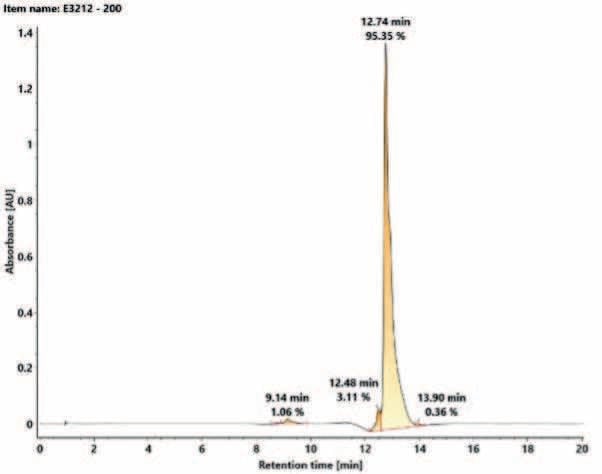
A customer recently compared the performance of a set of 200-mer oligonucleotides synthesized via the new method (Figure 1) with a control batch synthesized via the traditional method.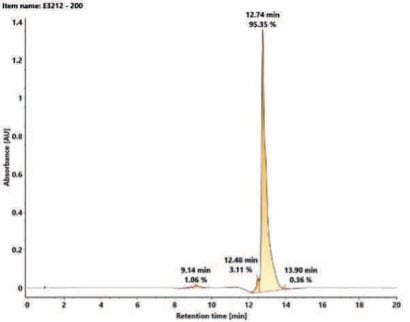 Figure 1. HPLC/MS of a 200-base long-chain oligonucleotide synthesized by the patented ATDBio methodology.
"They are much, much cleaner, and we are very happy with the quality. This is quite impressive"
Summary
Numerous areas of research and development, including genome editing; cloning and site-directed mutagenesis; validation of diagnostic assays; and the development of long read sequencing technologies, rely on the availability of highly pure long oligonucleotides of defined sequence. Often there is an additional requirement for the site-specific incorporation of chemical modifications into the oligonucleotide sequence. ATDBio, now a part of Biotage, has developed a patented approach to long oligonucleotides, allowing for the reproducible production of highly pure long oligonucleotides containing an unlimited range of chemical modifications.
Literature Number: AN976
