
This innovative SPE technique is used in applications where multiple suites of analytes with a broad polarity range are to be extracted simultaneously from a single water sample, such as organochlorine, triazine and organophosphate pesticides, or endocrine disrupters.
- Extract multiple suites with a single SPE cartridge
- Improve productivity
- Reduce costs
Samples containing multiple analyte suites of very different chemical characteristics can be efficiently extracted using layered cartridges. This means that a single sample can be collected and extracted in order to determine multiple analyte suites, whereas separate samples would be needed if more than one extraction cartridge was required. The layered cartridge approach can significantly reduce costs and improve productivity.
Depending on the polarity range of analytes to be extracted, cartridges with different layers are available.
The problem
Large, non-polar analytes such as some chlorinated pesticides, PAHs and PCBs can often be retained from aqueous samples using ISOLUTE® C4 or C8 (‘weakly retentive’) sorbents.
Smaller, more polar analytes such as acid herbicides often require much more retentive sorbents such as ISOLUTE® C18 or ENV+ for efficient extraction from aqueous samples.
But, if the more retentive sorbent is used to extract the large, non-polar analytes, they will be retained very strongly, and may be difficult to elute (requiring large elution volumes).
The solution
Layers of sorbent with different retention and elution characteristics can be combined in a single SPE cartridge to ensure efficient retention of analytes with a range of polarity/solubility.
When a less retentive sorbent is layered above a more retentive sorbent, the large, non-polar analytes will be retained on the top layer, while analytes requiring a more retentive phase will be retained on the bottom layer. This is illustrated in Figure 1.
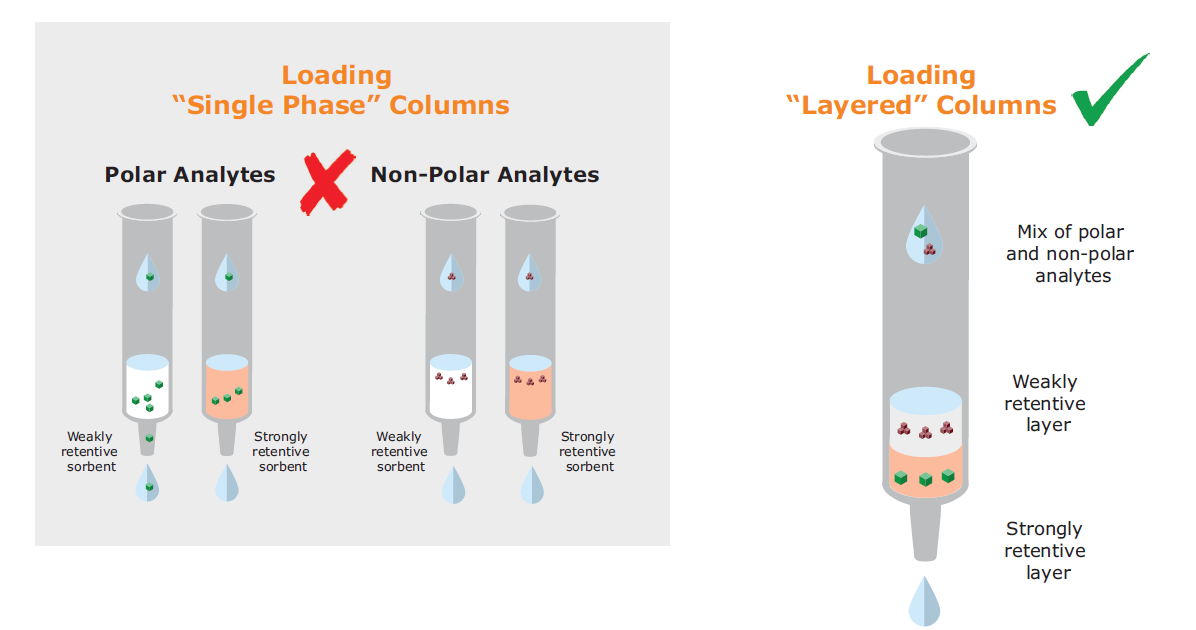
Figure 1: When polar species are loaded onto a single phase cartridge containing a ‘weakly retentive’ sorbent, they can breakthrough during load, ultimately leading to lower recoveries. When loading a mix of polar and non-polar analytes onto layered cartridges, non-polar species are trapped on the upper layer, and any more polar species that are not retained on the top layer will be trapped on the lower layer.
During elution, the larger, non-polar species are easily eluted from the less retentive upper layer, and are carried through the more retentive lower layer in the elution solvent without getting trapped. If these were retained on a single layered cartridge containing the more retentive phase only, they would be more difficult to elute and require the use of larger volumes of elution solvent. More polar, water soluble species are efficiently eluted from the lower layer together with the non-polar species, as the elution solvent passes through. This is illustrated in figure 2.
Example application
The layered cartridge approach was applied to the extraction of a broad range of organic pollutants from drinking water, including acid herbicides, base-neutral herbicides, PAHs, phthalate esters and phenolic compounds1.
Extraction method
SPE Cartridge: ISOLUTE® C8/ENV+ layered cartridge
In this cartridge, the less retentive ISOLUTE® C8 upper layer efficiently retains non-polar analytes such as large PAHs. The more retentive ISOLUTE® ENV+ layer retains polar species such as phenols and acid herbicides.
Sample Pre-treatment: Acidify sample to pH 2 with HCl. Add methanol (1%, v/v)
Cartridge: Methanol
Conditioning: Water
Cartridge: Up to 60 mL/min
Equilibration Sample Load: Acetone/ethyl acetate (1:1, v/v)
Following elution, the extract was evaporated to dryness and reconstituted in a solvent suitable for analysis. Each compound class was analysed separately, using optimized conditions.
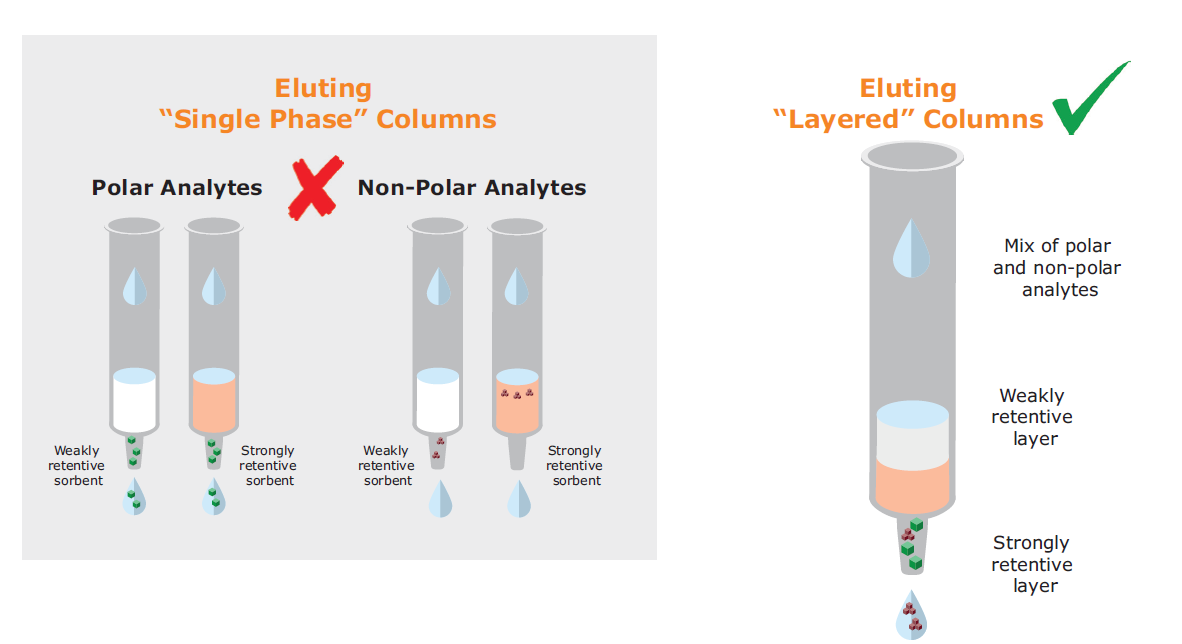
Figure 2: Non polar analytes can be difficult to elute from strongly retentive single phase cartridges. cartridges. When eluting a mix of polar and non-polar analytes from a layered cartridge, a suitable elution solvent can be used to elute the whole range of analytes in a small volume.
Typical analyte recovery
|
Analyte |
% Recovery |
Analyte |
% Recovery |
|
Base-neutral Herbicides |
2-methylphenol |
96 |
|
|
Metribuzin |
90 |
3-methylphenol |
96 |
|
Atrazine |
92 |
4-methylphenol |
96 |
|
Desethyl atrazine |
89 |
2-nitrophenol |
87 |
|
Ametrine |
90 |
2,4-dimethylphenol |
95 |
|
Desisopropyl atrazine |
85 |
2,4-dichlorophenol |
90 |
|
Terbutaline |
95 |
2,6-dichlorophenol |
90 |
|
Arachlor |
82 |
4-chloro-3-methylphenol |
86 |
|
Metolachlor |
95 |
2,4,6-trichlorophenol |
85 |
|
Propachlor |
80 |
2,4-dinitrophenol |
87 |
|
Molinate |
75 |
4-nitrophenol |
90 |
|
Propanil |
75 |
4,6-dinitro-2-Methylphenol |
90 |
|
Oxidiazon |
85 |
Pentachlorophenol |
85 |
|
Thiobencarb |
75 |
PAHs |
|
|
Acid Herbicides |
Naphthalene |
87 |
|
|
2,4-D |
86 |
Acenaphthalene |
90 |
|
MCPA |
95 |
Acenaphthene |
90 |
|
MCPB |
94 |
Fluorene |
92 |
|
MCPP |
92 |
Phenanthrene |
94 |
|
Bentazone |
88 |
Anthracene |
95 |
|
Phthalate Esters |
Fluoranthene |
95 |
|
|
Diethylhexyl phthalate |
92 |
Pyrene |
96 |
|
Dibutyl phthalate |
95 |
Benzo(a)anthracene |
96 |
|
Benzylbutyl phthalate |
96 |
Chrysene |
96 |
|
Diethyl phthalate |
98 |
Benzo(a)fluoranthene |
98 |
|
Dimethyl phthalate |
98 |
Benzo(k)fluoranthene |
95 |
|
Dioctyl phthalate |
94 |
Benzo(a)pyrene |
95 |
|
Phenols |
Indeno(1,2,3 cd)pyrene |
93 |
|
|
Phenol |
84 |
Dibenzo(a,h)anthracene |
95 |
|
2-chlorophenol |
90 |
Benzo(ghi)perylene |
96 |
Layered cartridge ordering information
Depending on the components of the analyte suite, choose a cartridge with the lower layer suitable for extraction of the most polar analytes.
For analyte suites containing mainly very non-polar analytes, with no polar analytes (such as acid herbicides), the ISOLUTE® C4/C18(EC) cartridge is recommended. For suites that include analytes which do not retain well on C18 type sorbents, cartridge configurations containing ISOLUTE® ENV+ are recommended.
|
Part Number |
Description |
Quantity |
|
934-0040-C |
ISOLUTE® C8/ENV+ 400 mg/6 mL |
30 |
|
935-0040-C |
ISOLUTE® C18/ENV+ 400 mg/6 mL |
30 |
|
931-0020-B |
ISOLUTE® C4/ENV+ 200mg/3 mL |
50 |
References
- Davi et al, Intern. J. Environ. Anal. Chem 74 (1-4) 155-166
Literature number: PPS428
