
Introduction
The environmental persistence of pharmaceuticals is of increasing interest, with little known regarding removal during wastewater treatment. This study investigates the potential of commercially available QuEChERS kits for the extraction and clean-up of a suite of common over-the-counter (OTC) pharmaceuticals from water and sludge cake. Extracts are analysed using LC-MS/MS.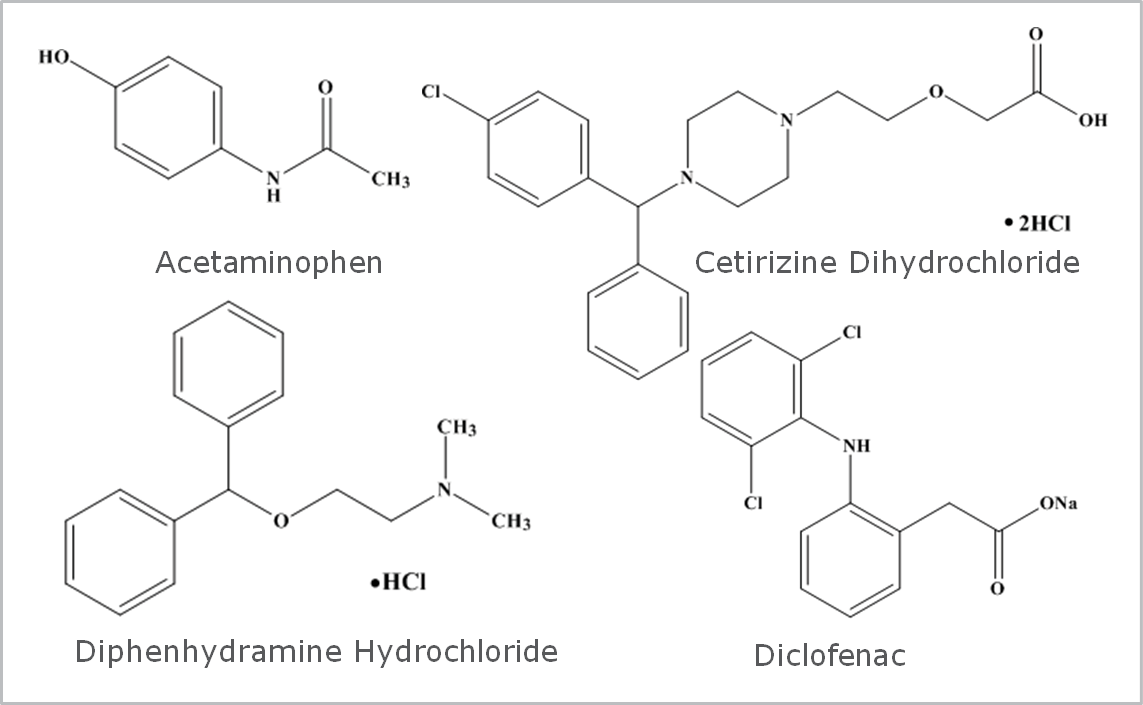
Figure 1. Structures of over-the-counter (OTC) drugs
ISOLUTE® QuEChERS products provide clean and efficient extraction for a variety of complex samples, reducing sample preparation to approximately 20 minutes to extract concentration (evaporation stage)
Analytes
Acetaminophen, cetirizine dihydrochloride, diphenhydramine hydrochloride and diclofenac.
Sample preparation procedure
Format:
QuEChERS 50 mL Centrifuge Tube (Q0000-50V)
ISOLUTE® QuEChERS 15 g EN Extraction Tubes (Q0020-15V)
QuEChERS EN Fruit and Vegetable (Q0035-15V)
QuEChERS EN Waxed Fruit and Vegetables (Q0060-15V)
QuEChERS EN Pigmented Fruit and Vegetables (Q0080-15V)
QuEChERS EN Highly Pigmented Fruit and Vegetables (Q0090-15V)
Sample preparation:
3.76 mL water, 20 µL of cetirizine, diphenhydramine and diclofenac and 140 µL of acetaminophen were dispensed into a 50 mL centrifuge tube. For the sludge experiments, 2.5 g of lyophilised sludge was weighed into the tube before the addition of water and pharmaceuticals in the quantity described above. 10 mL of neat acetonitrile was added, along with the contents of the EN extraction tube. The tube was shaken manually for 1 minute then centrifuged at 4000 rpm for 5 minutes.
Dispersive-SPE:
The supernatant (approx. 7 mL) was transferred to one of the four d-SPE kits, vortexed for 1 minute at 1400 rpm, then centrifuged at 4000 rpm for 5 minutes. The final extracted supernatant was transferred to a clean 15 mL centrifuge tube, and evaporated to dryness under nitrogen. The sample was re-constituted in 1.875 mL of 50:50 acetonitrile and water.
Calibration line preparation:
For each compound, a 1 mg/mL calibration solution was prepared by diluting a 10 mg/mL stock solution to a volume of 1.5 mL. Seven calibration standards were made over a linear range.
HPLC conditions
Instrument:
Thermo Finnigan Surveyor Autosampler with an MS Pump
Cartridge:
Thermo Hypersil Gold, 3 µm, 100 x 1 mm cartridge with a Hypersil C18 3µm guard cartridge
Mobile phase:
A: 0.1% formic acid in water B: acetonitrile
Flow rate:
50 µL/minute
Injection:
5 µL
Gradient:
Initial 95% A: 5% B, hold for 2 minutes Linear ramp to 100% B in 28 minutes 100% B, hold for 10 minutes
Linear ramp to initial conditions in 1 minute Hold for 10 minutes
Total run time:
51 minutes
Sample temperature:
4 °C
|
|
WATER |
SLUDGE CAKE |
|
Compound |
Retention |
Retention |
|
|
time (min) |
time (min) |
|
Acetaminophen |
1.59 |
1.75 |
|
Acetaminophen-(methyl-d3) [IS] |
1.59 |
1.75 |
|
Diphenhydramine Hydrochloride |
15.64 |
15.40 |
|
Cetirizine Dihydrochloride |
18.13 |
17.90 |
|
4((4-Chlorophenyl)Phenylmethyl)-1- Piperazine Ethanol Dihydrochloride [IS] |
17.75 |
17.45 |
|
Diclofenac |
22.93 |
22.95 |
MS conditions
Instrument:
Thermo Finnigan LCQ Classic
Ionisation mode:
ESI+
Desolvation temperature:
200 °C
ESI source settings
|
Parameter |
Value |
|---|---|
|
Sheath gas flow rate |
85 arbitrary units |
|
Aux gas flow rate |
0 |
|
Spray voltage |
3.5 kV |
|
Capillary temperature |
200 °C |
|
Capillary voltage |
10 V |
|
Tube lens offset |
5 V |
|
Drug |
MW (g/mol) |
m/z |
SRM Transition |
|---|---|---|---|
|
Acetaminophen |
151.06 |
152 |
152 → 110 |
|
Cetirizine Dihydrochloride |
461.81 |
389 |
389 → 201 |
|
Diphenhydramine Hydrochloride |
291.82 |
256 |
256 → 167 |
|
Diclofenac Sodium |
318.31 |
296 |
296 → 277 |
Results
The EN Waxed Fruit and Vegetable d-SPE kit (P/N Q0060-15V) was found to give the best results in terms of overall analyte recovery and extract cleanliness. However, recoveries of certain drugs (diclofenac sodium and cetirizine dihydrochloride) were relatively low, possibly due to their selective retention on the d-SPE sorbent.
Significant matrix effects were observed for extracts from sewage sludge compared with water (data not shown). Example chromatograms for extracts of a) water and b) sludge cake are shown in Figures 2 and 3 respectively. An example of the calibration line constructed for acetaminophen in water is shown in Figure 4.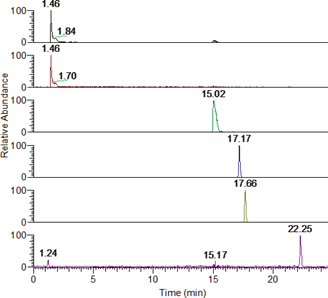
Figure 2. Extracted precursor ion chromatograms for over-the-counter (OTC) drugs in water in positive ion mode after preparation with EN Waxed Fruit and Vegetable d-SPE kit
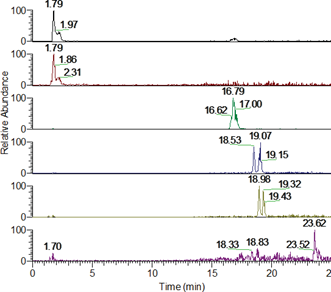
Figure 3. Extracted precursor ion chromatograms for over-the-counter (OTC) drugs in sludge in positive ion mode after preparation with EN Waxed Fruit and Vegetable d-SPE kit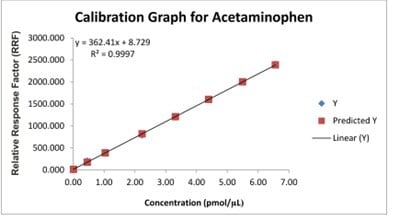
Figure 4. Typical calibration graph for Acetaminophen in water expressed on a linear scale
Recovery calculations were based upon the ratio of peak area for the spike before extraction and the spike after extraction experiments, with the latter adjusted to account for the evaporation step in the sample preparation method.
|
Compound |
WATER |
SLUDGE CAKE |
|
|
Recovery % |
R2 |
Recovery % |
|
|
Acetaminophen |
61.04 |
0.9997 |
52.69 |
|
Cetirizine Dihydrochloride |
16.08 |
0.9906 |
3.35 |
|
Diphenhydramine Hydrochloride |
57.01 |
0.9932 |
46.19 |
|
Diclofenac |
18.79 |
0.9929 |
15.55 |
Coefficient of determination (r2) calculations were based on calibration lines including a “zero” standard, spiked standards between 200–2400 pmol/µL for acetaminophen, 20–240 pmol/µL for cetirizine, diphenhydramine and 20-140 pmol/µL for diclofenac. The concentrations used for the internal standards acetaminophen-(methyl-d3) and 4((4-chlorophenyl) phenylmethyl)-1-piperazine ethanol dihydrochloride were 402 and 29 pmol/µL respectively.
Conclusions
Compared to existing clean-up methods, the QuEChERS was found to be quick and simple to perform. Although not optimized for clean-up of the target matrices, the method described in this application note achieves reasonable recoveries of all four compounds in both water and sludge cake. Despite significant matrix effects, limits of detection of between 3 and 12 µg/mL were obtained using a selected-reaction monitoring method and targeted precursor ion scan, indicating sufficient selectivity and sensitivity for detection in an environmental matrix using multiple acquisition modes.
This study suggests that a modified form of QuEChERS may be suitable for extraction and clean-up of pharmaceuticals in complex environmental matrices. Further work should investigate the use of alternative sorbent mixes in the d-SPE step to enhance clean-up and further reduce matrix effects.
Additional notes
The extraction with the sludge samples resulted in a final extract that ranged between an orange to dark yellow in colour (as shown below). An oily, lattice-type film was also observed on the surface of the sample, which remained in the clean-up tube after aliquoting a sample for the LC-MS/MS analysis.
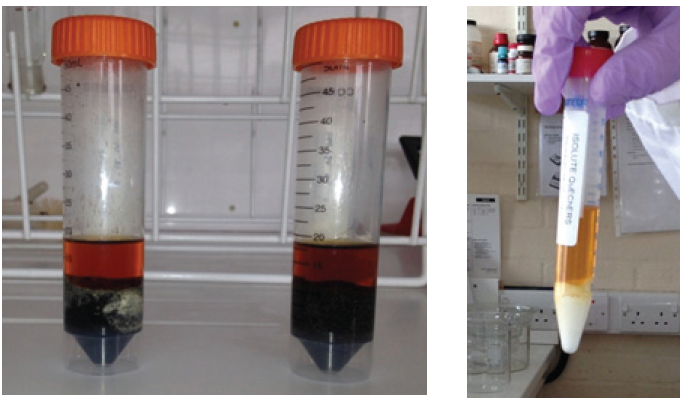
Figure 5. Left: Sludge extract before d-SPE. Right: Sludge extract after d-SPE
Ordering information
|
Part Number |
Description |
Quantity |
|
Q0020-15V |
QuEChERS EN Extraction Tube |
25 |
|
Q0035-15V |
QuEChERS EN Fruit and Vegetable |
25 |
|
Q0060-15V |
QuEChERS EN Waxed Fruit and Vegetable |
25 |
|
Q0080-15V |
QuEChERS EN Pigmented Fruit and Vegetable |
25 |
|
Q0090-15V |
QuEChERS EN Highly Pigmented Fruit and Vegetable |
25 |
|
Q0000-50V |
QuEChERS 50 mL Centrifuge Tube With Rack |
25 |
Acknowledgements
This work is part-funded by the European Social Fund (ESF) through the European Union’s Convergence programme administered by the Welsh Government. The authors thank Dŵr Cymru Welsh Water for assisting with the study.
Literature number: AN831
