
For research use only. not for use in diagnostic procedures.
Rebecca Mastrovito M.S. is currently employed as a Research and Development Associate II at NMS Labs in Horsham, PA, USA. For the past four years, she has been responsible for the develop- ment of their novel psychoactive substance portfolio. She has been recently published in a peer-reviewed journal for her work with phosphatidylethanol.
Introduction
Synthetic Cannabinoids are a sub-category of Novel Psychoactive Substances (NPS). Novel psychoactive substances refer to emerging substances that have been structurally modified from existing regulated substances. Synthetic cannabinoids are structurally related to tetrahydrocannabinol (THC), agonists of the CB1 and CB2 receptors. Synthetic cannabinoids are sold under a wide range of names such as K2, Spice, Legal Highs1. They can be easily found online and in convenience stores as dried plant material or liquids for e-cigarettes. The EMCDDA identified 190 new synthetic cannabinoids that were reported in 2019 as part of the early warning system1. These compounds have been synthetized specifically to circumvent existing laws regarding drug control and scheduling guidelines. These substances pose a significant public health concern due to their unknown potency and wide array of side effects. According to the EMCDDA, symptoms including agitation, nausea, psychosis, stroke, mass poisoning, and even death 2.
The development of a novel high-pressure liquid chromatography/ triple quad mass spectrometry method allows for the efficient and accurate identification of 12 synthetic cannabinoids in whole blood by LC-MS/MS. Samples are fortified with internal standard, buffered, and extracted using Supported Liquid Extraction (SLE).
Analytes
APP BINACA, ADMB FUBINACA, 5-Fluoro CUMYL P7AICA, 4 cyano CUMYL BINACA, 5-Fluoro MDMB PICA, 4-Fluoro MDMB BINACA, ADMB CHMINACA, MMB-FUBINACA, 5-Fluoro ADB/5-Fluoro-AEB, 5-Fluoro CUMYL PINACA, MDMB-4en-PINACA, CUMYL PeGACLONE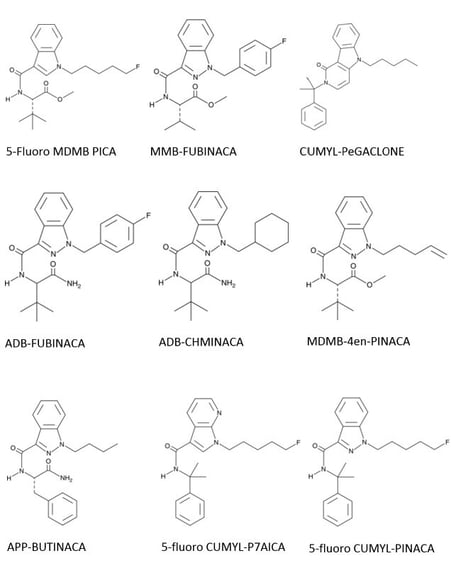 Figure 1. Synthetic cannabinoid structures.
Sample preparation procedure
Format
ISOLUTE® SLE+ 1 mL Supported Liquid Extraction Cartridges, Part Number 820-0140-CG.
Sample pre-treatment
Whole blood samples were fortified and 500 μL of sample, calibrators, and controls were aliquoted into extraction tubes. Each sample was fortified with 25 μL of internal standard and vortexed to mix. Samples were buffered with 500 μL of deion- ized water and vortexed.
Sample loading
750 μL of buffered sample was loaded onto the SLE+ cartridge with an appropriate collection tube in place. Positive pressure (2–5 psi) was applied using a Biotage PRESSURE+ 48 Positive Pressure Manifold to initiate flow of sample on the cartridge.
The sample was allowed to absorb for 5 minutes.
Analyte elution
Add 2 mL of ethyl acetate and gravity elute. Using positive pressure, push through any remaining solvent. Repeat, by adding 2 mL ethyl acetate and gravity elute. Using positive pressure, push through any remaining solvent.
Post extraction
The extracts were evaporated using a Biotage TurboVap® LV utilizing a ramped flow method: 1.5 L/min for 5 min and then 2.5 L/min until dryness. The water bath temperature was set at 30 °C.
Reconstitution
Samples were reconstituted by adding 200 μL of 50:50 (v/v) methanol/deionized water with 1% formic acid.
HPLC conditions
Instrument
Waters UPLC® Acquity System Xevo TQS (Waters, Milford, MA, USA)
Column
Waters Acquity BEH C18 (100 mm x 2.1mm, 1.7 µm)
Mobile phase
A: High Purity Deionized Water with 0.1% Formic acid B: High Purity Methanol and Acetonitrile (80:20)
Flow rate
0.4 mL/min
Injection volume
10 μL
Column temperature
50 °C
Table 1. HPLC gradient conditions.
|
Step |
Time (min.) |
Flow Rate (mL/min.) |
%A |
%B |
|
1 |
0 |
0.4 |
60 |
40 |
|
2 |
3 |
0.4 |
20 |
80 |
|
3 |
4 |
0.4 |
10 |
90 |
|
4 |
4.1 |
0.4 |
5 |
95 |
|
5 |
4.5 |
0.4 |
5 |
95 |
MS conditions
All experiments were carried out on a UPLC® system (Waters Acquity System, Waters, Manchester, UK) coupled to a tandem- quadrupole mass spectrometer (Xevo TQS, Waters, Milford, MA, USA). MS/MS detection was performed utilizing electrospray ionization (ESI) operating in positive ion mode with multiple reaction monitoing (MRM). The capillary voltage was set to 1.0 kV, the source temperature was 150 °C and the nitrogen desolvation gas was heated to 400 °C with a flow rate of 800L/h.
Table 2. MS conditions and retention times for target analytes.
|
Analyte |
M+1 |
Collision |
RT |
|
APP BINACA |
365.3 > 201.2 |
24 |
2.47 |
|
365.3 > 320.3 |
14 |
||
|
ADMB FUBINACA |
383.1 > 253 |
24 |
2.48 |
|
383.1 > 109 |
46 |
||
|
5F CUMYL P7AICA |
368.2 > 250 |
14 |
2.65 |
|
368.2 > 119 |
32 |
||
|
4 cyano CUMYL BINACA |
361.1 > 226.1 |
22 |
2.73 |
|
361.1 > 243.1 |
10 |
||
|
5F MDMB PICA |
377.2 > 232.1 |
16 |
3.00 |
|
377.2 > 144.1 |
38 |
||
|
4F MDMB BINACA |
364.3 > 219.2 |
24 |
3.05 |
|
364.3 > 304.3 |
14 |
||
|
ADMB CHMINACA |
371.1 > 326.1 |
16 |
3.12 |
|
371.1 > 241.1 |
26 |
||
|
MMB-FUBINACA |
384.3 > 253.2 |
22 |
3.13 |
|
384.3 > 109.1 |
38 |
||
|
5F ADB/5F-AEB |
378.2 > 145.1 |
38 |
3.28 |
|
378.2 > 233.2 |
22 |
||
|
5F CUMYL PINACA |
368.1 > 233 |
18 |
3.40 |
|
368.1 > 213 |
28 |
||
|
MDMB-4en-PINACA |
358.2 > 298.2 |
24 |
3.65 |
|
358.2 > 171.1 |
16 |
||
|
CUMYL PeGACLONE |
373.2 > 255 |
10 |
3.79 |
|
373.2 > 119 |
26 |
Results/Discussion
Analytical standards from Cayman Chemical (Ann Arbor, Michigan) were prepared in methanol and further diluted to the respective concentrations for calibrators and controls (see Table 3). A bulk serum cut-off calibrator, positive and negative controls were prepared by aliquoting 50 μL of the bulk serum material into 950 μL of whole blood.
Chromatographic separation is achieved over an elution gradient using a C18 cartridge outlined in Table 1. The extracted ion chromatograms (see Figure 2) and the observed retention times for all of the analytes are listed in Table 2. The observed recovery was > 60% for all compounds shown in Figure 3.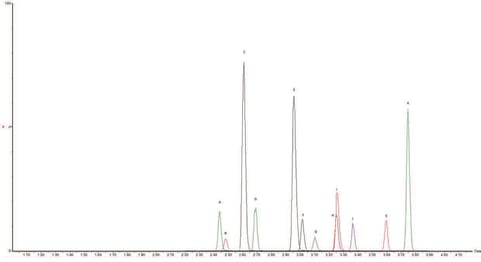 Figure 2. Method Chromatograph. (A) ADMB FUBINACA (B) APP BINACA () 5-Fluoro CUMYL P7AICA (D) 4-cyano CUMYL BINACA (E) 5-Fluoro MDMB PICA (F) 4-Fluoro MDMB BINACA (G) MMB-FUBINACA (H) 5-Fluoro ADB/5- Fluoro EMB (I) ADMB CHIMINACA (J) 5-Fluoro CUMYL PINACA (K) MDMB 4en PINACA (L) CUMYL PeGACLONE.
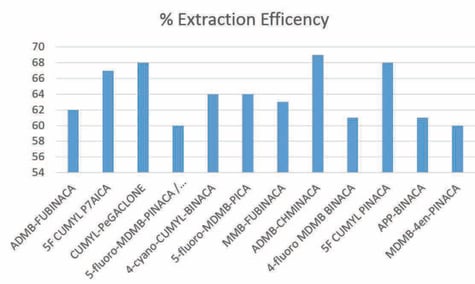 Figure 3. Recoveries for synthetic cannabinoids in blood at reporting limit using ISOLUTE® SLE+ 1 mL cartridge.
Table 3. Reporting limits for all respective compounds.
|
Analyte |
Reporting Limit (ng/mL) |
|
APP BINACA |
0.1 |
|
4 cyano CUMYL BINACA |
0.1 |
|
5F MDMB PICA |
0.1 |
|
4F MDMB BINACA |
0.1 |
|
ADMB CHMINACA |
0.1 |
|
MMB-FUBINACA |
0.1 |
|
5F CUMYL PINACA |
0.1 |
|
MDMB-4en-PINACA |
0.1 |
|
5F ADB/5F-AEB |
0.2 |
|
5F CUMYL P7AICA |
0.5 |
|
CUMYL PeGACLONE |
0.5 |
|
ADMB FUBINACA |
1.0 |
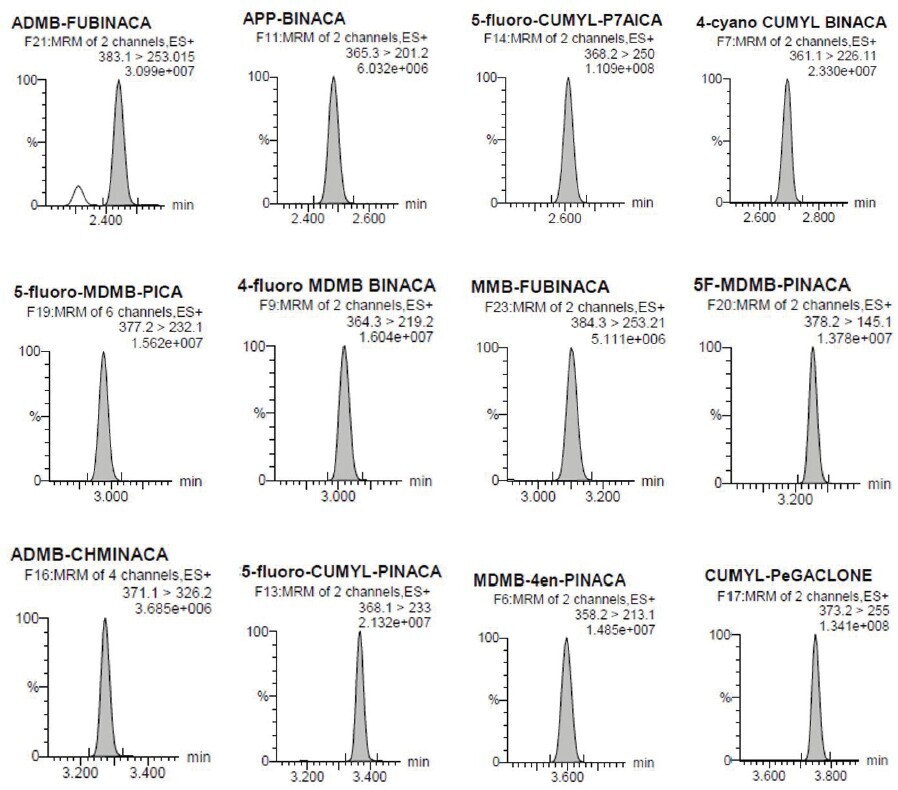 Figure 4. Individual chromatographs at the LOQ.
Conclusion
This ISOLUTE® SLE+ extraction method with analysis by LC-MS/MS extracted the novel synthetic cannabinoids from whole blood with recoveries of greater than 60%.
Ordering information
|
Part Number |
Description |
Quantity |
|
820-0140-CG |
ISOLUTE® SLE+ Supported Liquid Extraction Cartridges 1 mL Sample Volume (Tabless) |
30 |
|
415000 |
Biotage TurboVap® LV |
1 |
|
PPM-48 |
Biotage® PRESSURE+ 48 Positive Pressure Manifold |
1 |
References
- EU Drug Markets Report (2019). Lisbon, Portugal: European Monitoring Centre for Drugs and Drug Addiction; http://www.emcdda.europa.eu/system/files/publications/12078/20192630_TD0319332ENN_PDF.pdf. DOI: 10.2810/796253TD (Accessed 2/7/2020)
- PERSPECTIVES ON DRUGS: Synthetic cannabinoids in Europe (2019). Lisbon, Portugal: European Monitoring Centre for Drugs and Drug Addiction; http://www.emcdda.europa.eu/ system/files/publications/2753/POD_Synthetic%20canna- binoids_0.pdf (Accessed 2/7/2020)
Literature Number: AN944
