
Introduction
Analysis of tetrahydrocannabinol (THC) and its isomers is crucial for understanding their pharmacological effects and legal implications of cannabis use, especially in clinical testing, forensic toxicology, and sport antidoping. THC, the primary psychoactive component of cannabis, exists in several isomeric forms, including Δ9-THC, Δ8-THC, Δ10-THC each with distinct pharmacokinetic and pharmacodynamic properties (figure 1). Accurate identification and quantification of these isomers are essential for evaluating impairment, exposure, or intoxication. However, their analysis presents significant challenges due to their isobaric nature. Additionally, the complex nature of biological matrices such as whole blood adds to the difficulty of extracting and quantifying these compounds with high accuracy and precision.
This application note demonstrates an optimized extraction procedure of Δ9-THC, Δ8-THC, Δ10-THC, and the metabolites 11-hydroxy-THC and THC-COOH from whole blood using ISOLUTE® SLE+ followed by UHPLC-MS/MS analysis comparing two analytical column chemistries, a fluorophenyl and a biphenyl.
Analytes
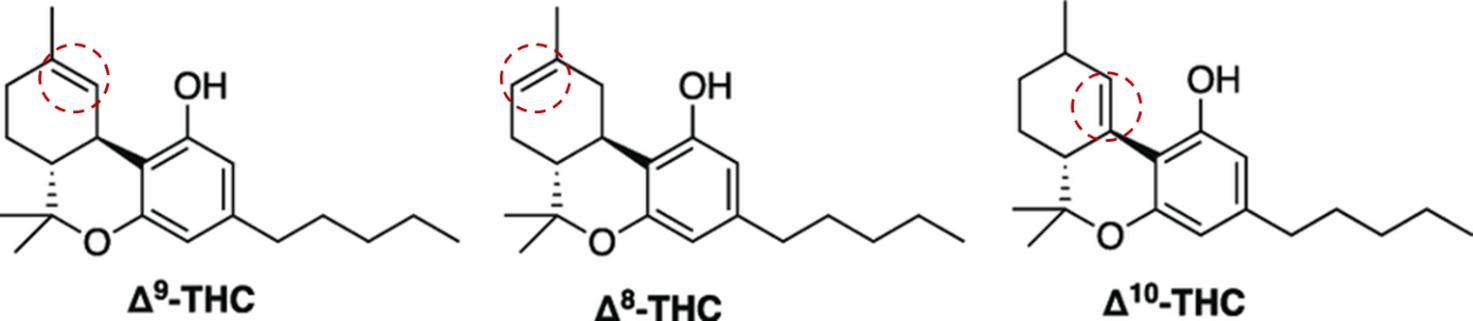
Figure 1. Structure of Δ8, Δ9, and Δ10 tetrahydrocannabinol (THC) isomers.
Sample preparation procedure
Format
ISOLUTE® SLE+ 400 µL capacity supported liquid extraction plate; Part number: 820-0400-P01.
Sample pre-treatment
100 µL aliquots of whole blood sample (Human K2EDTA) were spiked with analytes at low (5 ng/ml) and mid (50 ng/ml) concentrations. Samples were pretreated with 150 µL 0.1% formic acid and mixed well (by vortex or repeated pipetting).
Sample extraction
Load 225 µL of pretreated whole blood onto the ISOLUTE® SLE+ plate. Ensure that the sample covers the entire area of the ISOLUTE® SLE+ top frit. Using a Biotage® PRESSURE+ 96 positive pressure manifold, apply a pulse of pressure at 2-5 psi to load samples onto the sorbent. Allow samples to flow under gravity for 5 minutes.
Analyte elution
Apply 750 µL of ethyl acetate and gravity-elute into a collection plate. Add an additional 750 µL of ethyl acetate and gravity-elute into the same collection plate. Using positive pressure (15 psi, 30 seconds), push through any remaining solvent.
Post extraction
Evaporate the extract on a TurboVap® 96 Dual evaporator using the following parameters: N2 flow 50 L/min; temperature 40°C (gas) and 60°C (plate); and plate height 55 mm. Reconstitute the dried extracts with 200 µL methanol for LC-MS/MS analysis.
Analytical conditions
UHPLC conditions
Instrument: Shimadzu Nexera X2
Column 1: Restek fluorophenyl 2.7 µm (100 x 3.0 mm)
Mobile phase:
-
Mobile phase: A: 0.1 % formic acid in water
-
Mobile phase B: 0.1 % formic acid in acetonitrile
- Injection rinse solvents: water/ acetonitrile/ methanol/ isopropanol (1/1/1/1, v/v)
Oven temperature: 20◦C
Injection volume: 5 µL
Table 1. Condition 1 analytical elution gradient
|
Time |
%B |
Flow (mL/min) |
Gradient |
|
0.1 |
64 |
0.8 |
Isocratic |
|
6.5 |
64 |
0.8 |
Isocratic |
|
6.6 |
68 |
0.8 |
Linear ramp |
|
13.0 |
68 |
0.8 |
Isocratic |
|
13.1 |
100 |
0.8 |
Linear ramp |
|
14.0 |
100 |
0.8 |
Isocratic |
|
14.1 |
64 |
0.8 |
Linear |
|
16.0 |
64 |
0.8 |
Stop |
Condition 2:
Column: Restek Biphenyl, 2.7 µm, 100 x 2.1 mm CAT
Mobile phase:
-
Mobile phase A: 0.1% formic acid in water
-
Mobile phase B: 0.1% formic acid in acetonitrile-methanol (50:50, v/v)
-
Injection rinse solvents: Water/ acetonitrile/ methanol/ isopropanol (1/1/1/1, v/v)
Oven temperature: 10⸰C
Injection volume: 5 µL
Table 2. Condition 2 analytical elution gradient
|
Time |
% B |
Flow (ml/min) |
Gradient |
|
0.1 |
60 |
0.4 |
Isocratic |
|
15.0 |
60 |
0.4 |
Isocratic |
|
15.1 |
100 |
0.4 |
Linear |
|
16.1 |
100 |
0.4 |
Isocratic |
|
16.2 |
60 |
0.4 |
Linear |
|
18.0 |
60 |
0.4 |
Stop |
MS/MS conditions
Instrument Sciex 5500 MSD (Triple Quad)
Source temp: 600ᵒC
IonSpray Voltage (IS): 4500 kV
Curtain gas: 40
Collision gas (CAD): 8
Source gases: GS1 60 psi/GS2 60 psi
Table 3. Ion transition for MRM acquisition
|
g/mole |
MRM Transition (m/z) |
DP (volts) |
EP (volts) |
CE (volts) |
CXP (volts) |
|
|
Cannabigerol |
316.5 |
317.5→193.14 |
116.0 |
10.0 |
23.0 |
4.0 |
|
Δ8-THC |
314.5 |
315.18→193.10 |
81.0 |
10.0 |
29.0 |
6.0 |
|
Δ9-THC |
314.5 |
315.18→193.01 |
81.0 |
10.0 |
29.0 |
6.0 |
|
∆10-THC |
314.5 |
315.18→193.11 |
81.0 |
10.0 |
29.0 |
6.0 |
|
THC-COOH |
344.4 |
343.00→299.17 |
-165.0 |
-10.0 |
-28.0 |
-13.0 |
|
11-Hydroxy-THC |
330.4 |
329.10→268.10 |
-100.0 |
-10.0 |
-52.0 |
-7.0 |
Acquisition parameters: Dwell time: 200 msec
Results and discussions
Recovery and matrix effects
Extraction performance was investigated by comparing recovery and matrix effects using the following elution solvents: MTBE (750 µL x 2), ethyl acetate (EtOAc) (750 µL x 2), 750 µL EtOAc followed by 750 µl hexane, and 750 µL hexane followed by 750 µL EtOAc . While these four elution protocols yielded similar matrix effects, EtOAc achieved the highest recoveries of analytes (figure 2A and 2B).
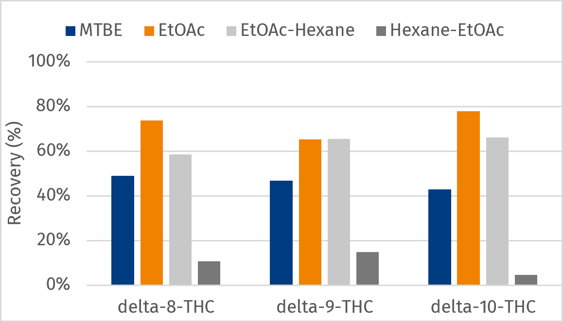
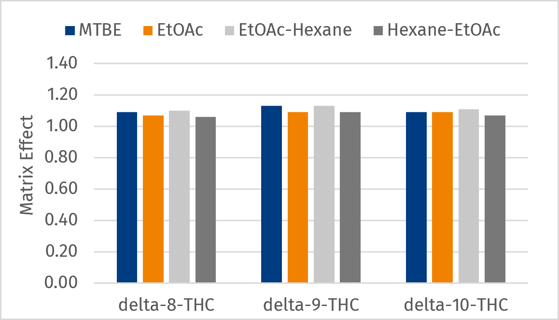
Figure 2A. Extraction recovery and matrix effects for Δ8-, Δ9-, Δ10-THC comparing elution solvents.
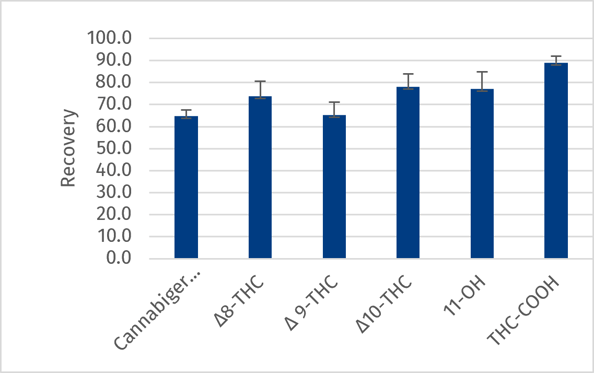
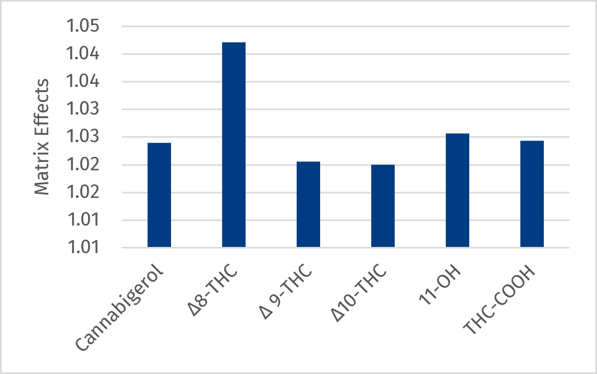
Figure 2B. Optimized extraction recovery and matrix effects for Δ8-, Δ9-, ∆10-THC and metabolites. (%RSD shown as error bars (n=3)).
The optimized extraction procedure using ISOLUTE® SLE+ effectively removed more than 90% of the phospholipids present compared to the protein precipitation method (figure 3).
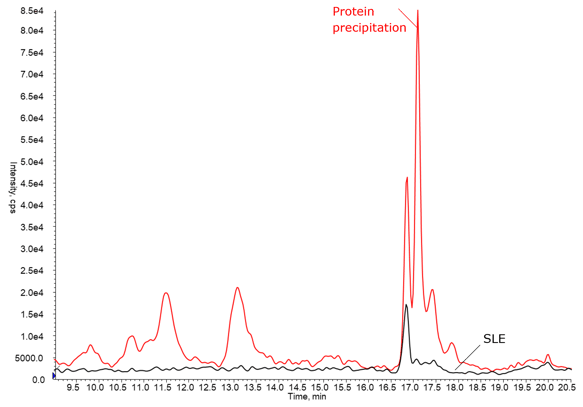 Figure 3. Phospholipids removal by ISOLUTE SLE+ (black) compared to protein precipitation (red).
Good linearity was achieved for all isomers and metabolites (r2=0.999, figure 4).
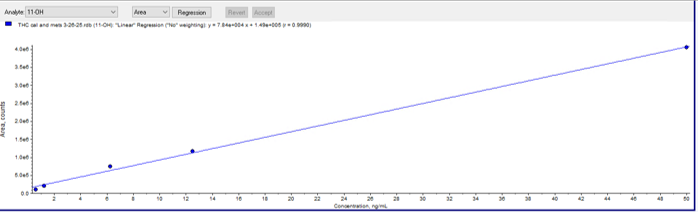
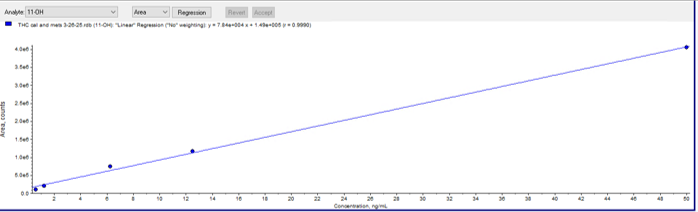
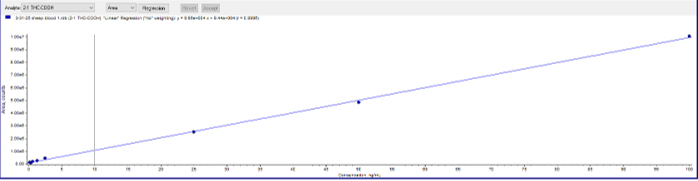 Figure 4. Representative calibration curves for Δ8-THC, Δ9-THC, 11-hydroxy-THC, and THC-COOH.
UHPLC conditions
One of the challenges in THC analysis is to achieve baseline separation for isomers such as Δ8-THC, Δ9-THC, and Δ10-THC in the analytical method. We compared the Restek Fluorophenyl and Biphenyl columns for their performance in separating these isomers. The Fluorophenyl column provides better resolution for THC isomeric forms than the Biphenyl column. Moreover, a lower oven temperature is more effective in separating the THC isomers for both columns (figure 5). Baseline separation for the THC isomers can also be achieved with a Biphenyl column using isocratic elution at 10◦C.
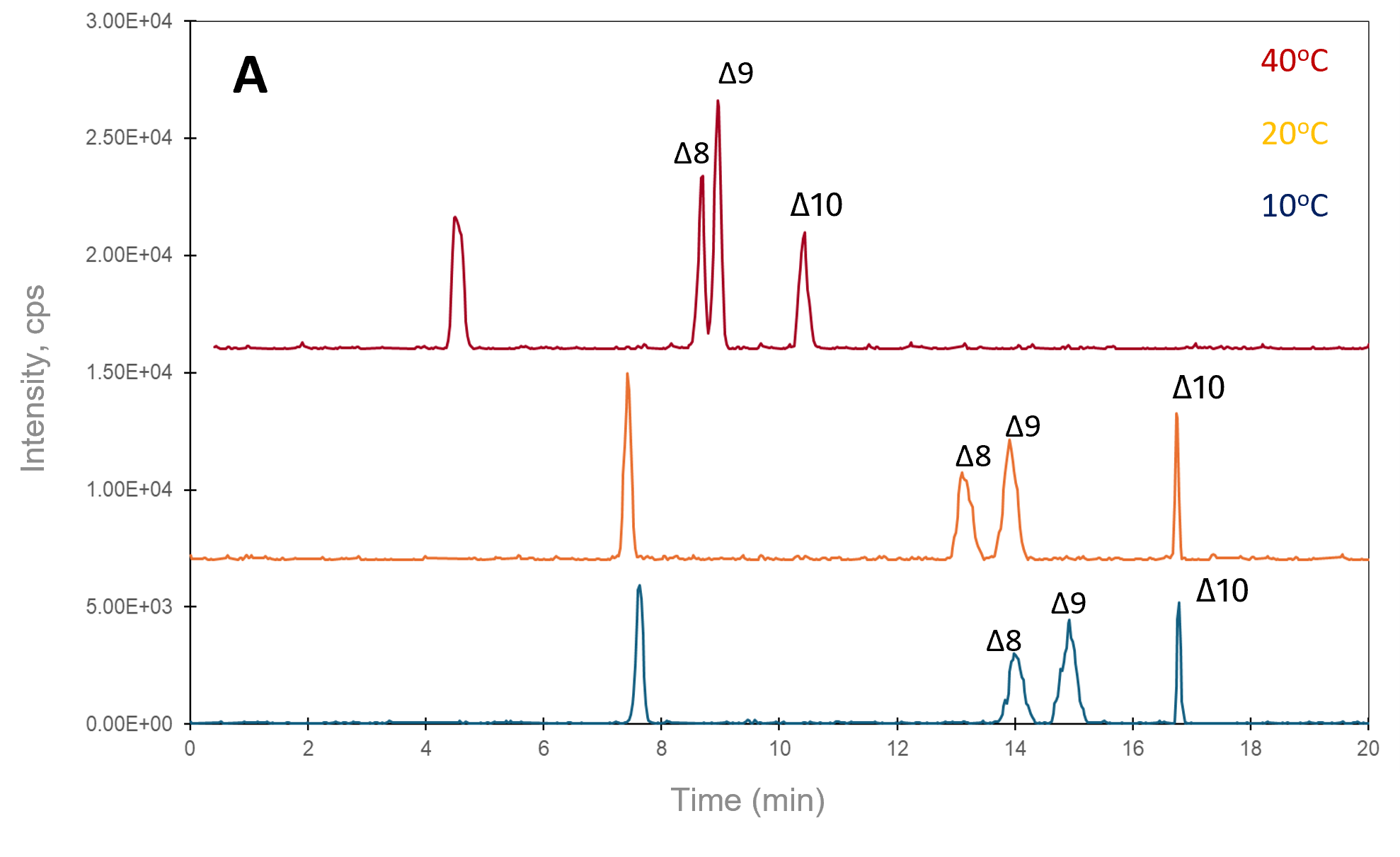
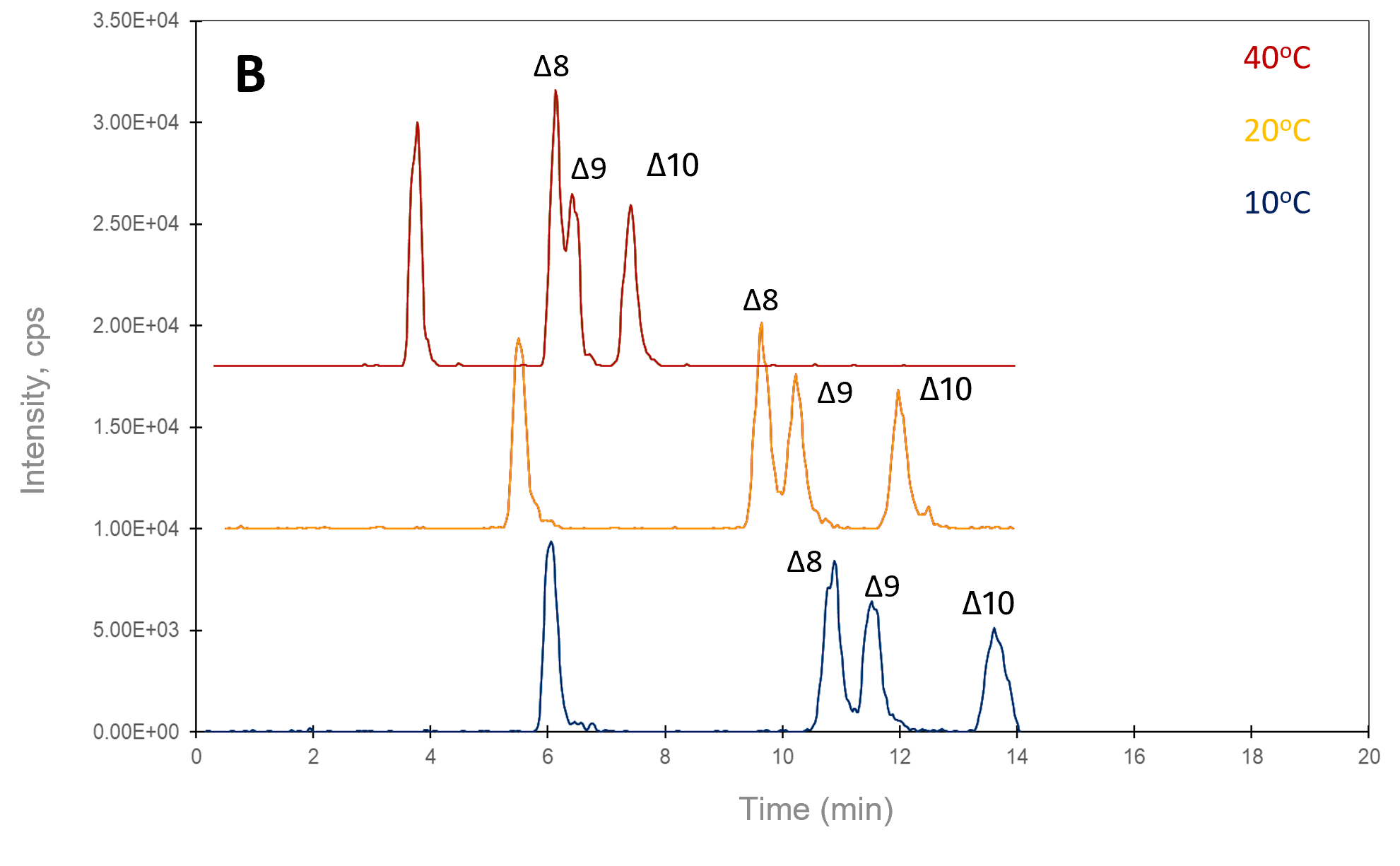 Figure 5. Impact of oven temperature on the separation of Δ8-, Δ9-, Δ10-THC using a Fluorophenyl (A) and Biphenyl (B) columns.
Conclusion
This ISOLUTE® SLE+ extraction method is a simple and effective technique for extracting the Δ8-THC, Δ9-THC, Δ10-THC isomers and the common metabolites such as 11-hydroxy-THC and THC-COOH from whole blood samples prior to LC-MS/MS analysis. The Fluorophenyl column with lower oven temperature (20◦C) provided optimal separation for the THC isomers.
Literature number: AN1025
