
Why do we need sample preparation?
There are very few techniques that can reliably analyze raw samples. Components in the sample matrix frequently interfere with analysis and mask analytes, especially in
chromatographic analyses. The solution is to perform sample preparation that can bring significant benefits to the analytical laboratory:
- More accurate results
- Improved Quality Control charts
- Lower detection limits
- Less instrument downtime
- Fewer reruns
Typical workflows in the environmental laboratory depend on the sample type.
Sample pre-treatment
For liquid samples, pre-treatment might include filtration to remove particulates or pH adjustment prior to extraction by liquid-liquid extraction or solid phase extraction (SPE).
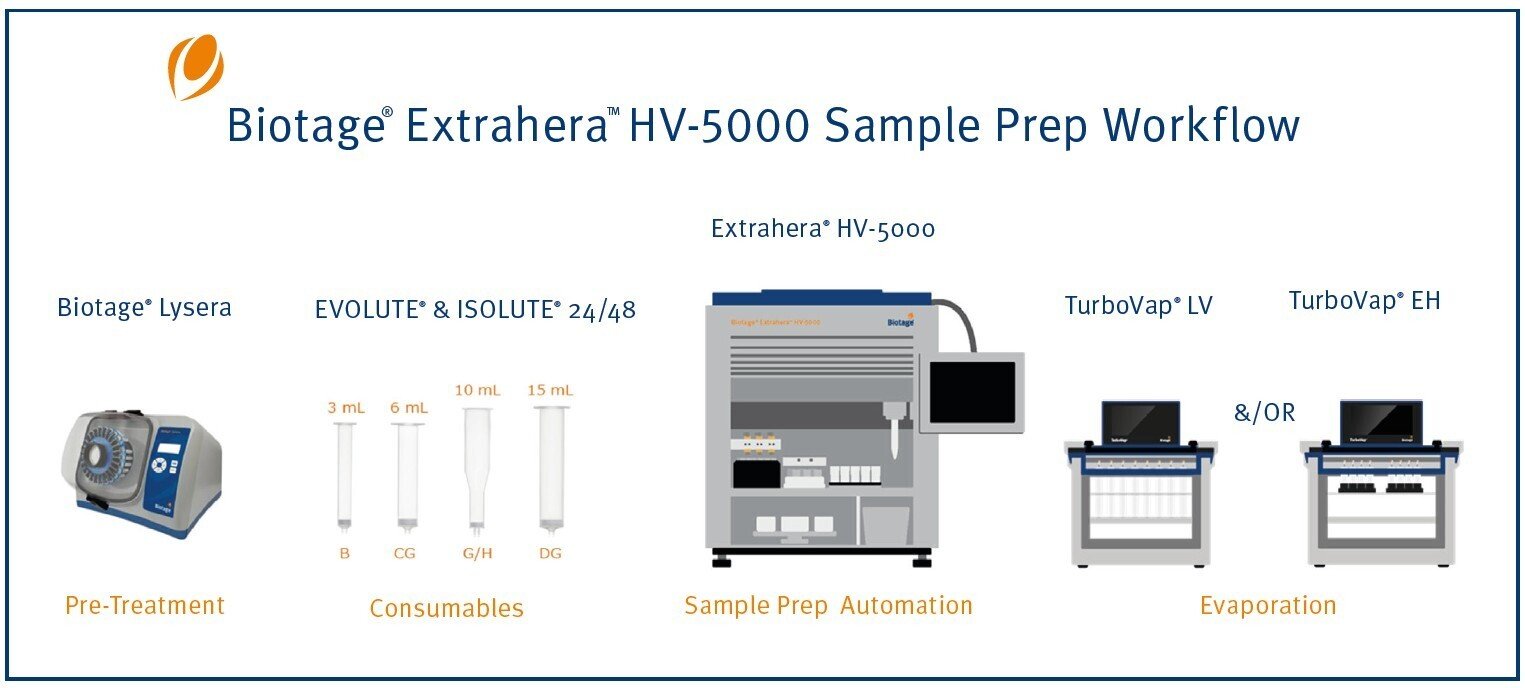
For solid samples such as soil, analytes must be extracted into a solvent that is suitable for the chosen analysis. Efficient extraction relies on good sample-solvent interaction, which means that the sample might need to be homogenized (or ground up finely) before extraction. Biotage® Lysera is a bead mill homogenizer used to process solid or semi solid samples before extraction.
Homogenized samples are then often extracted using a suitable organic solvent.
Solid-phase extraction consumables for automated extract clean up
Once extracted into a suitable solvent, further clean-up is often required. High quality SPE consumables in a range of formats facilitate automated clean up processes. This guide focuses on post extraction clean up techniques using ISOLUTE® SPE products.
Benefits of automated sample preparation
Biotage® Extrahera™ automated sample preparation systems can handle a range sample volumes and SPE cartridge sizes ideal for SPE based sample clean up. Automation of the clean-up process brings.
- Improved throughput and efficiency
- Improved data and error reduction
- Reduced cost per sample
Evaporation before analysis
Cleaned up samples usually require a concentration step before analysis. Biotage TurboVap® blowdown evaporators use a patented vortex evaporation system that increases the speed of evaporation by a factor of 10 compared with other techniques.
A range of features are incorporated that ensure the safety of your samples, with efficient, high throughput evaporation that matches your lab’s needs.
- Faster Evaporation
- Reduced RSD
- Improved recovery
This user guide contains methodologies for processing environmental samples using Biotage® Extrahera™ HV-5000.
Selected procedures are based on EPA methods and have been adapted for use on an automated SPE system using pre-packed SPE cartridges, wherever allowed by the EPA method.
In addition, there is a guide to method optimization using the HV-5000, outlining the factors which should be considered when for optimizing a solid phase extraction method or transferring a method to the automation system.
The Biotage® Extrahera™ HV-5000 automation system
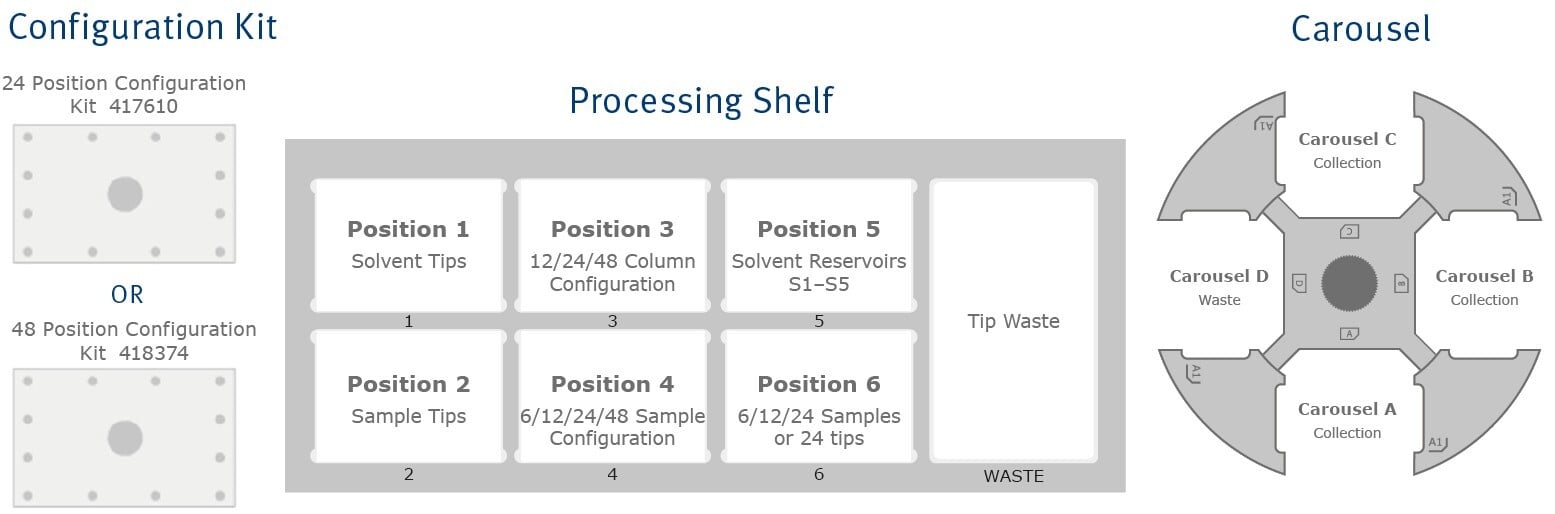
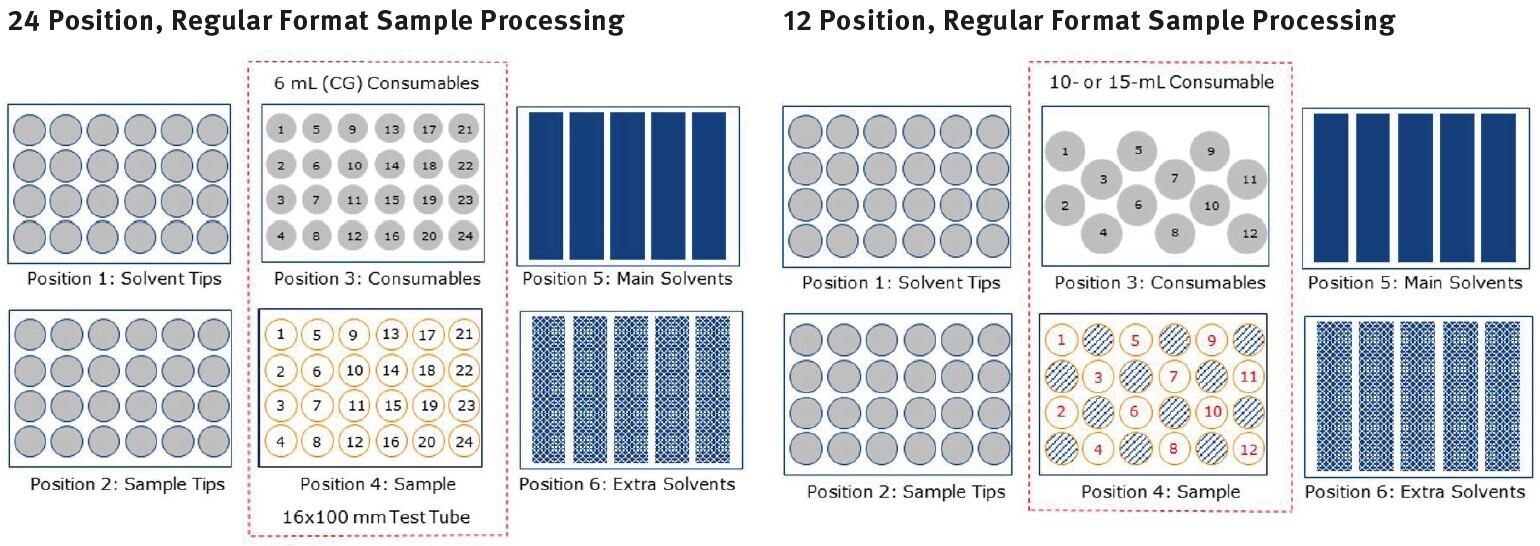
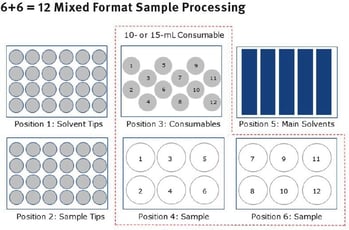
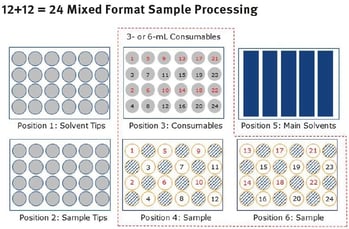
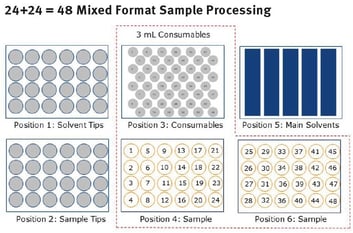
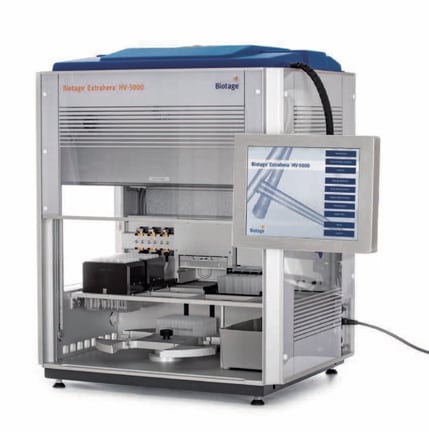 The new Biotage® Extrahera™ HV-5000, is a GLP capable, automated sample prep workstation solution dedicated to cartridge-based sample prep with support for classical SPE and SLE cartridge consumable formats. Using its 4-channel pipette head, the HV-5000 will aspirate and dispense high volumes from 250–5000 µL per channel. Combined with precision pipetting and positive pressure sample processing, the system caters to larger sample volumes compatible with 3-, 6-, 10- and 15-mL cartridge consumables in 12, 24, and 48 position formats.
Solid-phase extraction sorbents used in this guide
Alumina
Alumina is a highly porous form of alumina oxide, available in three pH ranges (acidic, basic neutral) for use in chromatographic clean up procedures.
It is used to separate analytes from interfering compounds of differing chemical polarity.
ISOLUTE® Alumina SPE sorbents (acidic, basic or neutral) are pre-packed into clean SPE cartridges for convenient use.
Florisil
Florisil® , a registered trade name of U. S. Silica Co., is a magnesium silicate with basic properties. It is used to separate analytes from interfering compounds prior to sample analysis by a chromatographic method.
ISOLUTE® FL (Florisil PR grade) SPE sorbent is pre-packed into clean SPE cartridges for convenient use.
Silica gel
Silica gel (silicic acid) is a regenerative adsorbent of silica with weakly acidic properties. It is used for the separation of analytes from interfering compounds of a different chemical polarity.
ISOLUTE® SI (silica gel) SPE sorbent is pre-packed into clean SPE cartridges for convenient use.
ISOLUTE® EPH
ISOLUTE EPH is a proprietary blend of media optimized for the fractionation of aliphatic and aromatic fractions of water or soil extracts.
Each batch of media is QC checked to ensure reproducible fractionation.
EPA Method 3610B; Alumina clean up for phthalate esters
This method utilizes ISOLUTE® AL-B (basic alumina) to clean up hexane extracts containing phthalate esters.
The methodology assumes that environmental samples have been previously prepared using an appropriate extraction method.
The cartridge clean up procedure uses solid phase extraction cartridges containing 40 µm particles of alumina (60 Å pores). Each cartridge is washed with hexane immediately prior to use. The sample extract (in hexane) is loaded onto the cartridge which is then eluted with a suitable solvent.
*Note: if organochlorine pesticides are known to be present, refer to method 3620.
Analytes
- Bis(2-ethylhexyl) phthalate
- Diethyl phthalate
- Butyl benzyl phthalate
- Dimethyl phthalate
- Di-n-butyl phthalate
- Di-n-octyl phthalate
Solid Phase Extraction cartridge
ISOLUTE® Al-B, 1 g / 6 mL (tabless) (p/n 715-0100-CG).
Methodology
|
Condition |
Hexane (5 mL). |
|
Load |
Sample extract in hexane (2 mL). |
|
Rinse |
Hexane (0.5 mL). |
|
Elute |
Acetone/hexane mix (20/80, v/v) (10 mL). |
|
Post Clean Up |
Prior to analysis, adjust the final volume of the eluant to the volume listed in the determinative method, using the techniques described in the appropriate 3500 series method. |
Time taken for procedure using Biotage® Extrahera™ HV-5000
|
Batch Size |
Time Taken (hh.mm.ss)* |
|
24 samples (6 mL cartridge) |
00.37.08 |
*Timing derived by programming the HV-5000 system to perform the methodology assuming appropriate consumables and solvent volumes per batch size are used.
Recommended sample rack and collection options
|
Batch Size |
Sample Volume |
Consumable Rack |
Sample Tube and Rack Used |
Elution Volume |
Collection Tube and Rack Used |
|
24 |
2 mL |
Column Rack, 24 x 6 mL (tabless), 413640SP |
16x100 mm test tube, 24 position sample rack, 414245SP |
10 mL |
18x75 mm collection rack, 415492 |
EPA Method 3620C; Florisil clean Up for phthalate esters (where organochlorine pesticide residues are known to be present)
This method utilizes ISOLUTE® AL-B (basic alumina) to clean up hexane extracts containing phthalate esters.
The methodology assumes that environmental samples have been previously prepared using an appropriate extraction method.
The cartridge clean up procedure uses solid phase extraction cartridges containing 40 µm particles of alumina (60 Å pores). Each cartridge is washed with hexane immediately prior to use. The sample extract (in hexane) is loaded onto the cartridge which is then eluted with a suitable solvent.
*Note: if organochlorine pesticides are known to be present, refer to method 3620.
Analytes
- Bis(2-ethylhexyl) phthalate
- Diethyl phthalate
- Butyl benzyl phthalate
- Dimethyl phthalate
- Di-n-butyl phthalate
- Di-n-octyl phthalate
Solid-phase extraction cartridge
ISOLUTE® Al-B, 1 g / 6 mL (tabless) (p/n 715-0100-CG).
Methodology
|
Condition |
Hexane (5 mL). |
|
Load |
Sample extract in hexane (2 mL). |
|
Rinse |
Hexane (0.5 mL). |
|
Elute |
Acetone/hexane mix (20/80, v/v) (10 mL). |
|
Post Clean Up |
Prior to analysis, adjust the final volume of the eluant to the volume listed in the determinative method, using the techniques described in the appropriate 3500 series method. |
Time taken for procedure using Biotage® Extrahera™ HV-5000
|
Batch Size |
Time Taken (hh.mm.ss)* |
|
24 samples (6 mL cartridge) |
00.37.08 |
*Timing derived by programming the HV-5000 system to perform the methodology assuming appropriate consumables and solvent volumes per batch size are used.
Recommended sample rack and collection options
|
Batch Size |
Sample Volume |
Consumable Rack |
Sample Tube and Rack Used |
Elution Volume |
Collection Tube and Rack Used |
|
24 |
2 mL |
Column Rack, 24 x 6 mL (tabless), 413640SP |
16x100 mm test tube, 24 position sample rack, 414245SP |
10 mL |
18x75 mm collection rack, 415492 |
EPA Method 3620C; Florisil clean up for phthalate esters (where organochlorine pesticide residues are known to be present)
This method utilizes ISOLUTE® FL (Florisil, PR grade) to clean up hexane extracts containing phthalate esters.
The methodology assumes that environmental samples have been previously prepared using an appropriate extraction method.
The cartridge clean-up procedure uses solid-phase extraction cartridges containing 40 µm particles of Florisil (60 Å pores). Each cartridge is washed with hexane immediately prior to use. The sample extract (in hexane) is loaded onto the cartridge which is then eluted with a suitable solvent.
Analytes
- Bis(2-ethylhexyl) phthalate
- Diethyl phthalate
- Butyl benzyl phthalate
- Dimethyl phthalate
- Di-n-butyl phthalate
- Di-n-octyl phthalate
Solid-phase extraction cartridge
ISOLUTE® FL, 1 g / 3 mL (tabless) (p/n 712-0100-BG); 1 g / 6 mL (tabless) (p/n 712-0100-CG); 1 g/15 mL (tabless) (p/n 712-0100-DG).
Methodology
|
Load |
Sample extract in hexane (1 mL). |
|
Rinse |
Hexane (0.5 mL). |
|
Elute 1 |
DCM/hexane (20/80, v/v) (10 mL). |
|
Elute 2 |
Acetone/Hexane mix (10/90, v/v) (10 mL). |
|
Post Clean Up |
Prior to analysis, adjust the final volume of the eluant to the volume listed in the determinative method, using the techniques described in the appropriate 3500 series method. |
Time taken for procedure using Biotage® Extrahera™ HV-5000*
|
Batch Size |
Time Taken (hh.mm.ss) |
|
24 samples (3 mL cartridge)** |
01:07:55 |
|
24 samples (6 mL cartridge) |
00:40:37 |
|
12 samples (15 mL cartridge) |
00:40:45 |
*Timing derived by programming the HV-5000 system to perform the methodology assuming appropriate consumables and solvent volumes per batch size are used
** Elution volume > 5 mL means that multiple aliquots are required to meet the method requirement using the 3 mL cartridge size, increasing run time.
Recommended sample rack and collection options
|
Batch size |
Sample volume |
Consumable Rack |
Sample Tube and Rack Used |
Elution Volume |
Collection Tube and Rack Used |
|
24 |
1 mL |
Column Rack, 24 x 6 mL (tabless), 413640SP |
16x100 mm test tube, 24 position sample rack, 414245SP |
2 x 10 mL |
18x75 mm collection rack, 415492 x2 |
|
12 |
1 mL |
Column Rack, 12 x 15 mL (tabless), 416848SP |
16x100 mm or 15 mL centrifuge tube, 24 position sample rack, 414245SP, & key plate (417282SP) |
2 x 10 mL |
18x75 mm collection rack, 415492 x2 |
EPA Method 3620C; Florisil clean up for PCBs and organochlorine pesticides
This method utilizes ISOLUTE® FL (Florisil, PR grade) to clean up hexane extracts containing PCBs and organochlorine pesticides. Use this method if both analyte classes are to be collected and analysed together.
If PCBs and organochlorine pesticides are required in separate fractions, see method 3620 C ‘separate fractions’.
The methodology assumes that environmental samples have been previously prepared using an appropriate extraction method.
The cartridge clean up procedure uses solid-phase extraction cartridges containing 40 µm particles of Florisil (60 Å pores). Each cartridge is washed with hexane immediately prior to use. The sample extract (in hexane) is loaded onto the cartridge which is then eluted with a suitable solvent.
Analytes
- Organochlorine Pesticides
- PCBs
Solid-phase extraction cartridge
ISOLUTE® FL, 1 g / 3 mL (tabless) (p/n 712-0100-BG) 1 g / 6 mL (tabless) (p/n 712-0100-CG).
Methodology
|
Condition |
Hexane (4 mL). |
|
Load |
Sample extract in hexane (1 mL). |
|
Rinse |
Hexane (0.5 mL). |
|
Elute |
Acetone/hexane (10/90, v/v) (9 mL). This eluant will contain the combined organochlorine pesticides and PCBs. |
|
Post Clean Up |
Prior to analysis, adjust the final volume of the eluant to the volume listed in the determinative method, using the techniques described in the appropriate 3500 series method. |
Time taken for procedure using Biotage® Extrahera™ HV-5000*
|
Batch Size |
Time Taken (hh.mm.ss) |
|
24 samples (3 mL cartridge)** |
00:47:37 |
|
24 samples (6 mL cartridge) |
00:25:05 |
|
12 samples (15 mL cartridge) |
00:31:14 |
*Timing derived by programming the HV-5000 system to perform the methodology assuming appropriate consumables and solvent volumes per batch size are used.
** Elution volume > 5 mL means that multiple aliquots are required to meet the method requirement using the 3 mL cartridge size, increasing run time.
Recommended sample rack and collection options
|
Batch size |
Sample volume |
Consumable Rack |
Sample Tube and Rack Used |
Elution volume |
Collection Tube and Rack Used |
|
24 |
1 mL |
Column Rack, 24 x 6 mL (tabless), 413640SP |
16x100 mm test tube, 24 position sample rack, 414245SP |
9 mL |
18x75 mm collection rack, 415492 |
|
12 |
1 mL |
Column Rack, 12 x 15 mL (tabless), 416848SP |
16x100 mm or 15 mL centrifuge tube, 24 position sample rack, 414245SP, & key plate (417282SP) |
9 mL |
18x75 mm collection rack, 415492 |
EPA method 3620C; Florisil clean up for PCBs and organochlorine pesticides
This method utilizes ISOLUTE® FL (Florisil, PR grade) to clean up hexane extracts containing PCBs and organochlorine pesticides. Use this method if the analyte classes are to be collected and analysed separately.
If PCBs and organochlorine pesticides are required in a single fraction, see method 3620 C ‘combined fractions’.
The methodology assumes that environmental samples have been previously prepared using an appropriate extraction method.
The cartridge clean up procedure uses solid-phase extraction cartridges containing 40 µm particles of Florisil (60 Å pores). Each cartridge is washed with hexane immediately prior to use. The sample extract (in hexane) is loaded onto the cartridge which is then eluted with a suitable solvent.
Analytes
- Fraction 1: PCBs plus some Organochlorine Pesticides
- Fraction 2: Most OC pesticides
- Fraction 3: Remaining OC pesticides
Solid-phase extraction cartridge
ISOLUTE® FL, 1 g / 3 mL (tabless) (p/n 712-0100-BG) 1 g / 6 mL (tabless) (p/n 712-0100-CG).
Methodology
|
Condition |
Hexane (4 mL). |
|
Load |
Sample extract in hexane (1 mL). |
|
Rinse |
Hexane (0.5 mL). |
|
Elute Fraction 1 |
Hexane (3 mL) this fraction contains the PCBs and some pesticides. |
|
Elute Fraction 2 |
Dichloromethane/hexane (26/74, v/v) (5 mL). This fraction contains most of the pesticides. |
|
Elute Fraction 3 |
Acetone/hexane (10/90, v/v) (5 mL). This fraction contains the remaining pesticides. |
|
Post Clean Up |
Prior to analysis, adjust the final volume of the eluant to the volume listed in the determinative method, using the techniques described in the appropriate 3500 series method. |
Time taken for procedure using Biotage® Extrahera™ HV-5000*
|
Batch size |
Time taken (hh.mm.ss) |
|
24 samples (3 mL cartridge)** |
01:02:00 |
|
24 samples (6 mL cartridge) |
00:48:02 |
|
12 samples (15 mL cartridge) |
00:39:37 |
*Timing derived by programming the HV-5000 system to perform the methodology assuming appropriate consumables and solvent volumes per batch size are used.
** Elution volume > 5 mL means that multiple aliquots are required to meet the method requirement using the 3 mL cartridge size, increasing run time.
The need for fractionation (3 separate fractions per sample) reduces the batch size that can be accommodated.
Recommended sample rack and collection options
|
Batch size |
Sample volume |
Consumable Rack |
Sample Tube and Rack Used |
Elution volume |
Collection Tube and Rack Used |
|
24 |
1 mL |
Column Rack, 24 x 6 mL (tabless), 413640SP |
16x100 mm test tube, 24 position sample rack, 414245SP |
5 mL |
16x75 mm collection rack, 415585 |
|
12 |
1 mL |
Column Rack, 12 x 15 mL (tabless), 416848SP |
16x100 mm or 15 mL centrifuge tube, 24 position sample rack, 414245SP, & key plate (417282SP) |
5 mL |
16x75 mm collection rack, 415585 |
EPA Method 3620C; Florisil clean Up for chlorinated hydrocarbons
This method utilizes ISOLUTE® FL (Florisil, PR grade) to clean up hexane extracts containing chlorinated hydrocarbons.
The methodology assumes that environmental samples have been previously prepared using an appropriate extraction method.
The cartridge clean up procedure uses solid-phase extraction cartridges containing 40 µm particles of Florisil (60 Å pores). Each cartridge is washed immediately prior to use. The sample extract (in hexane) is loaded onto the cartridge which is then eluted with a suitable solvent.
Analytes
- 2-Chloronaphthalene
- Hexachlorobenzene
- 1,2-Dichlorobenzene
- Hexachlorobutadiene
- 1,3-Dichlorobenzene
- Hexachlorocyclopentadiene
- 1,4-Dichlorobenzene
- Hexachloroethane
- 1,2,4-Trichlorobenzene
Solid-phase extraction cartridge
ISOLUTE® FL, 1 g / 3 mL (tabless) (p/n 712-0100-BG) ; 1 g / 6 mL (tabless) (p/n 712-0100-CG); 1 g/15 mL (tabless) (p/n 712-0100-DG).
Methodology
|
Condition |
Acetone/hexane (10/90, v/v) (5 mL). |
|
Load |
Sample extract in hexane (2 mL). |
|
Rinse |
Acetone/hexane (10/90, v/v) (0.5 mL). |
|
Elute |
Acetone/hexane (10/90, v/v) (10 mL). |
|
Post Clean Up |
Prior to analysis, adjust the final volume of the eluant to the volume listed in the determinative method, using the techniques described in the appropriate 3500 series method. |
Time taken for procedure using Biotage® Extrahera™ HV-5000*
|
Batch Size |
Time Taken (hh.mm.ss) |
|
24 samples (3 mL cartridge)** |
00:53:03 |
|
24 samples (6 mL cartridge) |
00:35:53 |
|
12 samples (15 mL cartridge) |
00:31:20 |
*Timing derived by programming the HV-5000 system to perform the methodology assuming appropriate consumables and solvent volumes per batch size are used.
** Elution volume > 5 mL means that multiple aliquots of elution solvent are required to meet the method requirement using the 3 mL cartridge size, increasing run time.
Recommended sample rack and collection options
|
Batch size |
Sample volume |
Consumable Rack |
Sample Tube and Rack Used |
Elution volume |
Collection Tube and Rack Used |
|
24 |
2 mL |
Column Rack, 24 x 6 mL (tabless), 413640SP |
16x100 mm test tube, 24 position sample rack, 414245SP |
10 mL |
18x75 mm collection rack, 415492 |
|
12 |
2 mL |
Column Rack, 12 x 15 mL (tabless), 416848SP |
16x100 mm or 15 mL centrifuge tube, 24 position sample rack, 414245SP, & key plate (417282SP) |
10 mL |
18x75 mm collection rack, 415492 |
EPA Method 3630; Silica Gel clean up for Derivatized Phenols
This method utilizes ISOLUTE® SI (Silica) to clean up hexane extracts containing derivatized phenols.
The cartridge clean up protocol uses solid phase extraction cartridges packed with 2 g of silica gel adsorbent. Each cartridge is solvent washed immediately prior to use. Aliquots of sample extracts are loaded onto the cartridges, which are then eluted with suitable solvent(s).
This silica gel cleanup procedure is performed on sample extracts that have undergone pentafluorobenzyl bromide derivatization, as described in Method 8041. The sample extract must be in 2 mL of hexane at this point.
Analytes
Pentafluorobenzyl bromide derivatized phenols: Phenol, 2-Methylphenol, 3-Methylphenol, 4-Methylphenol, 2,4-Dimethylphenol, 2-Chlorophenol, 2,6-Dichlorophenol, 4-Chloro-3-methylphenol,
2,4-Dichlorophenol, 2,4,6-Trichlorophenol, 2,3,6-Trichlorophenol, 2,4,5-Trichlorophenol, 2,3,5-Trichlorophenol, 2,3,5,6-Tetrachlorophenol, 2,3,4,6-Tetrachlorophenol, 2,3,4-Trichlorophenol, 2,3,4,5-Tetrachlorophenol, Pentachlorophenol
Solid-phase extraction cartridge
ISOLUTE® SI, 2 g / 6 mL (tabless) (p/n 460-0200-CG) ; 2 g/15 mL (tabless) (p/n 460-0200-DG).
Methodology
|
Condition |
Hexane (4 mL). |
|
Load |
Sample extract in hexane (2 mL). |
|
Rinse |
Hexane (0.5 mL). |
|
Wash |
Hexane (5 mL). Discard. |
|
Elute |
Toluene/hexane (25/75, v/v) (5 mL) |
|
Post Clean Up |
Prior to analysis, adjust the final volume of the eluant to the volume listed in the determinative method, using the techniques described in the appropriate 3500 series method. |
Time taken for procedure using Biotage® Extrahera
™
HV-5000*
|
Batch size |
Time taken (hh.mm.ss) |
|
24 samples (6 mL cartridge) |
00:48:52 |
|
12 samples (15 mL cartridge) |
00:43:26 |
*Timing derived by programming the HV-5000 system to perform the methodology assuming appropriate consumables and solvent volumes per batch size are used.
Recommended sample rack and collection options
|
Batch size |
Sample volume |
Consumable Rack |
Sample Tube and Rack Used |
Elution volume |
Collection Tube and Rack Used |
|
24 |
2 mL |
Column Rack, 24 x 6 mL (tabless), 413640SP |
16x100 mm test tube, 24 position sample rack, 414245SP |
5 mL |
16x75 mm collection rack, 415585 |
|
12 |
2 mL |
Column Rack, 12 x 15 mL (tabless), 416848SP |
16x100 mm or 15 mL centrifuge tube, 24 position sample rack, 414245SP, & key plate (417282SP) |
5 mL |
16x75 mm collection rack, 415585 |
EPA Method 3630; Silica gel clean up for organochlorine pesticides and PCBs (where PCBs are known to be present)
This method utilizes ISOLUTE® SI (Silica) to clean up hexane extracts containing organochlorine pesticides and PCBs (where PCBs are known to be present).
The cartridge clean up protocol uses solid phase extraction cartridges packed with 1 g of silica gel adsorbent. Each cartridge is solvent washed immediately prior to use. Aliquots of sample extracts are loaded onto the cartridges, which are then eluted with suitable solvent(s).
Analytes
- Fraction 1: Heptachlor, Aldrin, 4,4’-DDE, 4,4’-DDT, Aroclor 1016, Aroclor 1221, Aroclor 1232, Aroclor
1242, Aroclor 1248, Aroclor 1254, Aroclor 1264. - Fraction 2: alpha-BHC, gamma-BHC, beta-BHC, delta-BHC, Heptachlor epoxide, Endosulfan I, Dieldrin, Endrin, 4,4’-DDD, Endosulfan II, Endrin aldehyde, Endosulfan sulfate, 4,4’-Methoxychlor
Solid Phase Extraction cartridge
ISOLUTE® SI, 1 g/3 mL (tabless) (p/n 460-0100-BG); 1 g /6 mL (tabless) (p/n 460-0100-CG) ; 1 g/15 mL (tabless) (p/n 460-0100-DG).
Methodology
|
Condition: |
Hexane (4 mL). |
|
Load |
Sample extract in hexane (2 mL). |
|
Rinse |
Hexane (0.5 mL). |
|
Elute Fraction 1 |
Hexane (5 mL) |
|
Elute Fraction 2 |
Diethyl ether/hexane (50/50, v/v)(5 mL) |
|
Combine the fractions if analyte fractionation is not required |
|
|
Post Clean Up |
Prior to analysis, adjust the final volume of the eluant to the volume listed in the determinative method, using the techniques described in the appropriate 3500 series method. |
Time taken for procedure using Biotage® Extrahera™ HV-5000*
|
Batch Size |
Time Taken (hh.mm.ss) |
|
24 samples (3 mL cartridge)** |
01:01:26 |
|
24 samples (6 mL cartridge) |
00:51:11 |
|
12 samples (15 mL cartridge) |
00:37:45 |
*Timing derived by programming the HV-5000 system to perform the methodology assuming appropriate consumables and solvent volumes per batch size are used.
**Elution volume > 5 mL means that multiple aliquots of elution solvent are required to meet the method requirement using the 3 mL cartridge size, increasing run time.
Recommended sample rack and collection options
|
Batch size |
Sample volume |
Consumable Rack |
Sample Tube and Rack Used |
Elution volume |
Collection Tube and Rack Used |
|
24 |
2 mL |
Column Rack, 24 x 6 mL (tabless), 413640SP |
16x100 mm test tube, 24 position sample rack, 414245SP |
2 x 5 mL |
16x75 mm collection rack, 415585, x2 |
|
12 |
2 mL |
Column Rack, 12 x 15 mL (tabless), 416848SP |
16x100 mm or 15 mL centrifuge tube, 24 position sample rack, 414245SP, & key plate (417282SP) |
2 x 5 mL |
16x75 mm collection rack, 415585, x2 |
Clean-up of EPH (Extractable Petroleum Hydrocarbons) from water or soil extracts using ISOLUTE® EPH SPE cartridges
This method utilizes ISOLUTE® EPH to clean up hexane extracts containing of extractable petroleum hydrocarbons from soil or water extracts. The method cleanly separates the aliphatic fraction from the aromatic fraction for GC analysis.
The procedure assumes samples have been extracted into hexane using an appropriate sample pre-treatment method.
Analytes
- Fraction 1: Aliphatic hydrocarbons
- Fraction 2: Aromatic hydrocarbons
Solid-phase extraction cartridge
ISOLUTE® EPH, 1.45 g/3 mL (tabless) (p/n 928-0145-BG).
Methodology
|
Condition |
Hexane (6 mL). |
|
Load |
Sample extract in hexane (2 mL. |
|
Fraction 1 |
Hexane (1.5 mL). This contains the aliphatic fraction. |
|
Fraction 2 |
Dichloromethane (4.5 mL). This contains the aromatic fraction. |
|
Post Extraction |
Evaporate and reconstitute in a solvent suitable for the analytical method. See Application note AN877 for additional details. |
Time taken for procedure using Biotage® Extrahera™ HV-5000*
|
Batch size |
Time taken (hh.mm.ss) |
|
24 samples (3 mL cartridge) |
00:48:48 |
|
48 samples (3 mL cartridge) |
01:06:14 |
*Timing derived by programming the HV-5000 system to perform the methodology assuming appropriate consumables and solvent volumes per batch size are used.
Recommended sample rack and collection options
|
Batch size |
Sample volume |
Consumable Rack |
Sample Tube and Rack Used |
Elution volume |
Collection Tube and Rack Used |
|
24 |
1 mL |
Column Rack, 24 x 6 mL (tabless), 413640SP |
16x100 mm test tube, 24 position sample rack, 414245SP, x1 |
1 x 1.5 mL |
16x75 mm collection rack, 415585, x2 |
|
48 |
1 mL |
Column Rack, 48 x 3 mL (tabless), 415556SP, x1 |
16x100 mm test tube, 24 position sample rack, 414245SP, x2 |
1 x 1.5 mL |
12x75 mm collection rack, 415555SP, x2 |
Method development using the Biotage® Extrahera™ HV-5000
Guide to sample, SPE cartridge and collection tube options
For optimum throughput for your method, you should consider the following factors:
- Batch size
- Sample volume
- Collection volume
Impact of cartridge format on batch size
The maximum number of samples that can be extracted using the HV-5000 is dependent on cartridge format.
|
Cartridge format |
Maximum batch size |
|
3 mL |
48 |
|
6 mL |
24 |
|
15 mL |
12 |
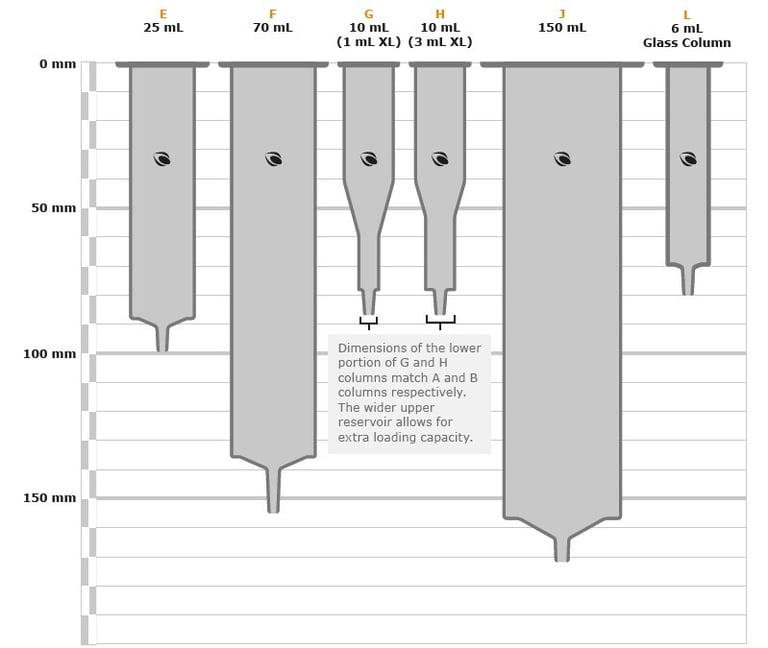
As can be seen from the examples in the application section, moving to a larger format cartridge (for example from a 1 g/3 mL format to a 1 g/6 mL or 1 g/12 mL format, see image) can adversely impact the number of samples that can be run in a single batch, but may allow for fewer solvent dispense steps, offsetting the apparent reduced throughput.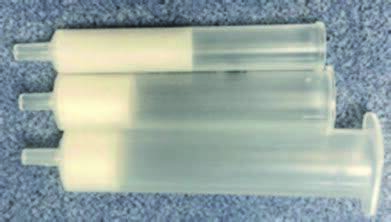 Figure 1.
Top = 1 g/3 mL, Middle = 1 g/6 mL, Bottom = 1 g/12 mL.
Impact of cartridge format on extraction time
If the method requires a 5 mL elution volume, then the sample can be added in one step for the D cartridge format, so the positive pressure settings only need to be applied once. Since the 5mL elution volume is larger than the cartridge format capacity it needs to be added in two parts meaning that the positive pressure settings need to be applied twice to load the entire sample. As the 5 mL elution volume is considerably larger than the 3 mL cartridge format capacity the procedure needs to perform 4 times leading to a considerably longer run time.
For the cartridges shown in Figure 1 the maximum solvent capacity is as follows:
|
Cartridge format |
Maximum reservoir capacity (with sorbent) |
# Dispense steps required for 5 mL elution |
|
1 g/3 mL (B) |
1.5 mL |
4 |
|
1 g/6 mL (C) |
3 mL |
2 |
|
1 g/15 mL (D) |
12 mL |
1 |
Impact of cartridge format on performance
In theory, a taller, narrower SPE cartridge can provide more effective clean up (better interference removal) than a shorter, wider cartridge packed with the same weight of sorbent.
In practice however, this is highly dependent on the solvent used, and the characteristics of the interferences being removed. Flow rates through shorter, wider cartridge are usually faster than taller, narrow equivalents, so if performance is not impacted, overall time for the extraction may be reduced with larger format cartridges.
For this reason, the choice of a 10 mL XL format cartridge may be beneficial for some methods, as it provides increased reservoir volume with the same tall, narrow sorbent bed dimensions as a B (3 mL) format cartridge.
Choice of SPE cartridge:
In addition to throughput considerations, to develop and optimize a method on the Extrahera™ HV- 5000, you must determine the mass of SPE sorbent required to ensure enough chemical capacity for the analytes of interest. In general, a good place to start is to assume ~5% of the SPE bed mass is equivalent to the maximum chemical loading capacity. For example, if you have 500 mg of SPE sorbent, then your estimated total analyte loading capacity will be roughly 25 mg.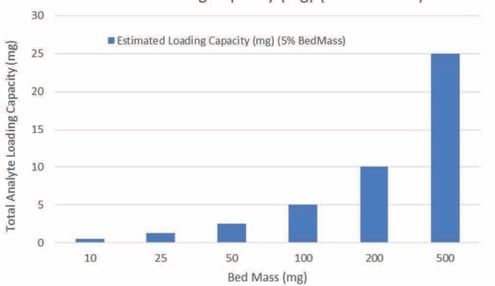 Figure 2.
Next you must determine the number of analytes, surrogates, and internal standards that you are screening for and divide the total loading capacity by the number of analytes. For example, if your total analyte loading capacity is 25 mg and you are screening for 25 total compounds, your maximum spike level for a single analyte is 1 mg.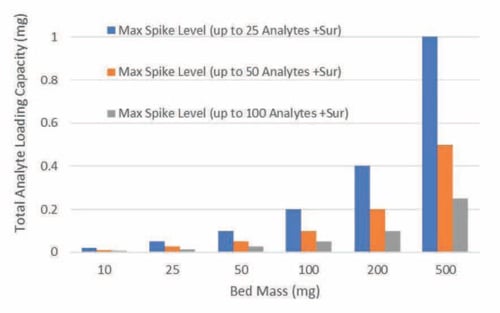 Figure 3.
Based on the bed mass utilized for the extraction method you can then estimate the maximum and minimum elution volumes required for the extraction method. Estimations for these volumes can are noted in the chart below.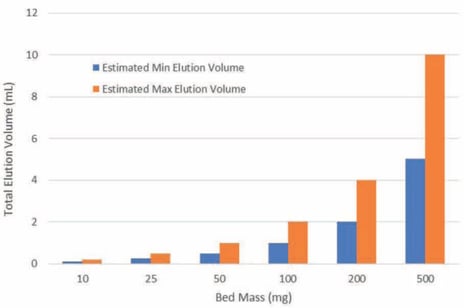
Figure 4.
This information can be used as a starting point for method optimization. For example, a method which screens for 25 compounds at a maximum spike level of 100 ug (i.e., 0.1 mg) per analyte would likely require approximately 100 mg of SPE sorbent.
Choice of sample and collection tube
A wide variety of tubes and containers can be used. The table below summarizes the options available.
|
POS 3 (SPE consumable) |
POS 4 (sample) |
POS 6 (sample) |
Collection (A-D) |
|
48 x 3 mL (B tube, Diag.) |
24, 16x100 mm |
24, 16x100 mm |
48, 12x75mm |
|
|
|
|
48, 5 mL well plate |
|
|
|
|
|
|
24 x 3 mL (B tube) |
24, 16x100 mm |
N/A |
24, 12x75mm, 16x75mm, or 18x75mm |
|
24 x 3 mL (B tube) |
12, 15 mL Centrifuge Tube |
12, 15 mL Centrifuge Tube |
24, 12x75mm, 16x75mm, or 18x75mm |
|
|
|
|
24, 10 mL well plate |
|
|
|
|
|
|
24 x 6 mL (DC tube) |
24, 16x100 mm |
N/A |
24, 12x75mm, 16x75mm, or 18x75mm |
|
24 x 6 mL (DC tube) |
12, 15 mL Centrifuge Tube |
12, 15 mL Centrifuge Tube |
24, 12x75mm, 16x75mm, or 18x75mm |
|
|
|
|
24, 10 mL well plate |
|
|
|
|
|
|
12 x 15 mL (DG Tube) |
12, 15 mL Centrifuge Tube |
N/A |
12, 12x75mm, 16x75mm, or 18x75mm |
|
12 x 15 mL (DG Tube) |
12, 16x75 mm |
N/A |
12, 12x75mm, 16x75mm, or 18x75mm |
|
12 x 15 mL (DG Tube) |
12, 18x75 mm |
N/A |
12, 12x75mm, 16x75mm, or 18x75mm |
|
12 x 15 mL (DG Tube) |
12, 16x100 mm |
N/A |
12, 12x75mm, 16x75mm, or 18x75mm |
|
12 x 15 mL (DG Tube) |
6, 50 mL Centrifuge Tube |
6, 50 mL Centrifuge Tube |
12, 12x75mm, 16x75mm, or 18x75mm |
|
12 x 15 mL (DG Tube) |
6, 40 mL VOA Vial |
6, 40 mL VOA Vial |
12, 12x75mm, 16x75mm, or 18x75mm |
|
12 x 15 mL (DG Tube) |
6, 20 mL VOA Vial |
6, 20 mL VOA Vial |
12, 12x75mm, 16x75mm, or 18x75mm |
|
|
|
|
|
|
12 x 10 mL (G Tube) |
12, 15 mL Centrifuge Tube |
N/A |
12, 12x75mm, 16x75mm, or 18x75mm |
|
12 x 10 mL (G Tube) |
12, 16x75 mm |
N/A |
12, 12x75mm, 16x75mm, or 18x75mm |
|
12 x 10 mL (G Tube) |
12, 18x75 mm |
N/A |
12, 12x75mm, 16x75mm, or 18x75mm |
|
12 x 10 mL (G Tube) |
12, 16x100 mm |
N/A |
12, 12x75mm, 16x75mm, or 18x75mm |
|
12 x 10 mL (G Tube) |
6, 50 mL Centrifuge Tube |
6, 50 mL Centrifuge Tube |
12, 12x75mm, 16x75mm, or 18x75mm |
|
12 x 10 mL (G Tube) |
6, 40 mL VOA Vial |
6, 40 mL VOA Vial |
12, 12x75mm, 16x75mm, or 18x75mm |
|
12 x 10 mL (G Tube) |
6, 20 mL VOA Vial |
6, 20 mL VOA Vial |
12, 12x75mm, 16x75mm, or 18x75mm |
|
|
|
|
|
|
12 x 10 mL (H Tube) |
12, 15 mL Centrifuge Tube |
N/A |
12, 12x75mm, 16x75mm, or 18x75mm |
|
12 x 10 mL (H Tube) |
12, 16x75 mm |
N/A |
12, 12x75mm, 16x75mm, or 18x75mm |
|
12 x 10 mL (H Tube) |
12, 18x75 mm |
N/A |
12, 12x75mm, 16x75mm, or 18x75mm |
|
12 x 10 mL (H Tube) |
12, 16x100 mm |
N/A |
12, 12x75mm, 16x75mm, or 18x75mm |
|
12 x 10 mL (H Tube) |
6, 50 mL Centrifuge Tube |
6, 50 mL Centrifuge Tube |
12, 12x75mm, 16x75mm, or 18x75mm |
|
12 x 10 mL (H Tube) |
6, 40 mL VOA Vial |
6, 40 mL VOA Vial |
12, 12x75mm, 16x75mm, or 18x75mm |
|
12 x 10 mL (H Tube) |
6, 20 mL VOA Vial |
6, 20 mL VOA Vial |
12, 12x75mm, 16x75mm, or 18x75mm |
Practical considerations
The width of the 5 mL tips means the instrument can reach the bottom of some of these tubes and not others. Some of the tubes and their features are detailed below.
For each tube there is a practical and theoretical volume maximum. The theoretical maximum gives a volume to the very top of the tube that may not allow the tube to be rotated on the turntable or allow for minimal immersion of the Extrahera™ HV-5000 tips. In these cases, the practical volume maximum should be used instead.
Where the tip can’t reach the bottom of the tube the approximate dead volume is also included measuring the volume of sample in the bottom of the well that can’t be reached by the HV pipette tip even at its lowest setting.
|
Tube Description |
Volume (mL) Theoretical |
Volume (mL) Practical |
Appropriate for Sample |
Appropriate for Elution |
Can Tip Reach Bottom? |
|
10 x 75 |
4.0 |
4.0 |
No |
No |
No |
|
12 x 75 |
6.0 |
5.5 |
No |
Yes |
No (1.6 mL dead vol.) |
|
13 x 100 |
10.0 |
9.5 |
No |
No |
No (2.6 mL dead vol) |
|
16 x 100 |
17.0 |
15.0 |
Yes |
No |
Yes |
|
16 x 75 |
12.0 |
10.0 |
Yes |
Yes |
Yes |
|
18 x 75 |
13.5 |
13.0 |
Yes |
Yes |
Yes |
|
Autosampler vial |
2.0 |
1.5 |
No |
Yes |
No (0.8 mL dead vol.) |
|
20 mL VOA |
20 |
18 |
Yes |
No |
Yes |
|
40 mL VOA |
40 |
38 |
Yes |
No |
Yes |
|
15 mL Centrifuge Tube |
15 |
15 |
Yes |
No |
Yes |
|
50 mL Centrifuge Tube |
50 |
50 |
Yes |
No |
Yes |
|
Biotage 24 Position Rack |
10 |
9.0 |
Yes |
Yes |
Yes |
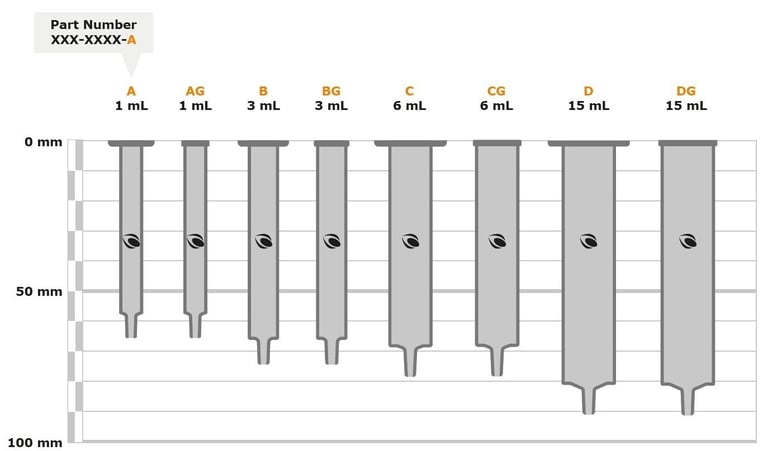
SPE cartridge sizes from Biotage
Literature Number: UI496
