
Summary and background
Purifying reaction mixtures often requires large volumes of solvent and multiple fraction collection vessels, especially when working at larger scales. Greener, more sustainable chemistry is becoming a “must do” rather than a “nice to do” objective in most synthetic chemistry labs. This applies not only to synthesis, but also to purification.
This application note outlines simple steps to help achieve these sustainability goals, even during scale-up, by reducing solvent consumption and the number of collected fractions.
Results and discussion
A Biotage® Initiator+ microwave was used to create a reaction mixture. The reaction mixture was analyzed by TLC in 30% ethyl acetate (EtOAc)/ heptane, Figure 1 and the Rf data used to create a linear gradient (7-60% EtOAc over 10 CV) on a Biotage® Selekt flash purification system. The method provided a complete separation of the product from several by-products (25 mg load) on a 10-gram Biotage® Sfär HC column, with the product eluting last, Figure 2. The nine fractions were collected into 18 x 150 mm culture tubes.
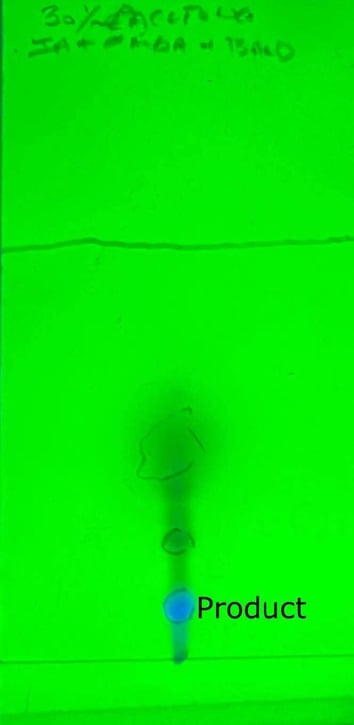
Figure 1. Reaction mixture TLC in 30% EtOAc/heptane shows a good separation of the product and less polar by-products.
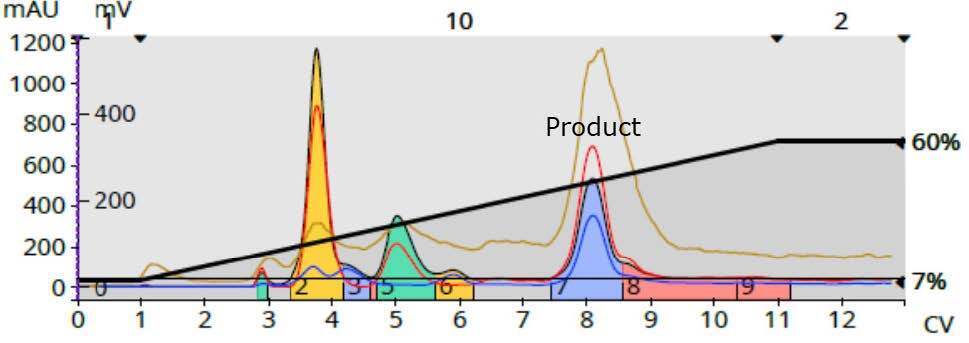
Figure 2. The TLC-derived linear gradient successfully separated the product from the earlier-eluting by-product using a 10-gram Biotage® Sfär HC column at a 25 mg load. Line color codes – Yellow = ELSD, Red = 254 nm, Blue = 330 nm, Black = λ-All 198-810 nm.
However, this 13 CV linear gradient required 195 mL of solvent to complete while separating and collecting several compounds (most undesired), Figure 3. Scaling the purification to a 25-gram column using the same linear gradient and load percentage would require 546 mL of solvent (13 CV x 42 mL/CV), yield only 52.5 mg of purified product, and use many more 18 x 150 mm vessels.
.jpg?width=974&height=340&name=biotage-an1013-figure3-Linear-gradient-terms-solvent-volume-consumed%20(195%20mL).jpg)
Figure 3. Linear gradient in terms of solvent volume consumed (195 mL).
Efficient scale-up reduces solvent use and the number of collection vessels while potentially increasing loading capacity. To achieve these goals, the linear gradient was converted into a step gradient using the Biotage® Selekt system’s Gradient Optimization feature. An Initial Waste parameter was built into the purification method to save fraction capacity. Initial Waste sends unwanted eluting compounds to waste, thus saving collection vessels for the desired compounds.
Gradient Optimization created a method of 34% EtOAc for 3.4 CV followed by a step to 46% EtOAc spanning 2.3 CV for a total of 5.7 CV, an estimated 56% reduction in solvent use. This optimized gradient was designed to elute the less polar compounds at 34% EtOAc and the product in 46% EtOAc. The Initial Waste was set to 3.0 CV to minimize the number of collection vessels being required. Along with the solvent volume reduction, Gradient Optimization often enables an increase in loading capacity.
A five-fold purification scale-up of the reaction mixture was attempted with a 25 g Biotage® Sfär HC column using the optimized step gradient. Fractions were collected in 25 x 150 mm culture tubes.
The scaled purification with a 125 mg load used 240 mL of solvent (only 45 mL more than the 10-gram column with the 13 CV linear gradient), Figure 4. Since Initial Waste was employed, only three collection vessels were needed for the product and one trailing by-product.
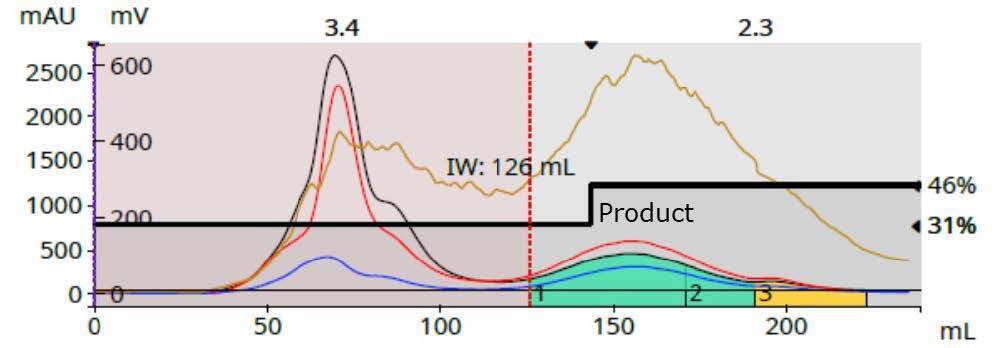
Figure 4. Optimized purification scale-up (125 mg load, 25-gram Biotage® Sfär HC column) with 3 CV Initial Waste (126 mL) provided improved throughput while reducing both solvent consumption and the number of required fraction vessels.
Conclusions
More efficient flash chromatography can be achieved by using simple optimization tools like Gradient Optimization and Initial Waste. These features can reduce solvent use by over 50%, decrease the number fraction vessels, and, in some cases, increase loading capacity.
Literature Number: AN1013
