
 Genome Science Research Institute, Genome Science Research Department 1, Screening Group
High speed evaporation is integral to the synthesis of the in-house compound library
Sumitomo Dainippon Pharma is working on highly original drug molecules that are internationally recognized for their value in the area of psychiatry where there is high demand for treatments. In 2008, the company’s Genome Science Research Institute introduced the Biotage® V-10 Touch Evaporation System into their workflow, employing the system to evaporate in-house compound solutions. We asked Mr. Masahiko Ikeda and Mr. Fumitaka Nishino from the same laboratory about the Biotage® V-10 Touch Evaporation System and how it has impacted their daily work.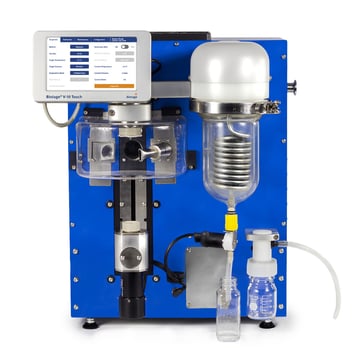
Our goal is to improve efficiency in our compound management system.
Dainippon Pharmaceutical and Sumitomo Pharmaceuticals merged in 2005. What kind of changes did the merger bring?
Ikeda: One of the duties of the screening group of the Genome Science Research Department 1, to which I belong, is the storage of hundreds of thousands of low-molecular-weight organic compounds (including those purchased from external sources) that will serve as sources for drug discovery. These compounds are mainly used for high-throughput screening (HTS), but as part of this work it is necessary to efficiently create a library of in-house synthesized compounds and submit them for assays. Taking the opportunity of the merger, we unified the vial standards for storing compounds and introduced an automated warehouse system linked to a barcode system. Originally, in-house synthesized products were submitted for assays either as a powder or after dissolution in DMSO (dimethyl sulfoxide), but for safety reasons, we decided to submit all of the compounds in DMSO as powders are difficult to handle.
DMSO is excellent for screening experiments, but difficult to remove
You use DMSO as a solvent for submitting compounds for assays. Why did you choose that methodology, and what challenges did it bring?
Ikeda: In HTS, compounds are dissolved in DMSO, which easily mixes with both water and oil. DMSO has little effect on the cells and proteins used in the assays, and does not volatilize easily, so it is a very convenient solvent that can be accurately added in microliter units. However, due to its high boiling point of 189 °C, we found it very difficult to remove.
Prior to the use of the Biotage® V-10 Touch, how did you handle recovery of samples dissolved in DMSO?
Nishino: In the past, samples were submitted in the form of powder, and due to the challenge of solvent removal only about 10–15% of all samples were submitted dissolved in DMSO. As DMSO is difficult to remove, samples that we wanted to keep were frozen in solution. However, if a compound is stored in DMSO for a long time, moisture absorption occurs, and the quality deteriorates. In such a case, unfortunately, we would have to discard the sample. Evaporation of the DMSO would be a far better solution to this issue than long-term storage. So, with our new plan to submit all samples in DMSO, an evaporation solution was required.
There are many evaporator systems available, so what made you choose the Biotage® V-10 Touch?
Nishino: There are various drying methods such as freeze- drying and centrifugal evaporation, but in each case it is necessary to process a large number of samples at once. These methods also often require re-formatting of the vial, which is a manual handling step. Ideally, we would be able to evaporate the DMSO from the same vial we are using to submit the assay.
Ikeda: Heating must be done quickly to avoid sample decomposition. The freeze-drying method has no problem with temperature conditions, but processing takes too long, so the number of samples that can be processed at one time is limited. Through our investigations and conversations with Biotage, we recognized that the Biotage V-10 Touch is a device that can evaporate DMSO from compounds in sample submission vials in a short time while keeping the temperature around 45 °C.
So, with your Biotage® V-10 Touch in place, how many samples are you currently processing?
Nishino: The number of samples to be processed may be as high as 50 per day. With the Biotage® V-10 Touch, it takes about 13 minutes to dry up one vial [set temperature 46 °C, 2 mL of DMSO solution in a 4 mL vial], and 16 samples can be set in the carousel at once. Once the method is set up, other tasks can be addressed until evaporation is complete, making for a very efficient workflow.
Have you had any issues with the Biotage® V-10 Touch so far?
Nishino: No real issues. In general, maintenance is limited to cleaning the seals, which is a quick and simple procedure, and due to the design of the system, there is no sample loss due to bumping.
How do you plan to use Biotage® V-10 Touch in the future?
Ikeda: In order to evaporate samples more efficiently, we are looking to update the carousel to a larger system.
Thank you for taking the time out of your busy schedules to talk with us today.
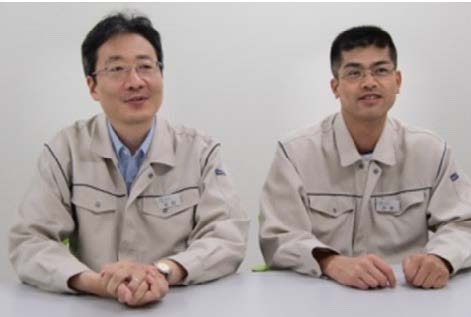
Masahiko Ikeda (left)
Sumitomo Dainippon Pharma Co., Ltd., Genomic Science Research Institute, Genome Science Research Department 1, Screening Group, Senior Researcher, Doctor of Pharmacy.
Fumitaka Nishino (right)
Sumitomo Dainippon Pharma Co. , Ltd., Genome Science Research Institute, Genome Science Research Department 1, Screening Group.
Literature Number: PPS694
