
Abstract
This study focused on evaluating purified protein yields from PhyTip® columns against other common technologies, namely filter plates, spin columns and magnetic beads. PhyTip® columns containing ProPlus (MabSelect Sure) and Ni-IMAC resins were used to purify IgG spiked in CHO cells and His-eGFP in BL21 cells, respectively. Capacity testing showed that PhyTip® columns outperformed filter plates, spin columns, and magnetic beads, offering superior binding efficiency and higher yields across various protein concentrations. Besides yield, we have highlighted the ease of use, ease of automation, and process control benefits of PhyTip® columns, making them the product of choice for protein purification applications.
Introduction
Small-scale protein purification serves as a rapid and efficient method for screening samples for protein expression, stability, and functionality prior to scaling up to larger volumes, during both research and process development stages. This small- scale protein purification approach conserves samples by minimizing material usage and the purification process can be expedited through parallel high-throughput techniques. Common platforms that are well-suited for small-scale protein purification include PhyTip® columns, spin columns, filter plates, and magnetic beads.
The primary objective in screening labs is to isolate substantial quantities of protein for downstream analysis/ assay. The main goal in process development revolves around optimizing purification methods and refining protocols to ensure reproducibility and facilitate seamless scalability for production. Various challenges that often impede protein purification efficiency in both screening and process development labs, includes low protein yields, sample handling errors, equipment limitations, and restricted throughput. PhyTip® columns, designed with automation in mind, overcome these challenges and are rapidly gaining recognition as a key protein purification technique.
The unique Dual-Flow Chromatography (DFC) design of PhyTip® columns maximize sample binding to the resin and is optimal for high protein recovery. Through a series of sample and buffer aspiration and dispensing sequences directly through the resin-packed tip, DFC captures and releases biomolecules, offering a level of process control that is both automatable and reproducible.
This paper provides a comparison of how PhyTip® columns efficiently purify proteins relative to other commonly used protein purification platforms namely filter plates, spin columns and magnetic beads. Yields were compared across purification platforms by saturating the resin to its dynamic binding capacity with protein.
Materials used
The comparative study was performed using Biotage 40 μL Ni-IMAC resin bed, 1 mL Hamilton tip (P/N: PTH-91-40-03); Cytiva Hi MultiTrap FF Ni Sepharose 6 Fast Flow Filter plate (P/N: 28400990); ThermoFisher Scientific Pierce™ Spin Columns Snap cap (P/N: 69725); ThermoFisher Scientific Pierce™ High Capacity Ni-IMAC MagBeads, EDTA compatible (P/N: A50591); Biotage 20μL ProPlus resin bed, 1mL Hamilton tip (P/N: PTH-91-20-07); Cytiva PreDictor MabSelect SuRe Filter Plate (P/N: 28925824); ThermoFisher Scientific Pierce™ High Capacity ProA MagBeads (P/N: A53036); Millipore Sigma IgG from Human Serum (P/N: 14506). All platforms used Biotage standard IMAC buffer kit (P/N: BUF-01-00-03) and Biotage standard ProPlus buffer kit (P/N: BUF-01-00-01) for respective experiments.
Methodology
Ni-IMAC resin with His-eGFP samples:
His-eGFP expressed in BL21cells were purified with Ni-IMAC resin to test capacity across the four platforms, mentioned above. For each platform, four concentrations (1 mg /mL, 0.9 mg /mL, 0.6 mg /mL, and 0.3 mg mL) of His-eGFP sample were purified in triplicate using 40 μL of Ni-IMAC resin bed to determine capacity of each platform. Note for filter plates, 50 μL of Ni-IMAC resin was used since Cytiva did not carry 40 μL Ni-IMAC resin filter plates. The His-eGFP was diluted with 1x PBS. Each platform used 200 μL of elution buffer. This was repeated twice for a total final volume of 600 μL. Yield was measured using fluorescence spectroscopy of the expressed GFP on a ThermoFisher ScientificTM NanoDropTM at 490nm wavelength. The NanoDropTM.
ProPlus resin with IgG samples:
In order to mimic realistic samples used in antibody research labs, IgG from human serum proteins were spiked in CHO media and were tested for capacity against four platforms, mentioned above. For each platform, four concentrations (4 mg/mL, 3 mg /mL, 2.25 mg /mL, and 1.5 mg /mL) of human IgG sample were tested in triplicate on a ProPlus 20 μL resin bed to determine the capacity of each platform. Each platform was eluted with 200 μL of elution buffer. The eluted sample was analyzed using nanodrop measurement. This was repeated twice for a total final volume of 600 μL elution.
Results and discussion
Ni-IMAC resin testing
Significantly higher yields of His-eGFP protein were obtained using PhyTip® columns with Ni-IMAC resin compared to filter plates, spin columns, and magnetic beads. PhyTip® columns with 40 μL Ni-IMAC resins performed significantly better than filter plates, spin columns, and magnetic beads for the three starting His-eGFP concentrations,1 mg/ml, 0.9 mg/ml, and 0.6 mg/ml (Figure 1).
Many factors influence capacity including resin specificity, sample characteristics, and sample-to-resin interactions. The DFC mechanism of the PhyTip® columns maximizes binding efficiency and, in turn, maximizes the use of its resin capacity. Biologic samples such as recombinant proteins typically exhibit slow binding kinetics. Sufficient sample residency time on column is therefore crucial for efficient binding. This can be easily controlled for Phytips with DFC, by multiple pass-throughs of the sample through the column1. In comparison, the sample flow-through speed through spin columns or filter plates is very fast and difficult to control. This limits the time for sample to interact with the resin resulting in insufficient binding, and, hence, inefficient protein purification.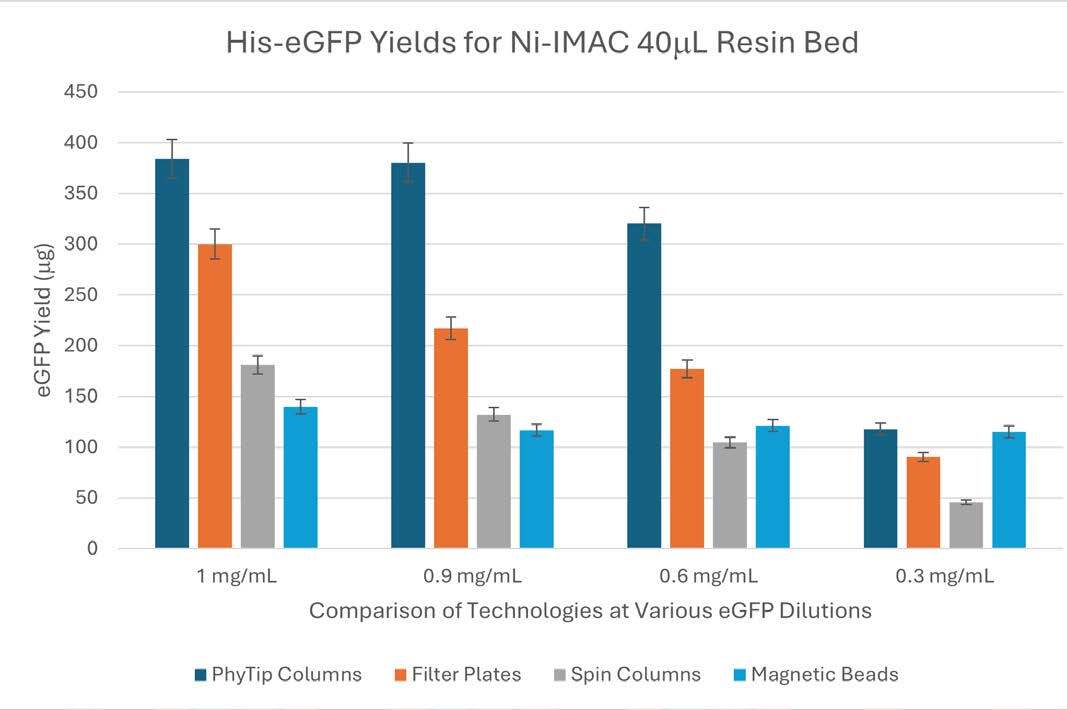 Figure 1. The eGFP capacity testing on 40 µL of IMAC resin are an average of triplicates for each of the samples shown above. The dilutions were prepared with 1x PBS.
ProPlus resin testing
Significantly higher human IgG yields were achieved using PhyTip® columns with a 20 μL ProPlus resin bed as compared to filter plates, spin columns, or magnetic beads across a series of dilutions ranging 1.5 mg/ml to 4 mg/ml (Figure 2). PhyTip® columns with ProPlus resin consistently outperformed other technologies, particularly at higher concentrations, showcasing their performance even at 4 mg/ml of IgG. These findings underscore the efficacy of PhyTip® columns in achieving higher protein yields across different concentrations, positioning them as a reliable choice for protein purification.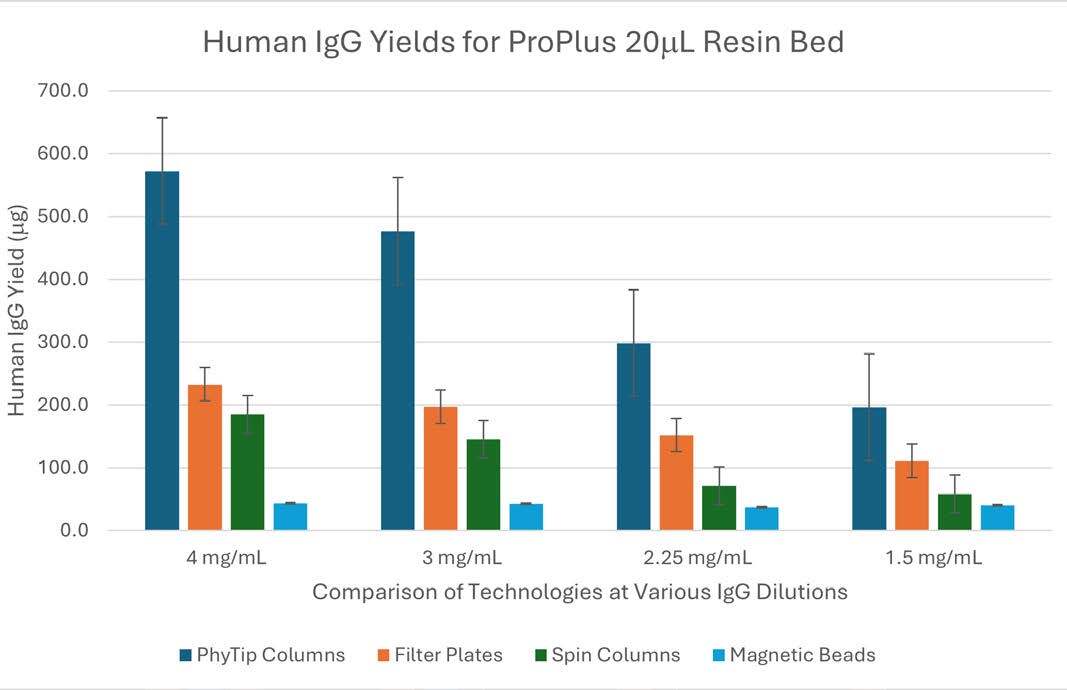 Figure 2. Human IgG capacity testing on 20 µL of ProPlus resin. Each sample seen is the average of triplicates for each dilution. The IgG protein sample is diluted and spiked with CHO media.
Biomolecules are easier to load on smaller resin-bed volumes. As the resin-bed volume size increases, there is typically a decrease in binding efficiency. However, PhyTip® columns offer better binding efficiency independent of resin bed volume. This is because DFC achieves prolonged and more complete perfusion of the resin bed, regardless of kinetic rate constants. The resulting separations are unaffected by column bed size, while additionally enabling fine control over separation parameters and allowing repeatable concentration of the sample as it passes through the resin.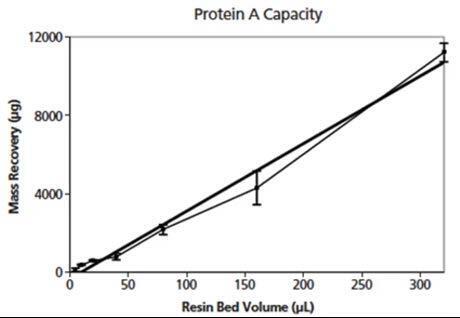 Figure 3. DFC efficiently binds protein to the specifications of the resin manufacturer. The yield accurately scales with resin bed volume. Experiments performed with 5- to 320-µL bed volumes packing into a 1mL pipette tip column and agarose-based protein A affinity resin.1
The scalability of PhyTip® columns is demonstrated in Figure 3, which shows a clear relationship between the volume of the resin bed and the amount of protein recovered. The study1 looked at the recovery of an IgG protein using columns with resin bed volumes ranging from 5 to 320 µL and confirmed that the capacity of PhyTip® columns matched the specifications provided by the resin manufacturer under saturating conditions.
Conclusion
PhyTip® columns are specifically designed to automate and maximize binding efficiency and reduce overall sample processing time. While competitive technologies struggle to achieve higher yields with smaller resin bed volumes, PhyTip® columns do not have this limitation. The range of available resin bed sizes enables researchers to optimize and scale their purification protocols for highest yields and protein concentration.
Supplemental information
Protein purification platform protocols
Conditions were established according to the standard protocols for each platform. Although results may vary with optimization, the performance of each platform was evaluated based on the respective manufacturer’s protocols.
PhyTip® columns protocol: This protocol followed the pre-gener- ated automated script designed to run on liquid handlers. A cycle refers to one sequence of aspiration, pause, dispense and pause commands. Pre-generated script proceeds as follows: equilibration, sample capture, wash, elute. Figure 4. Screenshot of the parameters set for PhyTip® columns for automated liquid-handling platform. The parameters can be altered to meet specific requirements of the experiment prior to each run.
Filter plate protocol: Followed manufacturer’s standard protocol. Protocol steps included: equilibration (x3), sample capture, incubation (30 mins), wash (x3), elution.
Spin columns protocol: Followed manufacturer’s standard protocol. The spin columns were filled with resin for respective ProPlus and IMAC testing. Protocol steps included: equilibra- tion, sample capture, wash, elution. The spin columns were centrifuged for 15 seconds at 10,000 x g for each step.
Magnetic beads protocol: Followed Opentrons pre-generated automation standard script. Protocol steps included: equilibra- tion, sample capture, incubation (30 minutes), wash (x2), elution.
Reference
1https://www.chromatographyonline.com/view/dual-flow-chromatography
Literature Number: WP03
