
By Austin Schlirf
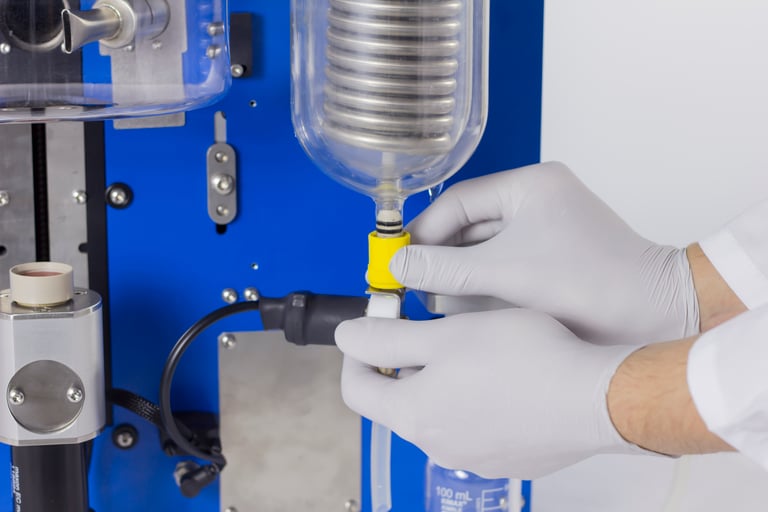
Removing solvent from purified products or from stored stock solutions is a major part of the organic synthetic workflow. Additionally, this dry down might be used while performing solubility experiments, taking aliquots from samples that are best stored dry, or when you make a mistake when adding solvent and it’s easier to dry it back down then re-aliquot. This can often lead to multiple exposures to evaporation cycles that use heat to speed up the evaporation process. In today’s post, we’ll work to answer the following: How does this applied heat affect my sample and can I see degradation over multiple evaporation cycles.
The Biotage® V-10 Touch operates by using high angular velocity rotation to reduce the chance of evaporative “bumping” and increase evaporative surface area. This enables rapid sample evaporation, but also comes with a reduction in temperature due to evaporative loss. When the sample cools it becomes more difficult to evaporate leading to longer evaporation times. Therefore, the V10 utilizes an adjustable power heating feedback loop to heat the sample to a target temperature.
Biotage has optimized methods specifically designed for the solvent being evaporated but not all samples are created equal. Below are two molecules that will be our test subjects to help determine if in fact evaporation at elevated temperature causes degradation. A diamide and an anhydride, were selected as representative examples for common end products or intermediates you may find in your synthetic pathway, Figure 1.
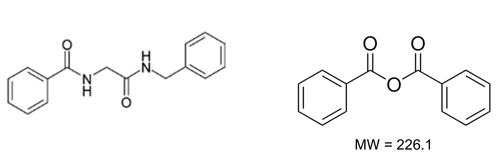
Figure 1: Structure of N-[2-(benzylamino)-2-oxoethyl]benzamide (left) and benzoic anhydride(right) used as representative examples in this study.
Each sample was dissolved in methanol and evaporated using the “Volatile” method. This method has a target temperature of 36˚C and target pressure of 30 mbar. An aliquot was taken to measure degradation after 0, 5, and 10 evaporation cycles. Under these conditions, I expect little to no degradation for the diamide sample and significant degradation for the anhydride. To quantify degradation, I used analytical LC/MS and integrated either the UV (benzoic anhydride) or TIC (diamide) peak to determine degradation of the pure samples. A loss of signal intensity from either signal indicates degradation.
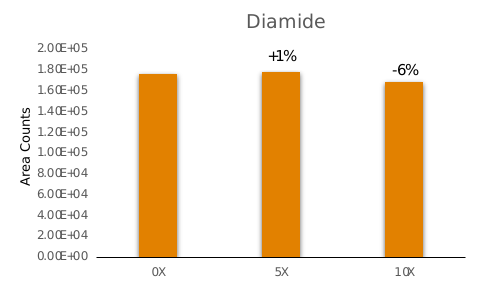
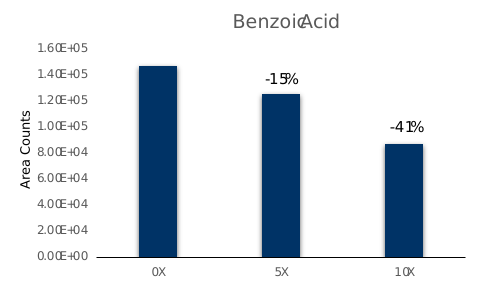
Figure 2. Top: Degradation of diamide sample after 0, 5, or 10 evaporation cycles. Bottom) Degradation of anhydride sample after 0, 5, or 10 evaporation cycles.
As expected, the benzoic anhydride is much more sensitive to the repeated, heated evaporation cycles compared to the diamide. This is most likely due to the sensitivity of an anhydride to air and moisture which can be exacerbated under heated conditions. There is the possibility that this degradation could be ameliorated by reducing the target temperature for the evaporation process; which increases drying time slightly, but can help protect your compounds in the long run.
How have you reduced the degradation risk during evaporation? Click here to learn how others have taken advantage of rapid evaporation with the Biotage® V-10 touch in their synthetic workflows.
