
Therapeutic discovery programmes often depend on the rapid evaluation of large and diverse plasmid libraries. These may include antibody-expression constructs, antigen-expression plasmids, transfer vectors, helper plasmids, packaging plasmids, and capsid variants. As construct numbers increase, plasmid preparation can become a bottleneck—particularly when downstream mammalian-cell transfection requires consistent yield, purity, and low endotoxin.
DEAE PhyTip® columns, packed with Astrea Bioseparations DEAE PuraBead® HF resin, provide an automation-ready approach to plasmid DNA purification for parallel screening workflows. The workflow combines manual sample preparation with automated plasmid capture, washing, and elution, and is designed to reduce repetitive handling and support sample-to-sample consistency.
A practical hybrid workflow
The workflow begins with bacterial cell-paste preparation, followed by resuspension, alkaline lysis, neutralisation, and clarification. Clarified lysate is then conditioned with an endotoxin-removal buffer before automated purification using 1,000 µL PhyTip® columns packed with 160 µL of DEAE PuraBead® HF resin.
Once samples are loaded, the automated process performs equilibration, capture, washing, and elution. The two elution fractions may be pooled to maximise recovery, with an optional isopropanol precipitation step used to concentrate the purified plasmid DNA before downstream analysis or application.
Workflow at a glance (Figure 1): Manual preparation—bacterial cell-paste preparation, resuspension, alkaline lysis, neutralisation, clarification, and conditioning with endotoxin-removal buffer. Automated purification—equilibration, capture, washing, and elution. After purification—the two elution fractions may be pooled to maximise recovery, followed by optional isopropanol precipitation to concentrate the plasmid DNA.
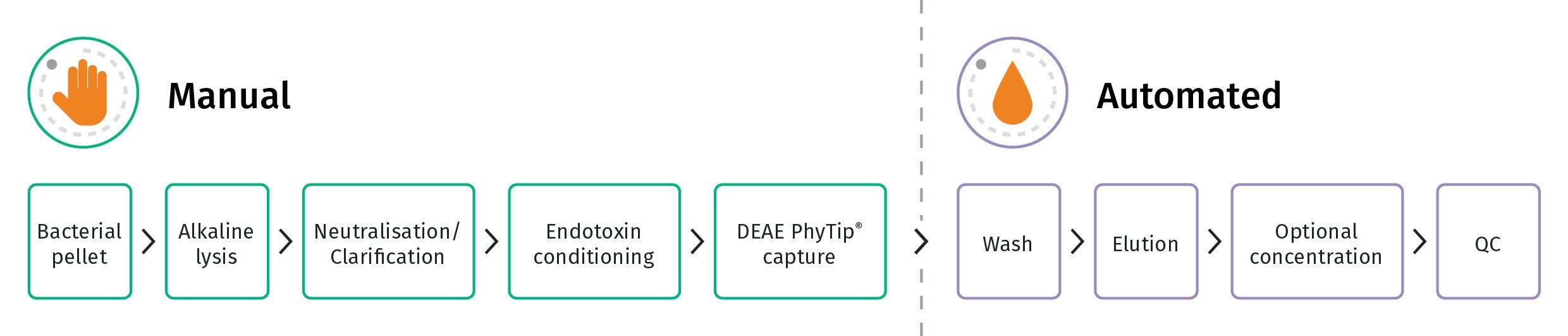 Figure 1. Workflow at a glance.
This combination of manual upstream preparation and automated purification is suited to laboratories that need to process multiple constructs in parallel without relying on a fully manual plasmid-prep workflow. The PhyTip® format is compatible with a range of liquid-handling platforms, supporting scale-up according to laboratory automation capacity.
Consistent plasmid recovery across replicates
The workflow was evaluated using a high copy mCherry plasmid preparation. Six DEAE PuraBead® HF PhyTip® columns were run in parallel, followed by plasmid concentration and quality assessment using UV-Vis, endotoxin testing, and agarose gel electrophoresis.
Table 1. The results showed consistent post-concentration recovery and quality across the six samples. Results are based on six parallel mCherry plasmid purifications using 160 µL DEAE PuraBead® HF PhyTip® columns. Yield, concentration, purity, and endotoxin values were measured after the concentration step.
|
Performance measure |
Result |
|
Average plasmid recovery |
113 ± 5 µg per sample |
|
Final DNA concentration |
1.2 ± 0.06 µg/µL |
|
A260/A280 purity ratio |
~1.92 |
|
A260/A230 purity ratio |
>2.0 |
|
Endotoxin after concentration |
1.1 ± 0.2 EU/µg |
|
Demonstrated parallel processing |
6 PhyTip® purifications
|
|
Automated purification runtime |
~1 h 45 min |
The reported UV purity ratios and low residual endotoxin support use of the recovered plasmid DNA in downstream transfection workflows. Importantly, the results also demonstrate reproducibility across parallel tips, helping teams generate comparable material when screening many related constructs.
Designed for discovery workflows
For antibody-expression, vector-development, and cell-based screening teams, the value of high-throughput plasmid purification is not simply faster processing. It is the ability to generate reliable plasmid material across a broad range of constructs while reducing manual variability and hands-on burden.
In this study, six samples were purified in parallel on a Biotage® ME automated pipette. Higher throughput may be possible with the wider PhyTip® format on other automation platforms, depending on instrument configuration and workflow design; it was not demonstrated in this six-sample evaluation.
By integrating automated capture, wash, and elution with straightforward upstream lysis and clarification, the DEAE PuraBead® HF PhyTip® workflow offers a practical route from construct generation to purified plasmid DNA for functional biological testing.
Learn more
For experimental methods including liquid-handling parameters, concentration steps, and replicate-level results, access the complete application note.
