
The growing challenge of scaling plasmid DNA production
As the field of gene therapy matures, the Adeno-Associated Virus (AAV) has solidified its position as the "gold standard" for therapeutic gene delivery. Its exceptional safety profile, tissue versatility, and capacity for long-term expression have made it the vehicle of choice for treating a diverse array of genetic disorders, from hemophilia to spinal muscular atrophy.
However, as the industry transitions from academic discovery to clinical and commercial manufacturing, the production of high-quality plasmid DNA (pDNA) emerges as a significant hurdle. In the race to bring life-changing therapies to patients, the manual methods of the past are becoming the bottlenecks of the present. Automated plasmid purification offers a scalable solution, reducing hands-on time by up to 95% while improving AAV yields
Why manual plasmid purification limits AAV production
For decades, the Maxi, Mega, and Giga-prep kits became the gold standard of the molecular biology lab. Researchers relied on gravity-flow kits to purify the pDNA required for viral vector production. While effective at a small scale, these manual processes are labor-intensive, repetitive, and highly susceptible to human error.
As bioprocessing demands higher throughput, manual purification cannot keep pace. Recent peer-reviewed research from KTH Royal Institute of Technology (Stockholm, Sweden), highlights the growing need to transition from manual workflows to automated systems in gene therapy manufacturing.
A head-to-head comparison: manual vs. automation
To evaluate the impact of automation, researchers compared the Biotage® PhyPrep system and (Figure 1) traditional manual kits. The study focused on the two most critical metrics in bioproduction: process efficiency and final product quality. The results demonstrate clear advantages for automated plasmid purification. 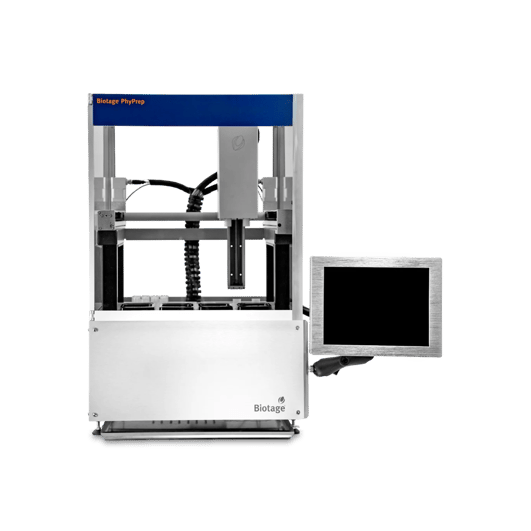
Figure 1. Biotage® PhyPrep system.
1. Dual-flow chromatography: improving DNA capture efficiency
Both the automated and manual systems utilize anion-exchange (AEX) resins to capture DNA. However, the mechanism of action differs significantly. Manual kits rely on a single-pass gravity flow. In contrast, the Biotage® PhyPrep system utilizes the patented Vaxiel™ column, which employs dual-flow chromatography (DFC).
By passing the sample back and forth over the resin bed rather than a single pass, DFC ensures maximum interaction between the DNA and the resin. This results in superior capture efficiency and higher pDNA yields compared to the "one-and-done" approach of gravity flow.
2. Radical reductions in "hands-on" time
One of the most striking findings of the study was the sheer volume of time saved. In high-throughput environments, "active" time is the most expensive resource.
The researchers reported that the Biotage® PhyPrep platform reduced active hands-on time by:
- 95% at the Giga scale
- Up to 85% at the Maxi and Mega scales
By automating the key steps such as cell lysis, clearing, and washing, can shift focus from repetitive tasks to higher-value activities like data analysis and process optimization. In commercial settings, this translates into:
- Lower operational costs
- Increased throughput
- Faster development timelines
How plasmid quality impacts AAV production performance
While yield and speed are vital, they mean nothing if the resulting pDNA fails to perform during transfection. The study found that although both methods produced similar purity ratios (260/280 and 260/230), the Biotage® PhyPrep system consistently delivered higher quality pDNA.
The real differentiator appeared during AAV production. Plasmids purified via the Biotage® PhyPrep system and resuspended in optimized elution buffer produced the highest titers in the AAV-MAX production system. Conversely, manually purified plasmids resuspended in standard Tris-EDTA (TE) buffer failed to produce detectable amounts of AAVs in some instances.
The transfection advantage of automated purification
The researchers observed that the plasmids purified with Biotage® PhyPrep formed larger, more stable transfection complexes with AAV-MAX reagents. These larger complexes significantly increased transfection efficiency. The study highlights that integrated, automated workflows allow for rapid screening of multiple candidates while using lower material volumes—a necessity for accelerating therapies toward the clinic.
Next-generation automation: purification and concentration in one workflow
It is worth noting that while the study in New Biotechnology utilized the previous generation of the Biotage® PhyPrep, the technology has since evolved. The new Biotage® PhyPrep is now an all-in-one instrument that automates both purification and concentration. It empowers researchers to streamline workflows, reduce variability, and accelerate timelines in drug discovery and development.
Modern workflows often require pDNA concentrations up to 1 mg/ml. Achieving this involves an ethanol precipitation step. The new system integrates automated on-column alcohol precipitation. These concentration kits function to both desalt and concentrate the DNA, providing high-capacity recovery in low elution volumes, ensuring the pDNA is "transfection-ready" the moment it leaves the instrument.
Why automated plasmid purification is critical for gene therapy manufacturing
The shift toward automation is no longer a luxury of "big pharma"—it is necessity for making gene therapies affordable and accessible. By leveraging automated systems like the Biotage® PhyPrep, manufacturing sites can ensure consistency, maximize yield, and significantly reduce the risk of batch failure.
As global demand for AAV-based therapies grows, our production methods must evolve. Transitioning to automated plasmid purification is a vital step in ensuring that the next generation of medicine reaches the patients who need it most, faster and more reliably than ever before.
Summary
This blog reviews how automated plasmid purification helps overcome key bottlenecks in AAV production by replacing traditional manual Maxi, Mega, and Giga-prep workflows. It outlines the differences between manual and automated systems, highlighting improvements in scalability, reproducibility, and efficiency. It also discusses how technologies such as Biotage® PhyPrep contribute to higher plasmid DNA yield and improved quality.
