
Introduction
Antibiotics, utilized in both human and veterinary medicine, are primarily administered to treat and prevent bacterial infections.1 Over the past two decades, global consumption of these medicines has rapidly increased, rising by 65% between the years 2000 and 2015.2 Such extensive use, coupled with continuous environmental discharge into surface and groundwater systems, has become a critical environmental focus due to the risk of antimicrobial resistance (AMR).3,4 Indeed, trace amounts of antibiotic residues – ranging from nanograms to micrograms per liter – are now universally detected across diverse aquatic environments.5
Conventional water treatment plants are often not optimized for the complete removal of these micropollutants, resulting in their continued accumulation in the environment. As regulatory frameworks, such as EU Watch List under the wider Water Framework Directive, continue to evolve, laboratories face continuous pressure to deliver reproducible, high-throughput analyses of multi-class pharmaceuticals at trace levels.
Extracting structurally diverse antibiotics—such as sulfonamides, fluoroquinolones, and tetracyclines—from a single water sample requires comprehensive sample preparation. Traditional, manual solid phase extraction (SPE) workflows are both time-consuming and prone to procedural errors, especially when handling the typically larger environmental sample volumes. The Biotage® PrepXpert-8 addresses these bottlenecks by automating the SPE workflow for up to eight samples in parallel, ensuring consistency in accuracy and precision, as well as seamless method optimization. This method demonstrates a dual-mode, tandem extraction approach utilizing the EVOLUTE EXPRESS® WCX (weak cation exchange) and EVOLUTE® EXPRESS AX (anion exchange) chemistries to simultaneously capture a broad spectrum of antibiotics.
Experimental
Target analytes
The analytes targeted for quantification are listed in Table 1.
Table 1. Antibiotics targeted for quantification.
|
Antibiotic class |
Target analyte(s) |
|
Diaminopyrimidines |
Trimethoprim |
|
Fluoroquinolones |
Ciprofloxacin, Danofloxacin, Enrofloxacin, Marbofloxacin, Norfloxacin, Ofloxacin |
|
Nitroimidazoles |
Ronidazole |
|
Sulfonamides |
Sulfachloropyridazine, Sulfadoxine, Sulfamethoxazole |
|
Tetracyclines |
Doxycycline, Oxytetracycline, Tetracycline |
Materials & reagents
The water used was ultrapure (18.2 MΩ·cm) and drawn daily from a Milli-Q® IX 7003 water purification system. Methanol and formic acid were of LC-MS grade and purchased from Rathburn. The analytical standards were purchased from Sigma-Aldrich and LGC. The EVOLUTE® EXPRESS WCX (3 mL, 60 mg) and EVOLUTE® EXPRESS AX (3 mL, 60 mg) cartridges used to isolate and purify the target analytes were installed in a stacked (tandem) configuration.
Extraction procedure
The extraction procedure is summarized below. The exact parameters used on the Biotage® PrepXpert-8 are summarized in Table 2.
-
Condition both sorbents with 5 mL of methanol followed by 5 mL of HPLC-grade water at a flow rate of 5 mL/min.
-
Load 40 mL of the water sample through the tandem SPE cartridges at a flow rate of 5 mL min-1.
-
Wash the tandem setup with 5 mL of 5% methanol in water to remove unbound polar interferences.
-
Dry the SPE cartridges using nitrogen for 10 minutes.
-
Elute the analytes using 4 mL of 1% formic acid in methanol. Then, rinse the sample containers with additional 4 mL of 1% formic acid in methanol to ensure any analytes remaining in the vial are collected. Use the rinsate to elute any remaining analytes from the tandem SPE cartridge setup.
-
Evaporate the combined eluate to dryness under a flow of nitrogen, with the bath temperature maintained at 40 °C. Reconstitute the dried extract in 1 mL of mobile phase (0.1% formic acid & 10% methanol in water) prior to injection.
Table 2. Biotage® PrepXpert-8 method parameters
|
Operation |
Amount |
Input |
Output |
Flow (mL min-1) |
|
Condition |
5 mL |
MeOH |
Solvent |
5 |
|
Condition |
5 mL |
H2O |
Solvent |
5 |
|
Load |
40 mL |
Sample |
Aqueous |
5 |
|
Wash |
5 mL |
5% MeOH |
Solvent |
5 |
|
Dry |
10 min |
Nitrogen |
Solvent |
- |
|
Rinse |
4 mL |
1% F.A. in MeOH |
Sample |
80 |
|
Elute |
4 mL |
Sample |
Vial A |
2 |
|
Elute |
4 mL |
1% F.A. in MeOH |
Vial A |
2 |
Analytical conditions
Separation of antibiotics was performed using a Thermo Scientific Dionex UltiMate 3000 UHPLC+. The detection of analytes was facilitated by a Thermo Scientific Quantum Access MAX triple quadrupole mass spectrometer, operating in positive electrospray ionization (ESI+) and multiple reaction monitoring (MRM) modes. Operating conditions included a spray voltage of 5000 kV, vaporizer and capillary temperatures at 300 °C and 320 °C, respectively, and argon CID gas at 135 kPa. MRM transitions, analytical parameters and the LC gradient conditions are summarized in tables 3, 4 and 5, respectively.
|
Table 3. MRM t |
|
||
|
Analyte |
MRM transition |
Collision (eV) |
|
|
Ciprofloxacin |
332.07 → 245.00 |
25 |
|
|
Danofloxacin |
358.05 → 314.00 |
18 |
|
|
Doxycycline |
445.08 → 428.16 |
20 |
|
|
Enrofloxacin |
360.06 → 316.18 |
20 |
|
|
Marbofloxacin |
363.04 → 320.07 |
15 |
|
|
Norfloxacin |
320.02 → 276.15 |
20 |
|
|
Ofloxacin |
362.06 → 318.15 |
20 |
|
|
Oxytetracycline |
461.12 → 426.06 |
20 |
|
|
Ronidazole |
201.00 → 140.10 |
10 |
|
|
Sulfachloropyridazine |
285.05 → 156.00 |
15 |
|
|
Sulfadoxine |
310.99 → 156.05 |
20 |
|
|
Sulfamethoxazole |
254.05 → 156.00 |
15 |
|
|
Tetracycline |
445.11 → 428.13 |
25 |
|
|
Trimethoprim |
291.07 → 230.17 |
25 |
|
Table 4. Analytical conditions.
|
Parameter |
Condition |
|
Column |
C18 (2.1 x 50 mm, 1.7 µm) |
|
Mobile phase A |
0.1% F.A. in H2O |
|
Mobile phase B |
0.1% F.A. in MeOH |
|
Flow rate |
0.4 mL min-1 |
|
Injection volume |
10 µL |
|
Detection |
ESI+ |
Table 5. LC gradient conditions.
|
Time |
Flow (mL min-1) |
%A |
%B |
|
0.01 |
0.4 |
90 |
10 |
|
1.00 |
0.4 |
90 |
10 |
|
3.00 |
0.4 |
5 |
95 |
|
4.00 |
0.4 |
5 |
95 |
|
4.01 |
0.4 |
90 |
10 |
|
8.00 |
0.4 |
90 |
10 |
Results
Selectivity & specificity
To evaluate the specificity of the assay, both blank and spiked water samples were analyzed. The results demonstrated accurate quantification of all target antibiotics, free from any interference. Representative chromatograms obtained from a 0.1 µg L⁻¹ standard are shown in Figure 1.
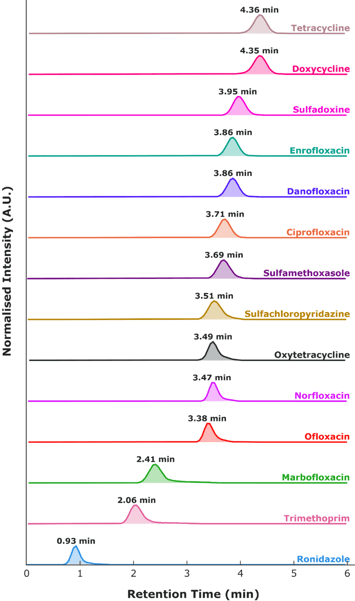 Figure 1. Separation of antibiotics. Chromatograms are normalized and offset for clarity.
Linearity & range
To evaluate linearity, linear regression analysis was performed on calibration standards prepared at seven concentration levels (0.05, 0.1, 0.15, 0.2, 0.25, and 0.5 µg L-1) and analyzed in duplicate. The analytical method exhibited excellent linearity over the specified range (0.05—0.5 µg L-1), yielding R² ≥0.99 for all calibration curves. A representative calibration plot is presented in Figure 2.
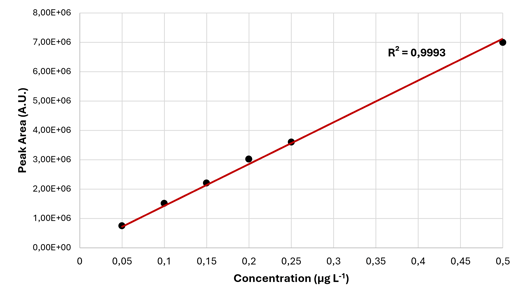 Figure 2. Calibration curve for ronidazole.
Limits of detection & quantification.
Evaluation of the assay’s sensitivity was carried out by calculating the limit of detection (LOD) and limit of quantification (LOQ) using signal-to-noise ratios of 3:1 and 10:1, respectively. The resulting LOD and LOQ were 0.05 µg L-1 and 0.1 µg L-1, respectively.
Accuracy & precision
Method accuracy and precision were evaluated by extracting blank drinking water samples spiked with each antibiotic at 0.25 µg L-1. Individual injection recoveries ranged from 72% to 109%, demonstrating acceptable accuracy for these concentrations. Precision, expressed as percentage relative standard deviation (%RSD, also known as coefficient of variance) from ten replicate injections, was also appropriate for the concentrations used and ranged between 5 and 11%. Acceptance criteria of 70–120% recovery and ≤20% RSD were applied as fit-for-purpose performance criteria for analytical method performance, following the general principles outlined in the Eurachem guide.6 Average recoveries and their corresponding %RSD, shown as error bars, are presented in Figure. 3.
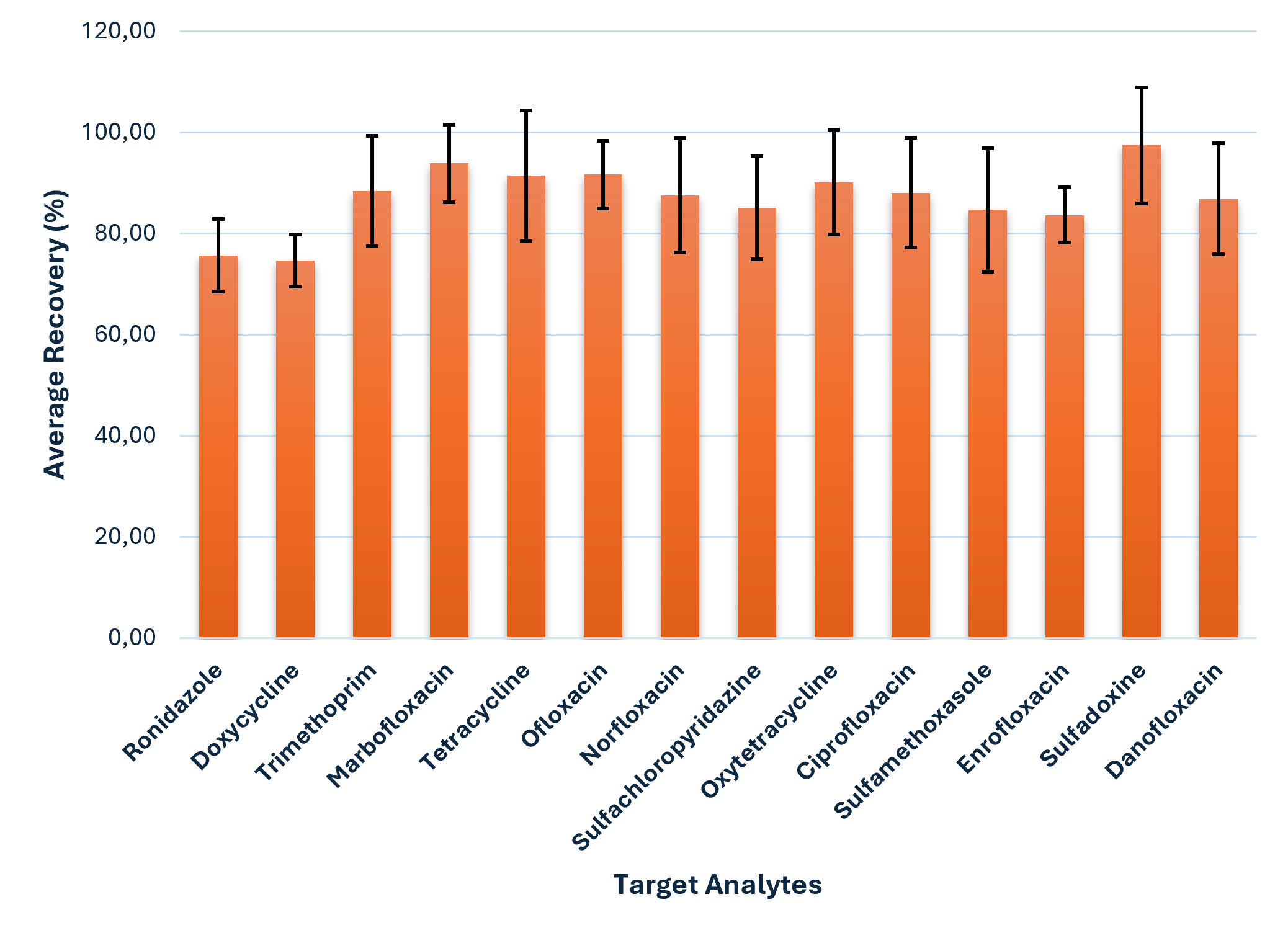 Figure 3. Average recoveries (%, n=10) of antibiotics spiked into drinking water at 0.25 μg L-1. RSDs (%) are shown as error bars.
Conclusions
The automated solid-phase extraction (SPE) utilizing the Biotage® PrepXpert-8 provides an effective, high-throughput solution for the trace-level analysis of multi-class antibiotics in drinking water. Employing a tandem extraction approach with the EVOLUTE EXPRESS® WCX and EVOLUTE EXPRESS® AX chemistries, the method successfully extracted 14 structurally diverse analytes, overcoming the temporal and procedural constraints, as well as errors, often associated with traditional manual extractions.
The analytical method demonstrated a strong performance, achieving accurate, interference-free quantification with excellent linearity across the targeted calibration range. Moreover, the assay is shown to be highly sensitive, offering limits of detection and quantification suitable for routine trace-level monitoring. The method maintained acceptable analyte recovery rates and demonstrated good precision across replicate injections, confirming its reliability for routine application.
Overall, the ability to automate the extraction of up to eight samples in parallel ensures the consistency, precision and efficiency necessary for the monitoring of aquatic micropollutants in accordance with the evolving environmental regulations.
Literature number: AN1041
References
1. H. Wang et al. Antibiotic residues in meat, milk and aquatic products in Shanghai and human exposure assessment. Food Control (2017).
2. Grgić et al. UV filters as a driver of the antibiotic pollution in different water matrices. Journal of Environmental Management (2021).
3. C.F. Poole New trends in solid-phase extraction. TrAC Trends in Analytical Chemistry (2003).
4. M. Gbylik-Sikorska et al. Liquid chromatography–tandem mass spectrometry multiclass method for the determination of antibiotics residues in water samples from water supply systems in food-producing animal farms. Chemosphere (2015).
5. S. Matongo et al. Pharmaceutical residues in water and sediment of Msunduzi River, KwaZulu-Natal, South Africa. Chemosphere (2015).
6. Cantwell, H. (ed.) The Fitness for Purpose of Analytical Methods: A Laboratory Guide to Method Validation and Related Topics. 3rd ed. Eurachem (2025).
