
This application note describes the extraction of a range of SPICE drugs and metabolites in urine which are typically screened in forensic toxicology panels using ISOLUTE® SLE+ in a 96-well plate format. Both manual (Biotage Pressure+ 96) and automated (TECAN Freedom EVO® 100) processing conditions are described.
Introduction
Synthetic cannabinoids have become an increasing problem as an ever changing target for detection during drug screening. A clean and fast extraction method is needed for accurate detection and quantitation of illicit drugs in biological matrices. Supported liquid extraction addresses this need.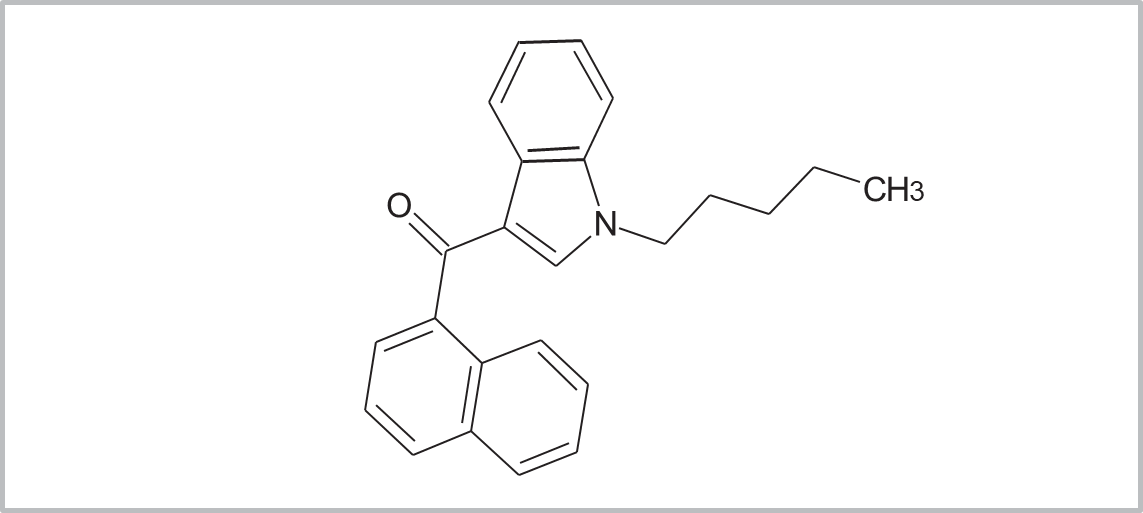
Figure 1. Structure of JWH 018
ISOLUTE SLE+ Supported Liquid Extraction plates and cartridges offer an efficient alternative to traditional liquid-liquid extraction (LLE) for bioanalytical sample preparation, providing high analyte recoveries, no emulsion formation, and significantly reduced sample preparation time.
Analyte
JWH-018, JWH-073, JWH-200, JWH-250, JWH-250-N-(5-hydroxypentyl), JWH-018-N-5-(pentanoic acid), JWH-073 N-(3-hydroxybutyl), JWH 018 N-(4-hydroxypentyl), XLR-11, UR-144, UR-144 (5-Chloropentyl), UR-144-(pentanoic acid), UR-144-(5-hydroxypentyl)
Fully automated sample preparation workflow using Tecan Freedom EVO®100 Work Station
Format: ISOLUTE® SLE+ 400 µL Supported Liquid Extraction Plate, part number 820-0400-P01
TECAN pre-planning: The pipetting strategy of buffers, samples and solvents was planned to minimize pipette tip usage and add solutions as needed with no risk of sample cross contamination. The sample, buffer and solvent volumes are limited to the 96-well volumes and should be predetermined based on empirical knowledge. Calibration, QC and fortified standards were prepared offline.
Urine hydrolysis station: (96-well collection plate): Pipette in this exact order: ammonium acetate (100 mM, pH 5, 380 µL), β-glucuronidase (5000 units/mL, 10 µL), urine (400 µL, calibration standard, QC standard, blank or patient sample) and internal standard (20 µL) into designated wells. Agitate sample plate and heat to recommended enzyme conditions for 60 minutes. This step can also be conducted offline.
Pre-treatment station: (96-well collection plate): Pipette hydrolysed urine samples (400 µL) and ammonium hydroxide (2%, v/v, 400 µL) into designated wells. Mix the solution by aspirating and dispensing several times into well.
Extract station: (ISOLUTE® SLE+ plate): Pipette 400 µL of pre-treated samples into designated wells of ISOLUTE SLE+ extraction plate. Apply a short pulse of vacuum to initiate flow and then allow sample to absorb for 5 minutes. Apply ethyl acetate (2 x 700 µL) into each well and allow solvent to flow under gravity. Apply brief vacuum pulse.
Post extraction: Evaporate sample to dryness and reconstitute in mobile phase
Manual sample preparation workflow for Biotage® Pressure+ 96 Manifold
Format: ISOLUTE® SLE+ 400 µL Supported Liquid Extraction Plate, part number 820-0400-P01
Urine hydrolysis: Add β-glucuronidase at a concentration of 5000 units/mL to 1 mL of patient urine, fortified calibration standards and QC standards in appropriate container. Add ammonium acetate (pH 5, 100 mM, 1 mL). Spike the solution with internal standard. Incubate sample as per instructions with enzyme.
Sample pre-treatment: Load 400 µL of hydrolysed urine samples onto the ISOLUTE® SLE+ 96-well plate. Apply a short pulse of positive pressure and allow samples to absorb for 5 minutes.
Analyte elution: Apply ethyl acetate (2 x 700 µL). Apply short pulses of pressure and collect eluent.
Post extraction: Evaporate sample to dryness and reconstitute in mobile phase
HPLC conditions
Instrument: Agilent 1200 Liquid Handling System (Agilent Technologies, Berkshire, UK)
Column: Mac-MOD ACE Excel 2 C18-AR, 2.1 x 100 mm i.d. (Mac-MOD Analytcal, Chadds Ford, PA.)
Mobile phase: A: 0.1% formic acid in water B: 0.1% formic acid in methanol
Isocratic: 15% A/ 85% B at 300 µL/min; 10 minute run time
Injection Volume: 10 µL
Temperature: Ambient
Mass spectrometry conditions
Applied Biosystems/MDS Sciex 4000 Q-Trap triple quadrupole mass spectrometer (Applied Biosystems, Foster City, CA.) equipped with a Turbo Ionspray® interface for mass analysis.
Ion source temperature: 500 °C
|
Scan Function |
Analyte |
MRM Transition |
Declustering Potential (DP) |
Collision Energy (CE) |
Cell Exit Potential (CXP) |
|
1 |
JWH-073 |
328>155 |
40 |
30 |
16 |
|
2 |
JWH-018 |
342>155 |
40 |
30 |
16 |
|
3 |
JWH-018 N-(4-hydroxypentyl) |
358>155 |
40 |
30 |
16 |
|
4 |
JWH-018 5-pentanoic acid |
372>155 |
40 |
30 |
16 |
|
5 |
JWH-073 N-(3-hydroxybutyl) |
344>155 |
40 |
30 |
16 |
|
6 |
JWH-250 N-(5-hydroxypentyl) |
352>120.9 |
40 |
30 |
16 |
|
7 |
JWH-200 |
385>155 |
40 |
30 |
16 |
|
8 |
JWH-250 |
336>121 |
40 |
30 |
16 |
|
9 |
d5-JWH-018 N- (4-hydroxypentyl |
363.5> 155 |
40 |
35 |
16 |
|
10 |
XLR-11 |
330>125 |
30 |
35 |
16 |
|
11 |
UR-144 |
312.5>125 |
30 |
35 |
16 |
|
12 |
UR-144 5-Chloro-pentyl |
346.9>125 |
30 |
35 |
16 |
|
13 |
UR-144 Pentanoic Acid |
342.5>125 |
30 |
35 |
16 |
|
14 |
UR-144 5-Hydroxy-pentyl |
328.5>125 |
30 |
35 |
16 |
Results
The TECAN Freedom EVO® 100 liquid handling system was set up to fully automate the process of extracting drugs from biological matrix using ISOLUTE® SLE+ in a 96-well plate format. The overall process requires a series of workstations dedicated to an enzymatic hydrolysis, sample pre-treatment and sample extraction sub-process. Figure 3 shows an illustration of the work platform set-up to facilitate processing of patient samples, calibration standards and QC standards through each sub-process station. Each sub-process is conducted in a 96-well plate. Figure 4 shows a photograph of the workstation illustrated in Figure 3.
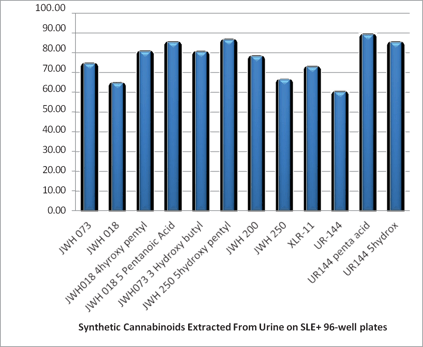 Figure 2. Plot of averaged recoveries (n=7) for SPICE drugs spiked into urine at 10ng/mL and extracted using the Biotage Positive PRESSURE+ 96 manifold.
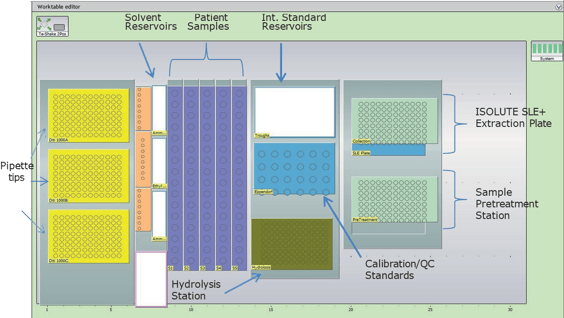 Figure 3. Illustration of Tecan Freedom Evo® 100 workstation layout for fully automated SPICE drug extraction from urine. The process set-up includes a 96-well plate station for hydrolysis of urine using enzyme, acid or base. Sample pre-treatment is facilitated in a separate 96-well plate prior to loading onto ISOLUTE® SLE+ plate for sample extraction.
Blank human urine was fortified with a suite of SPICE standards listed in Table above. The extraction of SPICE analytes from multiple biological matrices was recently reported in Application note 774. This same methodology was adapted for the programming of the TECAN Freedom EVO 100 to facilitate automation. Urine calibrators and QC standards were prepared offline and loaded onto TECAN liquid handler. The manual extraction of the SPICE suite was conducted on a Biotage PRESSURE+ 96 manifold. Initial recoveries of the analytes from the ISOLUTE SLE+ 400 µL 96-well plate were determined using the semi-automated process (Figure 2) The number of averaged samples used to determine the recoveries was seven with percent relative standard deviations less than 10.
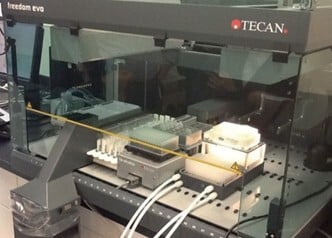 Figure 4. Picture of actual TECAN Freedom EVO® 100 liquid handling workstation used for SPICE drug extraction processing.
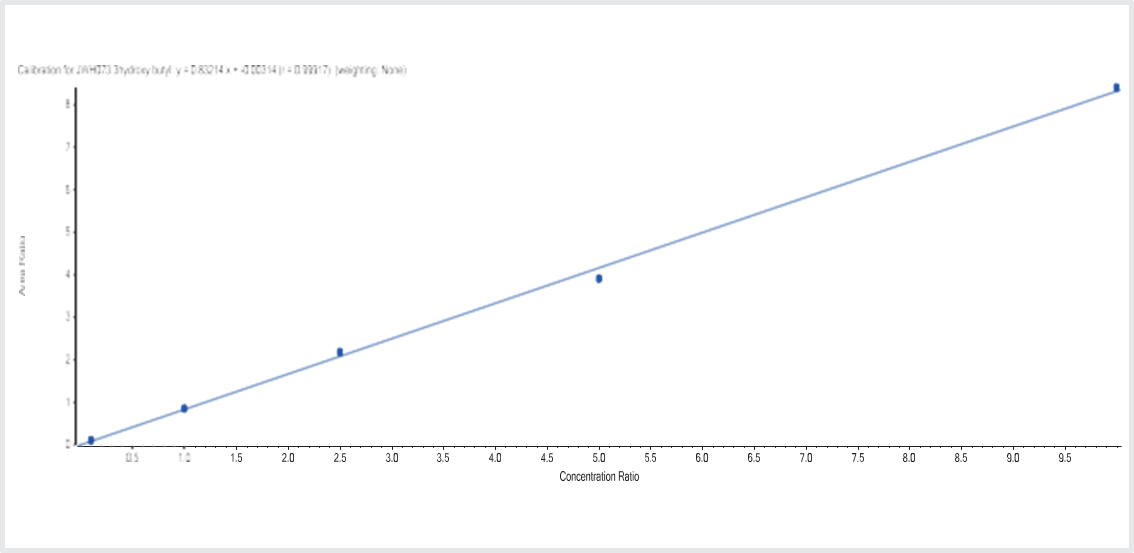
Figure 5. Calibration curve for JWH073 3-hydroxybutyl (r2>0.99) generated from calibration standards extracted using TECAN Freedom EVO 100 liquid handling system. This curve is typical for 5-level standard curve determination for all of the SPICE drug analytes.
A series of urine matrix calibration standards at 3, 5, 10, 25, 50 and 100 ng/mL were prepared offline. In-house QC check standards were prepared using a different urine matrix from the one used to prepare calibration standards. The samples were loaded onto the TECAN Freedom EVO 100 and extracted on the ISOLUTE SLE+ 400 µL 96-well plate without performing the hydrolysis step. Calibration curves were generated for each analyte. Figure 5 shows a typical calibration curve generated for each analyte. The mass spec response for each extracted QC standard was measured against the appropriate calibration curve to deter- mine the concentration for each analyte. The measured concentrations and the percent accuracy (in parentheses) for each QC analyte are listed in Table below.
|
Calculated Concentration of Fortified QC standards (% Accuracy) |
||
|
Drug Analyte |
QC 75 ng/mL |
QC 15 ng/mL |
|
JWH-073 |
52.76 (70) |
17.95 (119) |
|
JWH-018 |
55.41 (74) |
16.40 (109) |
|
JWH-018 N- (4-hydroxypentyl) |
62.57 (83) |
13.74 (92) |
|
JWH-018 5-pentanoic acid |
70.22 (94) |
15.35 (102) |
|
JWH-073 N-(3-hydroxybutyl) |
66.17 (88) |
14.92 (99) |
|
JWH-250 N-(5-hydroxypentyl) |
74.43 (99) |
15.13 (101) |
|
JWH-200 |
81.04 (108) |
17.64 (118) |
|
JWH-250 |
57.43 (77) |
13.93 (93) |
|
XLR-11 |
65.24 (87) |
15.29 (102) |
|
UR-144 |
65.17 (87) |
16.81 (112) |
|
UR-144 5-Chloro-pentyl |
83.21 (110) |
15.99 (106) |
|
UR-144 Pentanoic Acid |
73.65 (98) |
15.48 (103) |
|
UR-144 5-Hydroxy-pentyl |
59.29 (80) |
12.95 (86) |
Acknowledgements
Biotage would like to thank Bradford Elmore and Simon Fogarty of TECAN for the use of the TECAN® Freedom EVO 100 workstation and their work in facilitating this collaborative effort.
References
Extraction of Synthetic Cannabinoids (SPICE) and Metabolites from Urine, Plasma, and Whole Blood using ISOLUTE SLE+ Prior to LC-MS-MS Analysis. Biotage Application Note 774, December 2012.
Victor E. Vandell, Bradford Elmore, Simon Fogarty, Frank Kero and Elena Gairloch, “A Method for Automated Extraction of Pain Medication from Urine for Analysis by LC-MS/MS” MSACL 2013, San Diego, California.
Ordering information
|
Part Number |
Description |
Quantity |
|
820-0400-P01 |
ISOLUTE® SLE+ + 400 µL Supported Liquid Extraction Plate |
1 |
|
PPM-96 |
Biotage® Pressure+ 96 Positive Pressure Manifold |
1 |
|
SD-9600-DHS-NA |
Biotage® SPE Dry 96 |
1 |
Literature number: AN793
