
This application note demonstrates the practical application of metal scavenging in the removal of palladium from a model Active Pharmaceutical Ingredient (API).
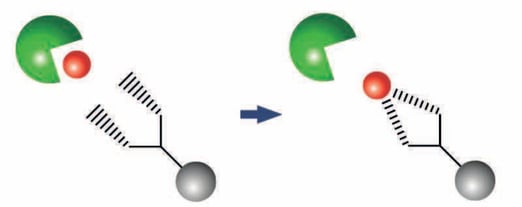
Figure 1: Metal scavenger (left). Target metal bound to metal scavenger (right).
Introduction
Biotage supported resin and silica based metal scavengers are effective reagents for the removal of trace Platinum Group Metals (PGMs) from catalysed reactions to final APIs. They are applied in a variety of different industries, from pharmaceutical to fine chemical, from agrochemical to waste treatment.
In this study, metal scavenger kit K-MS-3 was used to first screen a contaminated compound and provide the basis for an Standard Operating Procedure (SOP) for larger scale metal scavenging. The kit provides metal scavengers in an easy to use screening evaluation format with example SOPs to enable rapid determination of a suitable metal scavenging candidate for an API mixture. The metal scavengers are industry proven and supported by a regulatory qualification support package.
A 1 g cartridge of metal scavenger is a good starting point to evaluate the product of a metal catalysed reaction that used 1–2 mol % catalyst at 1 mmol scale. For larger/smaller reactions, this can be scaled accordingly.
Results
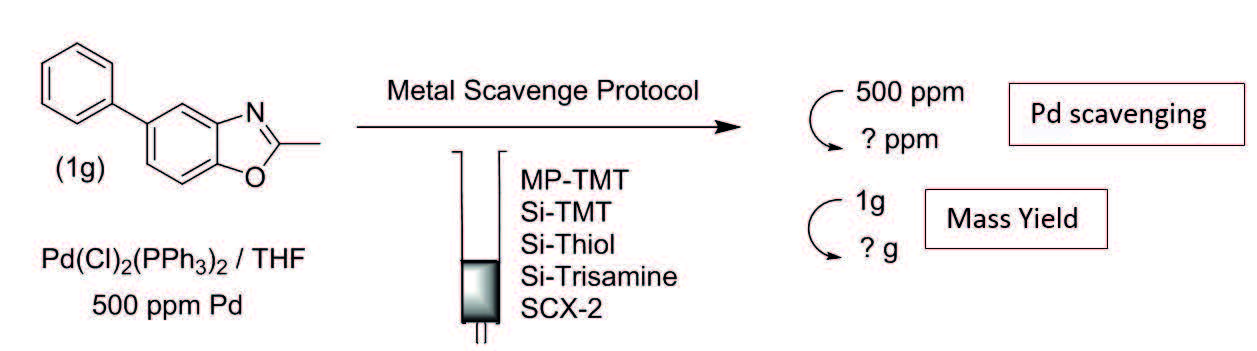
Figure 2: The initial scavenger screen
The purpose of the initial screen was to quickly identify candidates that are not likely to be effective downstream. Based on our data below, carbon (our control experiment) and ISOLUTE® SCX-2 were least effective in this application, so Biotage® MP-TMT, ISOLUTE® Si-Thiol, ISOLUTE® Si-TMT and ISOLUTE® Si-Trisamine were chosen as potential scale-up candidates.
In our work, we were also looking for method robustness, so we eliminated ISOLUTE Si-Trisamine as a candidate as its basic character may limit the downstream scope of application (for example if an API contains acidic sites). Thus ISOLUTE Si-TMT became the primary screening candidate for our scale-up trials.
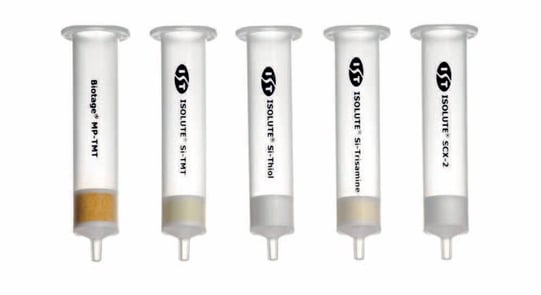
Figure 3: Convenient ready to use metal scavenging screening cartridges
|
Scavenger 1 g/15 mL Fixed Bed |
Time to Flow Through/s |
Vol. Flow Rate mL/min |
Approx. Linear Flow Rate cm/min |
Pd Before ppm |
Pd After ppm |
Mass Recovery% |
Pd Reduction % |
|
Biotage® MP-TMT |
333 |
1.8 |
1.4 |
500 |
10 |
99.3 |
98.0 |
|
ISOLUTE® Si-TMT |
440 |
1.0 |
0.8 |
500 |
9 |
99.3 |
98.2 |
|
ISOLUTE® Si-Thiol |
430 |
1.0 |
0.8 |
500 |
10 |
98.1 |
98.0 |
|
ISOLUTE® Si-Trisamine |
371 |
1.4 |
1.0 |
500 |
9 |
99.8 |
98.2 |
|
ISOLUTE® SCX-2 |
418 |
1.4 |
1.0 |
500 |
469 |
91.6 |
6.2 |
|
Carbon |
380 |
1.6 |
1.2 |
500 |
94 |
66.0 |
81.2 |
|
ISOLUTE® Si-TMT |
Vol. Flow Rate mL/min |
Approx. Linear Flow Rate cm/min |
Pd Before/ppm |
Pd After/ppm |
Pd Reduction % |
|
1 g/15 mL |
1.0 |
0.8 |
500 |
9 |
98.2 |
|
50 g fixed bed |
15 |
0.8 |
25000 |
95 |
99.6 |
Scale-up
Based on initial screening results, a number of parameters were determined for further scale-up. The aspect ratio of the fixed bed was kept consistent with the 1 g/15 mL screening experiment by the use of a 50 g Biotage® SNAP cartridge, but maintaining aspect ratio is not always necessary for metal scavenging depending on the mechanism of action.
The data shows that the scavenging performance from screen to larger scale was reliable. We noted a slight improvement in scavenging on larger scale, which we attribute to our ability to more accurately make measurements on a larger scale. It may be that the small scale screening was more effective than we recorded. Based on these results; rationale to apply metal scavenging at even larger scale exists using linear flow rates corresponding to the 50 g flow style scavenging example.
Scale-up parameters
Metal Scavenger: ISOLUTE® Si-TMT, Mass of Fixed-Bed: 50 g, Dimensions: 80 mm x 40 mm (SNAP 50 g cartridge), Flow Mode: one pass, Equilibration Protocol: 3CV clean ethyl acetate, Volumetric Flow Rate: 15 mL/min, Linear Flow Rate: 0.8 cm/min.
Mass yields
In our screen, we compared Biotage metal scavengers with a classic carbon treatment. The carbon adsorption method removed some of the palladium but it was not the most effective. More significantly, our API analogue was lost to the carbon column (recovered yields were generally 66% compared to near quantitative from the metal scavengers) denoting agreement with consensus on the generic impact of carbon adsorption processing on mass yield and atom economy. In all cases, Biotage metal scavengers afforded higher yields of API.
Equipment
Metal Scavengers, Biotage® MP-TMT, ISOLUTE® Si-TMT, ISOLUTE® Si-Thiol, ISOLUTE® SCx-2, ISOLUTE® Si-Trisamine. Format: 1 g/15 mL cartridge. Solvents: standard HPLC grade lab solvents. Other: Biotage® Gravity Rack p/n 123-2016 / 123-2019 (16 mm/ 19 mm dia tube rack).
Detailed methodology
Scavenger cartridges were equilibrated using 3–5 bed volumes of clean solvent (no need to collect eluent). 1 mL (corresponding to approx. 100 mg of dissolved API) was added to each cartridge on a Biotage® Gravity Rack and allowed to flow through under gravity at RT. [In some positions, the scavenger bed became discoloured at the surface, which is usually an indication of metal scavenging]. The cartridges were each further washed with
2–4 mL of ethyl acetate. Since the scavenged metal is tightly bound, this wash step may be increased significantly to remove any slower running API from the cartridge. The eluent from each of the tubes was evaporated to dryness. The extract was weighed and analysed for Pd content by ICP analysis.
Ordering information
|
Part Number |
Description |
Quantity |
|
121-0001 |
PTFE Stopcock/Needle Unit |
10 |
|
121-0009 |
Universal PTFE Stopcock |
10 |
|
K-MS-2 |
Metal Scavenging Toolkit - Batch |
1 |
|
K-MS-3 |
Metal Scavenging Screening Kit - SPE |
1 |
|
1201-0126-D |
Top Cap, 15 mL Colum |
100 |
|
123-2016 |
Biotage® Gravity rack with 16 mm Collection Tube Rack |
1 |
|
123-2019 |
Gravity Rack with 19 mm Collection Tube Rack |
1 |
Literature number: AN878
