
Introduction
This application note describes a solid phase extraction (SPE) protocol for the extraction of aflatoxin M1 (AM1) internally standardized with aflatoxin B2 (AB2) from infant formula using ISOLUTE® Myco SPE columns with LC MS/MS.
Mycotoxins are toxic metabolites produced by fungal molds on food crops. Regulation and legislation for testing mycotoxin contamination have established which mycotoxins are prevalent in a wide variety of food and agricultural products. This application note describes an SPE protocol appropriate for LC-MS/MS analysis of aflatoxin M1 found in infant formula.
The method described in this application note achieves high recoveries of aflatoxin M1 from infant formula with %RSDs and LOQs that all meet the requirements set in European regulations for its measurement.
ISOLUTE® Myco solid phase extraction columns provide robust, reliable sample preparation for multiple mycotoxin classes from a wide range of foodstuffs. Using a single, easy-to-use sample preparation product, scientists can prepare diverse food/crop samples for analysis by LC-MS/MS.
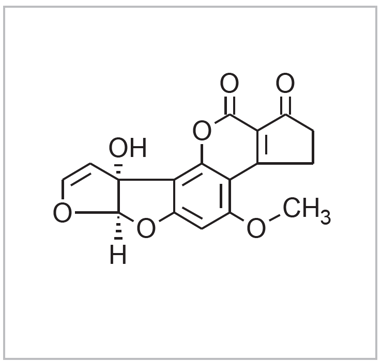
Figure 1. Structure of Aflatoxin M1
Analytes
Aflatoxin M1, aflatoxin B2 (internal standard (IS))
Sample preparation procedure
Column configuration
ISOLUTE® Myco 60 mg/3 mL column (Tabless) Part Number 150-0006-BG
Sample pre-treatment
- Sample processing: Reconstitute the infant formula according to the manufacturer’s recommendations using 1% formic acid (aq) as the solvent. Add a small volume of AB2 at an appropriate concentration (e.g. 18 μL x 100 ng/mL AB2 in 36 mL formula = 50 ng/L).
- Extraction: Shake the reconstituted formula vigorously by hand for 30 seconds. Place the sample tube in an ultrasonic water bath and sonicate for 20 minutes. Centrifuge the sample tube at 4000 g for 10 minutes.
- Work-up: Spoon off and discard the upper cream layer.
Solid-phase extraction
Use flow rates of 1 mL/min throughout
Condition
Condition the column with acetonitrile (2 mL)
Equilibration
Equilibrate column with water (2 mL)
Sample loading
Load pre-treated sample (5 mL) onto the column at a maximum flow rate of 1 mL/min (gravity load is recommended)
Interference wash 1
Wash the column with water (5 mL)
Interference wash 2
Wash the column with 10% acetonitrile (aq) (5 mL)
Drying
Dry the column for 5 minutes at maximum vacuum or positive pressure
Interference wash 3
Wash the column with hexane (5 mL)
Drying
Dry the column for 5 minutes at maximum vacuum or positive pressure
Elution
Elute with 0.1% formic acid in acetonitrile (2 mL)
Post-elution
The eluate is dried in a stream of nitrogen using a TurboVap® LV. Reconstitute in 0.1 % acetic acid in 20 % acetonitrile:methanol (1:1, v/v, 1mL). Filter using a 0.2 μm PTFE membrane filter prior to analysis.
HPLC conditions
Conditions used to generate the data in this application note. Other HPLC conditions may be appropriate.
Instrument
Shimadzu Nexera UHPLC (Shimadzu Europe Gmbh)
Column
Kinetex XB-C18 50 x 2.1 mm 2.6 µm dp (Phenomenex, Macclesfield, UK)
Mobile phase
A: 1 mM ammonium acetate, 0.5% acetic acid
B: 1 mM ammonium acetate, 0.5% acetic acid in 95% methanol (aq)
Flow Rate
0.45 mL/min
Injection
20 µL
Gradient
Initial 20 % B, hold 1.0 min
Iinear ramp to 73 % B in 6 min
linear ramp to 100 % B in 0.2 min, hold 2.3 min
linear ramp to initial conditions in 0.2 min
hold 2.3 min, total run time 10.0 min
Column temperature
40°C
Sample temperature
15°C
Table 1. Typical retention times for AM1 and AB2 using the LC-MS/MS method described
|
Retention Time (min) |
|
|
Aflatoxin M1 |
3.4 |
|
Aflatoxin B2 |
3.8 |
MS conditions
Ions were selected in order to achieve maximum sensitivity. The MS was operated in positive polarity mode, using multiple reaction monitoring.
Instrument
AB Sciex Triple Quad 5500 (Warrington, UK)
Source
Turbo-V ESI
Desolvation temperature
500°C
Curtain gas
30 psi
Spray voltage
+0.5 kV
Gas 1
60 psi
Gas 2
60 psi
Collision gas
7 psi
Table 2. Positive ion mode - MRM parameters. Note: MRM detection window 60 s / target scan time 0.1 s / settling time 50 ms/scan pause 5 ms
|
MRM transition |
RT |
Compound ID |
DP, V |
EP, V |
CE, V |
CXP, V |
|
329.0>273.3 |
3.4 |
aflatoxin M1 1 |
80 |
10 |
32 |
12 |
|
329.0>229.2 |
3.4 |
aflatoxin M1 2 |
80 |
10 |
52 |
12 |
|
329.0>301.1 |
3.4 |
aflatoxin M1 3 |
80 |
10 |
26 |
12 |
|
315.1>287.0 |
3.8 |
aflatoxin B2 1 |
100 |
10 |
35 |
12 |
|
315.1>259.1 |
3.8 |
aflatoxin B2 2 |
100 |
10 |
40 |
12 |
|
315.1>243.1 |
3.8 |
aflatoxin B2 3 |
100 |
10 |
51 |
12 |
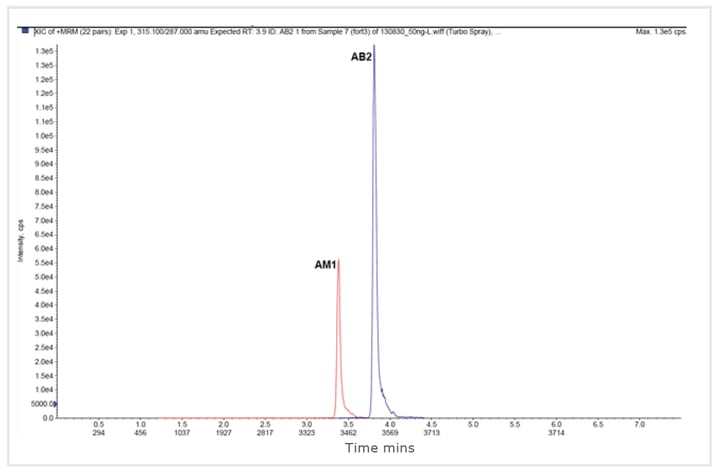 Figure 2. Extracted ion chromatograms in positive ion mode using ISOLUTE® Myco protocol at 50 ng/L (aflatoxin M1 and aflatoxin B2 (IS)) from reconstituted infant formula
Validation criteria
Method linearity was determined using internally standardized matrix-matched calibration standards in six replicates over eight levels; the ranges are shown in table 3 below.
Table 3. Working range for determination of aflatoxin M1 in infant formula (ng/L) along with corresponding LC-MS/MS on-column matrix-matched calibration range (fg/µL). Aflatoxin B2 was added for use as an internal standard at a single concentration.
|
Analytes |
Working range, ng/L (fg/µL on column) |
|
aflatoxin M1 |
2 to 100 (10 to 500) |
|
Aflatoxin B2 (IS) |
40 (200) |
Limit of quantitation (LOQ) was determined from the lowest matrix-matched standard meeting EU repeatability and recovery criteria.
Repeatability (%RSDr) was determined from single acquisitions of 4 SPE replicates of a single sample extraction. The RSDs generated gave close agreement when processed using ISOLUTE® Myco across three separate SPE sorbent batches.
Recovery was determined as a % of ISOLUTE® Myco extract spike before sample prep to a spike level close to the analytical LOQ.
Results
The extracted ion chromatogram in figure 2 demonstrates chromatography at 50 ng/L (aflatoxin M1, aflatoxin B2) from a spiked extraction of 6 g infant formula reconstituted with 36 mL of 1% formic acid (aq). Good linearity was achieved for aflatoxin M1 as demonstrated in the example chart shown in figure 3.
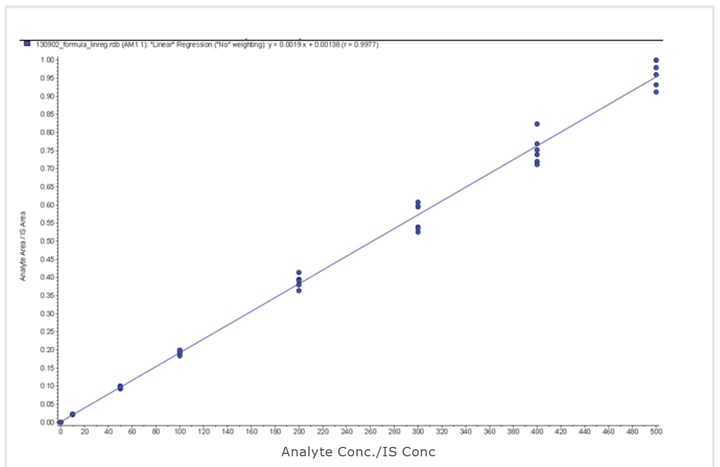
Figure 3. Internally standardized calibration for aflatoxin M1 from reconstituted infant formula using the ISOLUTE® Myco protocol from 2 to 100 ng/L (aflatoxin B2 at 40 ng/L)
This work was performed following the relevant analytical performance criteria referenced in Commission Implementing Regulation (EC) 401/2006. Aflatoxin M1 extracted using the ISOLUTE® Myco protocol achieved the limits of quantitation and recovery required by the European standards for mycotoxin analysis. Table 4 displays results for LOQs, %RSDr, and recovery % against corresponding target performance criteria referenced in section 4.3.1.(subparts a - g) of commission implementing regulation (EC) 401/2006.
Table 4. Analyte recovery and limit of quantitation data for aflatoxin M1 from reconstituted infant formula using the ISOLUTE® Myco protocol.
|
Infant formula |
LOQ (ng/kg) |
%RSDr |
Recovery % |
||||
|
Analyte |
r2 |
Target |
Actual |
Target |
Actual |
Target |
Actual |
|
aflatoxin M1 |
0.9977 |
≤ 25 |
2 |
≤ 20 |
6.4 |
60 to 120 |
90 |
Reference literature:
European Commission. (2006). Commission Regulation (EC) No 401/2006 of 23 February 2006 laying down the methods of sampling and analysis for the official control of the levels of mycotoxins in foodstuffs. Official Journal of the European Union, L70, 12-34.
European Commission. (2023). Commission Regulation (EU) 2023/915 of 25 April 2023 on maximum levels for certain contaminants in food and repealing Regulation (EC) No 1881/2006. Official Journal of the European Union, L 119, 103-157.
Literature number: AN807
