
Introduction
Antiepileptic drugs (AED) are prescribed to suppress seizures in epilepsy patients. A variety of different types of AEDs have been synthesized to pharmacologically address different types of epilepsy. The ability to therapeutically monitor these drugs in patients is necessary for maintaining optimal medical care and managing any adverse effects of the drug. A fast and clean extraction method is needed that works in a variety of biological matrices and affords a high throughput workflow. Here supported liquid extraction is demonstrated as an effective way to extract AEDs from neat oral fluid and oral fluid collected with commercial kits such as the Quantisal™ (Immunalysis) and Intercept® (OraSure Technologies) with good efficiency. The method was developed on a 96-well plate format to facilitate a high throughput workflow model.
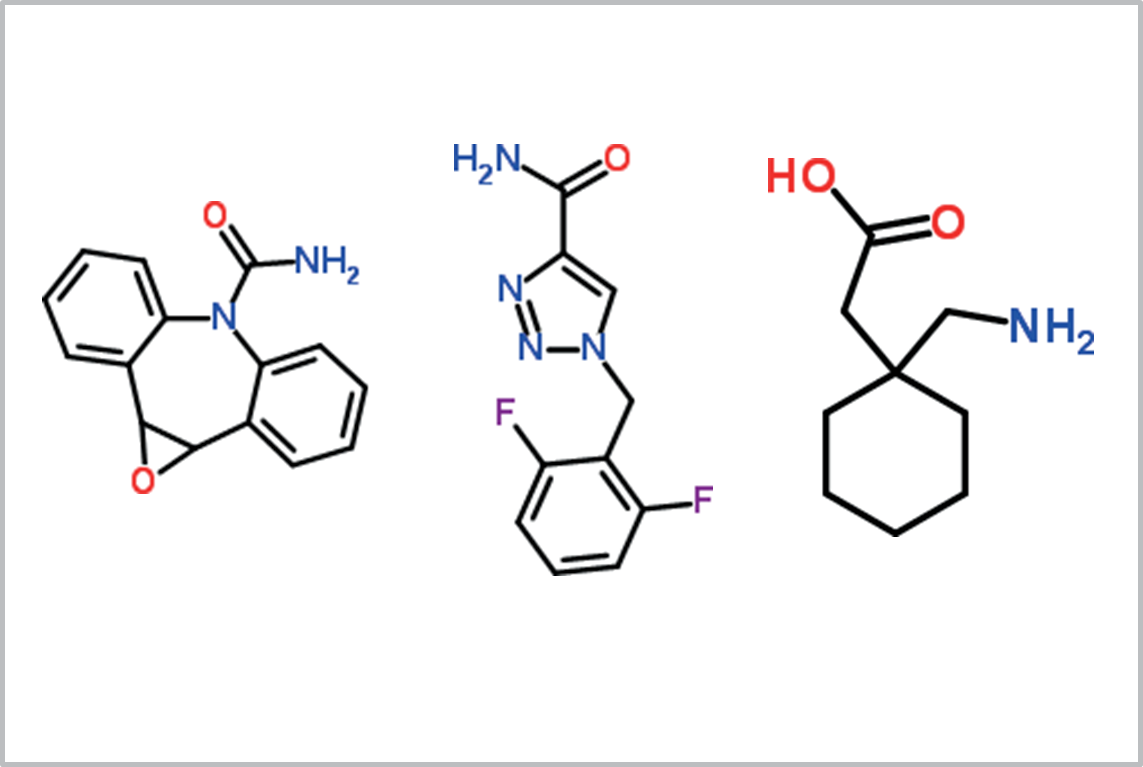
Figure 1. Structures of Carbamazepine Epoxide,Rufinamide and Gabapentine
ISOLUTE® SLE+ Supported Liquid Extraction plates and cartridges offer an efficient alternative to traditional liquid-liquid extraction (LLE) for bioanalytical sample preparation, providing high analyte recoveries, no emulsion formation, and significantly reduced sample preparation time.
Analytes
Tiagabine, Carbamazepine 10,11 epoxide, Oxcarbazepine, Gabapentin, Vigabatrin, Rufinamide and Felbamate
Sample preparation procedure
Format: ISOLUTE SLE+ 400 μL Supported Liquid Extraction Plate, part number 820-0400-P01
Sample pre-treatment: Pipette neat oral fluid or buffered oral fluid (blank, calibrator and patient, (100 µL)) into a container. Add Ammonium Acetate (5mM, pH 2.9, 250µL). Add up to 50 µL of internal standard.
Sample processing: Load up to 400 µL of pre-treated oral fluid sample onto the ISOLUTE SLE+ 96-well plate. Apply a short pulse of positive pressure or vacuum and allow samples to absorb for 5 minutes.
Analyte elution: Elute analytes with methyl tert-butyl ether containing 1% (v/v) trifluoroacetic acid (conc) solution (2 x 700 µL). Allow sample to flow through by gravity and collect eluent. Apply positive pressure or vacuum as needed to facilitate a constant flow of approximately 1 mL/min (10-12 drops).
Post extraction: Evaporate to dryness (45 °C for 15 mins) and reconstitute sample into mobile phase.
Additional information: Oral fluid was tested as a neat solution and as a buffered solution using proprietary buffer solutions provided by the Immunalysis Quantisal kit and the OraSure Intercept kit.
HPLC conditions
Instrument: Agilent 1200 Liquid Handling System (Agilent Technologies, Berkshire, UK)
Column: Phenomenex Gemini C18, 150 mm x 4.6 mm (5 µm)
Mobile phase: Solvent A: 5mM Ammonium Formate with 0.01% (v/v) Formic Acid
Solvent B: Methanol: Acetonitrile (50:50, v/v)
Gradient:
|
Step |
Time (min) |
Flow Rate (µL/min) |
%A |
%B |
|
1 |
0.0 |
1000 |
70 |
30 |
|
2 |
0.50 |
1000 |
70 |
30 |
|
3 |
3.0 |
1000 |
30 |
70 |
|
4 |
4.0 |
1000 |
30 |
70 |
|
5 |
4.5 |
1000 |
70 |
30 |
|
6 |
7.5 |
1000 |
70 |
30 |
Mass spectrometry conditions
Applied Biosystems/MDS Sciex 4000 Q-Trap triple quadrupole mass spectrometer (Applied Biosystems, Foster City, CA.) equipped with a Turbo Ionspray® interface for mass analysis.
Ionization Source Temperature: 700 °C
|
Analyte |
MRM Transition |
Declustering Potential (DP) |
Collision Energy (CE) |
Cell Exit Potential (CXP) |
|
Gabapentine |
172>154 |
40 |
25 |
16 |
|
Felbamate |
178>117 |
40 |
25 |
16 |
|
Rufinamide |
239>127 |
40 |
25 |
16 |
|
Oxcarbazepine |
253>208 |
40 |
25 |
16 |
|
Tiagabine |
376>247 |
40 |
25 |
16 |
|
Vigabatrine |
130>70.9 |
40 |
25 |
16 |
|
Carbamazepine Epoxide |
253>180 |
40 |
30 |
16 |
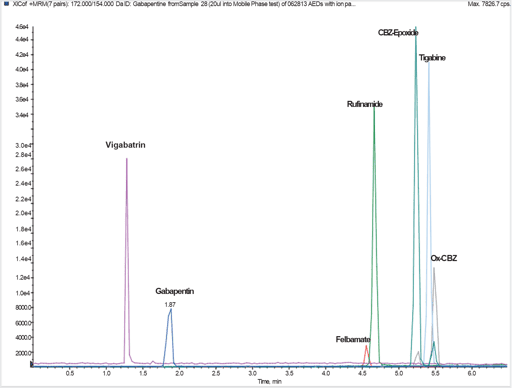
Figure 2. Extracted ion chromatogram of antiepileptic drugs
Results and discussion
Antiepileptic drug (AED) stock standards were prepared in methanol: acetone (80:20, v/v) at 100 µg/mL concentration. The parameters for LC-MS/MS analysis were identified and optimized using the stock solutions (Figure 2). The stock solutions were fortified into blank neat oral fluid matrix at final spiking concentrations of 20 ng/mL. Oral fluid was also collected using two different commercial kits to test effects of buffer solutions on analyte recovery. The two kits used were the Immunalysis Quantisal kit and the OraSure Intercept kit. The elution strategy utilizes methyl tert-butyl ether mixed with 1% concentrated trifluoroacetic acid (TFA) (v:v) to yield optimal recoveries. The addition of TFA to the extraction solvent seemed to increase overall recoveries from 5–10%.
An ion pairing pre-treatment strategy was found to be most effective for neutral AEDs.
The pre-treatment strategy calls for 10 mM ammonium acetate to be added to the fortified matrix at a 1:2.5 (v:v) ratio. Recoveries for the AEDs using this pre-treatment strategy were good for all of the neutral AEDs in either neat or buffered oral fluid and substantially lower for the zwitterionic AEDs (Figure 3). The lower recovery for the gabapentin and vigabatrin was attributed to their acidic and basic functionality which maintains a charge on the molecule under acidic or basic pH. This constant charge increases the aqueous solubility of the zwitterionic AEDs and lowers their propensity for efficient elution with water immiscible organic solvents.
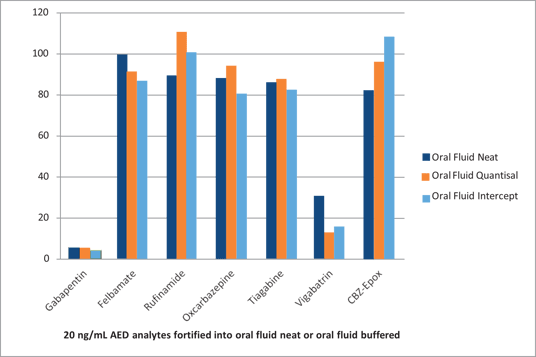 Figure 3. Plot of average recoveries for neutral and zwitterionic antiepileptic drugs (n=7) fortified into neat and buffered oral fluid at 20 ng/mL.
Ordering information
|
Part Number |
Description |
Quantity |
|
820-0400-P01 |
ISOLUTE® SLE+ 400 µL Supported Liquid Extraction Plate |
1 |
|
SD-9600-DHS-EU |
Biotage® SPE Dry Sample Concentrator System 220/240 V |
1 |
|
SD-9600-DHS-NA |
Biotage® SPE Dry Sample Concentrator System 100/120 V |
1 |
|
PPM-96 |
Biotage® Positive Pressure Manifold 96 position |
1 |
Literature number: AN811
