
For research use only. NOT for use in diagnostic procedures.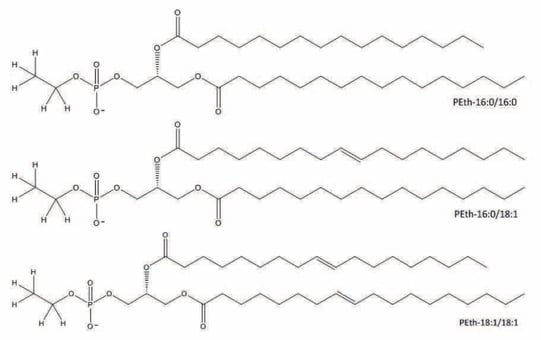 Figure 1. Chemical structures of three common PEth species.
Introduction
Phosphatidylethanol is an alcohol biomarker with a high degree of specificity; blood concentration of PEth correlates to the amount of alcohol consumed. This application note describes the extraction of 3 common species of PEth from whole blood using ISOLUTE® SLE+ supported liquid extraction prior to HPLC-MS/MS analysis.
ISOLUTE SLE+ supported liquid extraction fixed-well plates offer an efficient alternative to traditional liquid-liquid extraction (LLE) for bioanalytical sample preparation, providing high analyte recoveries, no emulsion formation, and significantly reduced sample preparation time.
This simple sample preparation procedure produces clean extracts, good recoveries with low RSD, and LOQ from 20 ng mL-1. This method can be automated using Biotage® ExtraheraTM, see appendix for details.
Analytes
PEth is a group of phospholipids comprising a phosphoethanol head group and 2 fatty acid tails of varying length and saturation. This application note covers 3 commonly occurring species:
- 1,2-dipalmitoyl-sn-glycero-3-phosphoethanol (PEth-16:0/16:0)
- 1-palmitoyl-2-oleoyl-sn-glycero-3-phosphoethanol (PEth-16:0/18:1)
- 1,2-dioleoyl-sn-glycero-3-phosphoethanol (PEth-18:1/18:1)
- D5 -1-palmitoyl-2-oleoyl-sn-glycero-3-phosphoethanol (D5-PEth-16:0/18:1) was used as an internal standard.
See Figure 1 for chemical structures.
Sample preparation procedure
Format
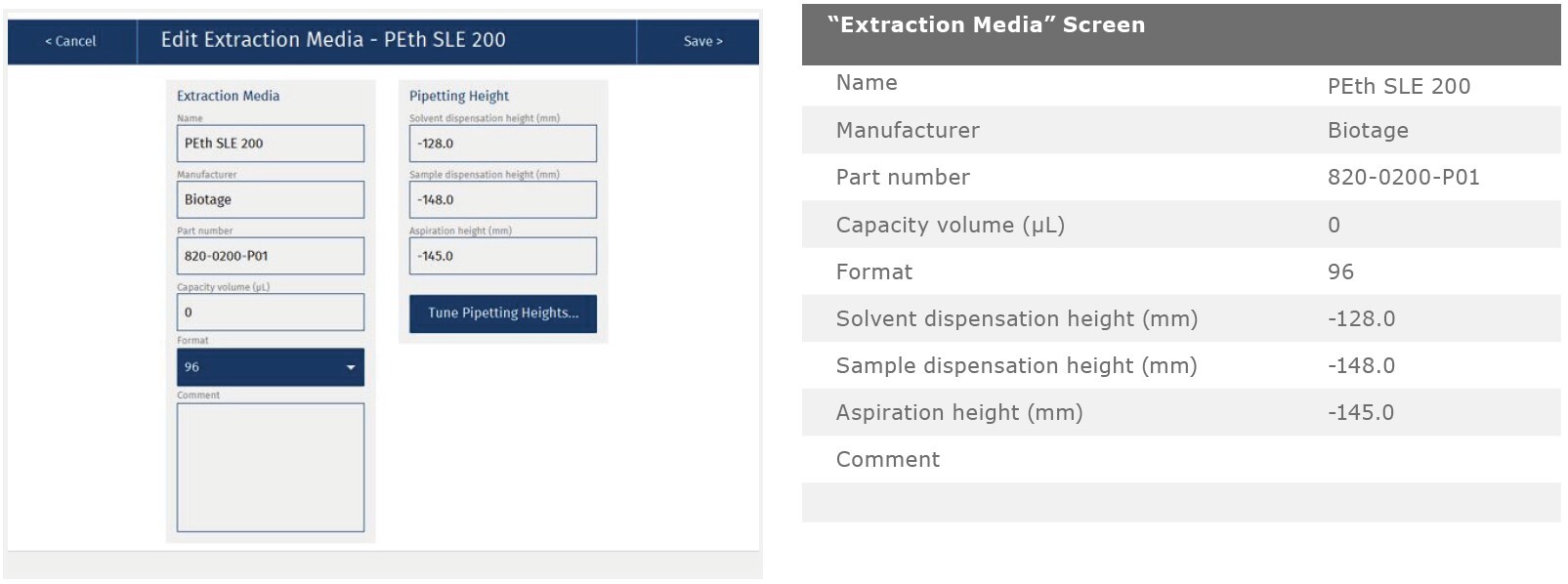
ISOLUTE® SLE+ 200 μL supported liquid extraction plate, part number 820-0200-P01.
Sample pretreatment
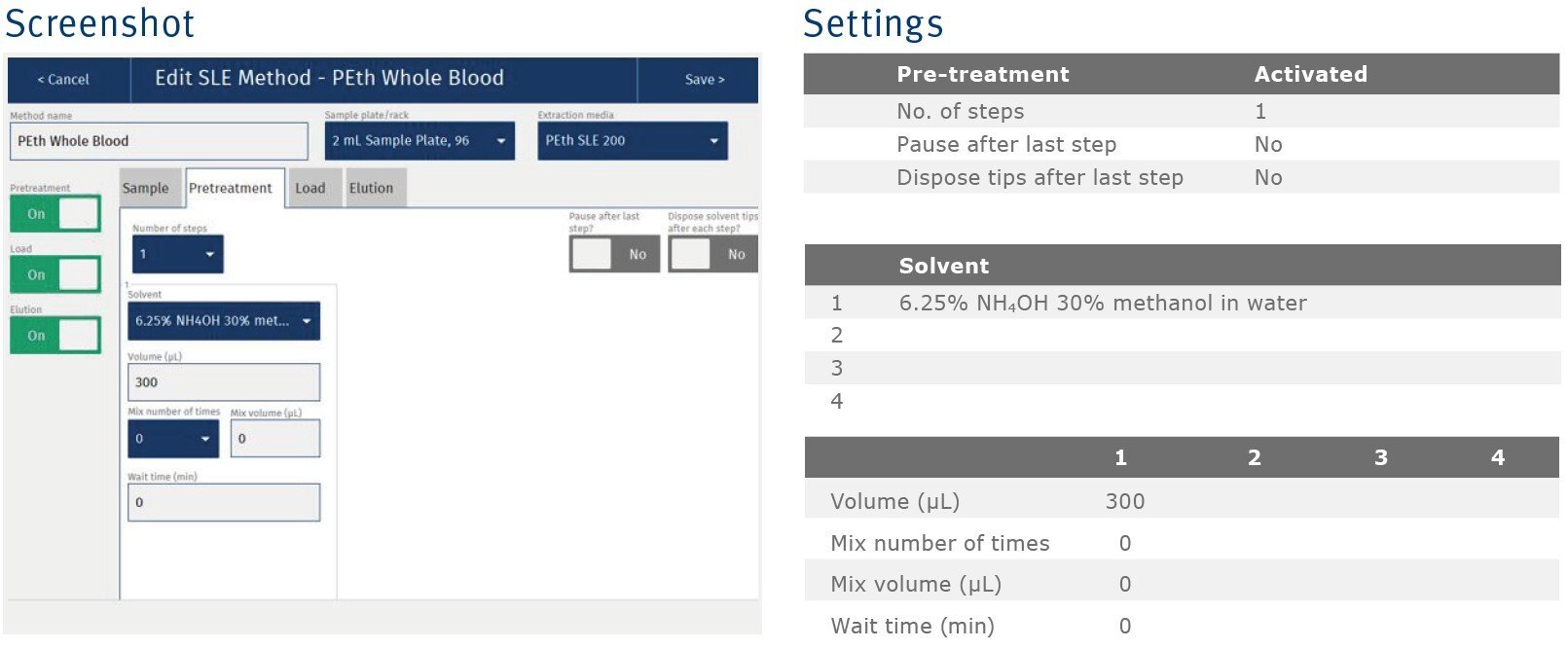
To 20 μL of whole blood, add 300 µL of 6.25% (v/v) aqueous ammonium hydroxide in 30% aqueous methanol. Add an appropriate amount of internal standard separately or mix internal standard into the ammonium hydroxide pre-treatment solution prior to adding to the sample. Mix thoroughly and allow to equilibrate.
Sample loading
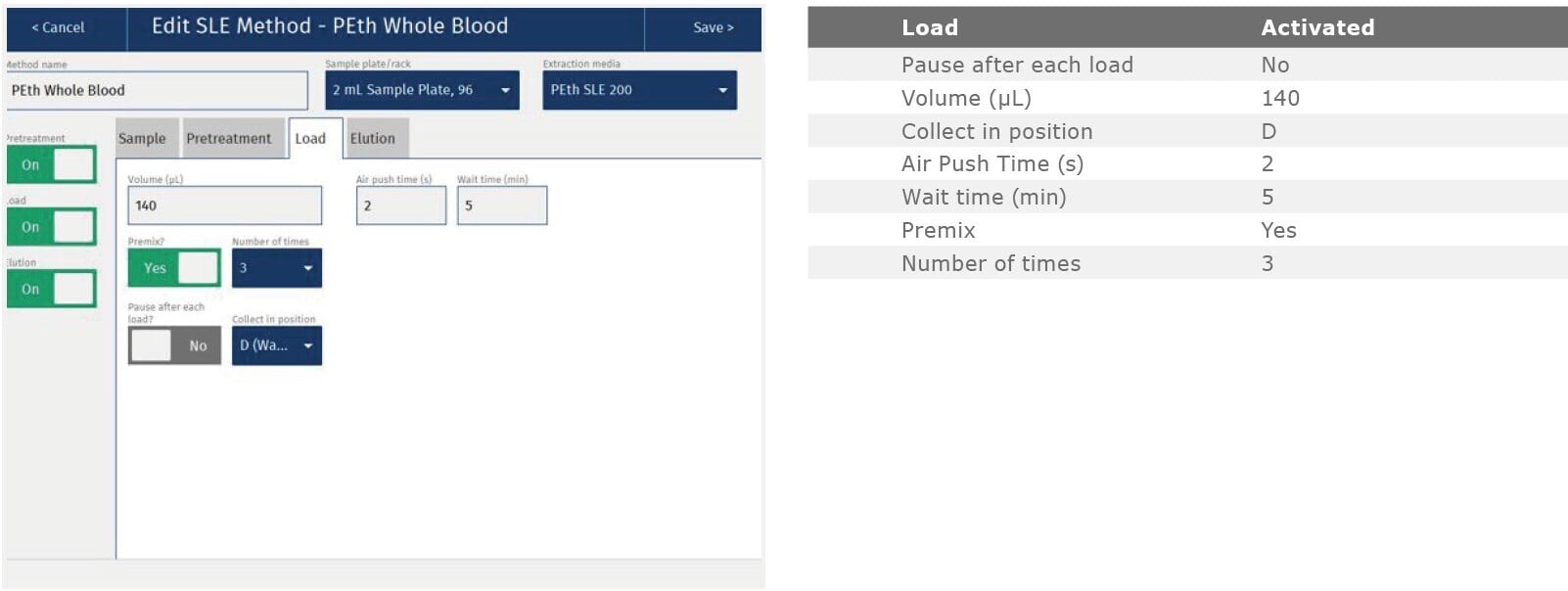
Load 140 μL of the pre-treated whole blood into each well of the ISOLUTE SLE+ plate (equivalent to 8.75 µL whole blood). Ensure the well-frit surface is completely covered by the pre-treated sample. Using a Biotage® PRESSURE+96 Positive Pressure Manifold, apply 2–5 psi of pressure to load samples onto the sorbent. Wait 5 minutes for the sample to equilibrate on the sorbent.
Analyte extraction
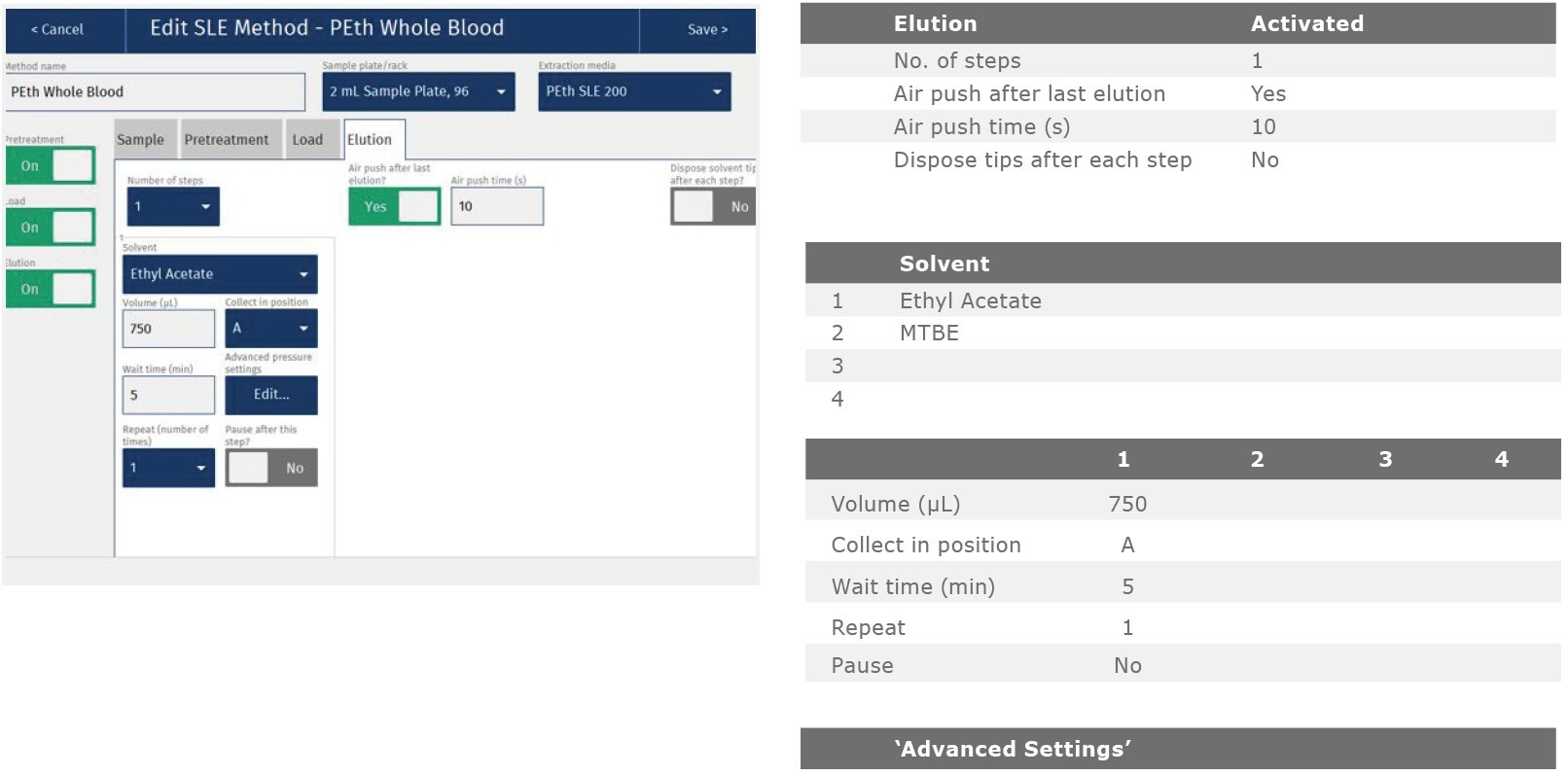
Apply 750 µL of ethyl acetate and allow to flow under gravity for 5 minutes. Apply pressure (5–10 seconds) to remove any remaining extraction solvent.
Post elution and reconstitution
Dry the extract in a stream of air or nitrogen using a Biotage® SPE Dry 96 (40 °C at 60 L min-1). Reconstitute the extracts with 150 µL mobile phase A:B (85:15 v/v). Mix thoroughly.
HPLC conditions
Instrument
Waters Alliance 2795 HPLC with a 20 µL loop.
Column
Agilent Poroshell 120 EC-C8 2.1 x 50 mm, 2.7 µm analytical column; and Poroshell 120 EC-C8 2.1 x 5 mm, 2.7 µm UHPLC guard column.
Mobile phase
A: acetonitrile: 2 mM ammonium acetate (aq) 80:20 v/v;
B: propan-2-ol.
Flow rate
0.25 mL min-1.
Table 1. Gradient conditions.
|
Time |
% A |
% B |
Curve |
|
0.00 |
85 |
15 |
1 |
|
0.40 |
85 |
15 |
1 |
|
3.50 |
15 |
85 |
6 |
|
3.51 |
5 |
95 |
6 |
|
5.50 |
5 |
95 |
6 |
|
6.00 |
85 |
15 |
6 |
|
8.90 |
85 |
15 |
1 |
Injection volume
10 μL (partial loop)
Sample temperature
12 °C
Column temperature
Room temperature
Mass spectrometry conditions
Instrument
Waters Ultima Pt triple quadrupole mass spectrometer using electrospray ionization.
Capillary voltage
3.2 kV
Desolvation temperature
350 °C
Ion source temperature
100 °C
Negative ions acquired in multiple reaction monitoring (MRM) mode:
Table 2. MRM conditions.
|
Compound |
MRM Transition |
Cone Voltage (V) |
Collision Energy (eV) |
|
PEth-16:0/16:0 |
675.4 > 255.2 |
35 |
31 |
|
PEth-16:0/18:1 |
701.4 > 281.2 |
35 |
34 |
|
PEth-18:1/18:1 |
727.5 > 281.2 |
35 |
32 |
|
D5-PEth-16:0/18:1 (IS) |
706.5 > 281.2 |
35 |
32 |
Results and discussion
Chromatography
PEth species were chromatographed with a superficially porous C8 column using dilute ammonium acetate (aq) / acetonitrile and propan-2-ol. The overlaid extracted ion chromatogram (EIC) in Figure 2 demonstrates partial separation of the three PEth species was achieved. No inter-species contributions were observed in the EICs, demonstrating the HPLC-MS/MS method is capable of distinguishing between common PEth species.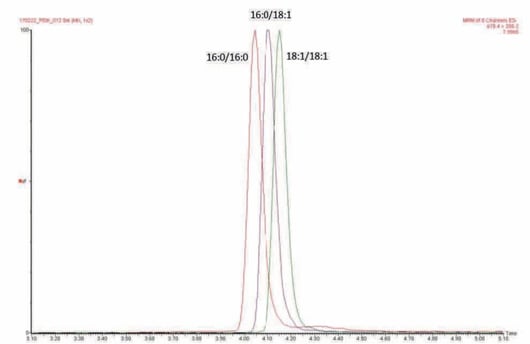 Figure 2. PEth Standards in Solvent Equivalent to 200 ng mL-1 in Whole Blood.
Recovery and repeatability
Method performance was assessed by spiking whole blood with three PEth species plus an internal standard at 200 ng mL-1, equivalent to 1.75 ng when extracting 140 µL of pre-treated whole blood. Recovery was determined relative to fortified blanks containing the same amount of extracted matrix. Recoveries for three PEth species were between 84% and 89% using an optimized ISOLUTE® SLE+ 200 µL protocol (Figure 3). Extraction RSDs were between 5% and 6% (Figure 3). Representative EICs of 3 PEth species extracted from 20 µL whole blood spiked at 200 ng mL-1 are free from interfering peaks (Figure 4).
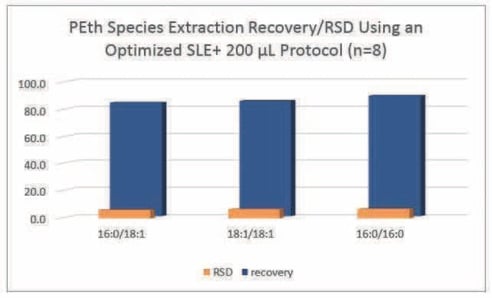 Figure 3. Percentage recovery and RSD of PEth species.
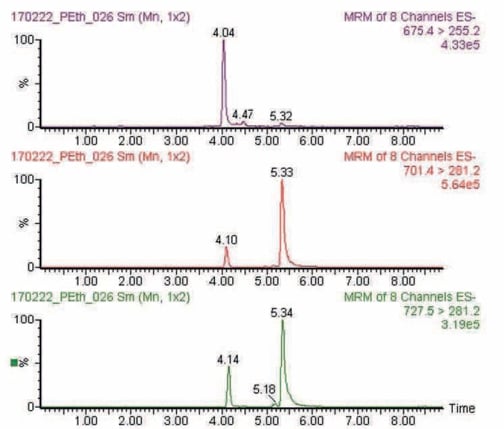 Figure 4. Extracted ion chromatograms of PEth species (16:0/16:0, 16:0/18:1, 18:1/18:1) 20 µL whole blood Spiked at 200 ng mL-1
Calibration Curves
Calibration curves were constructed by spiking whole blood from 20 ng mL-1 to 20 µg mL-1 for each PEth species prior to extraction; the internal standard was spiked at 2 µg mL-1.
Coefficient of determination (r2) values are demonstrated greater than 0.990 for each PEth species using the optimized extraction protocol. Representative curves are shown in Figure 5.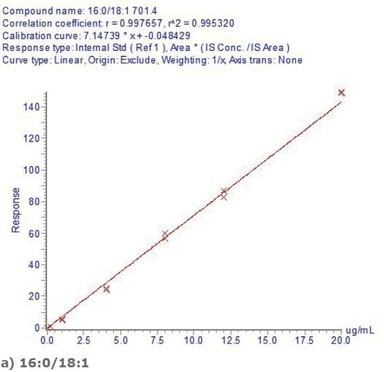
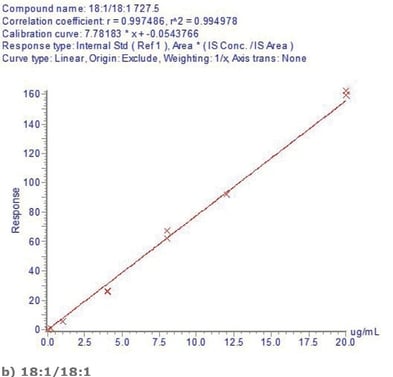
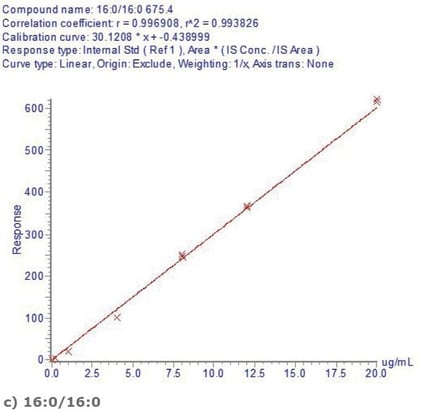 Figure 5. Representative PEth species calibration curves from 20 ng mL-1 to 20 µg mL-1
LOQ was estimated from the calibration curves where the signal/noise ratio was greater than 10:1. S/N values, estimated LOQ, coefficients of determination and precision RSDs are presented in Table 3.
Table 3. Lower Limits of Quantitation (LLOQ) using optimized ISOLUTE® SLE+ extraction protocol.
|
PEth Species |
LOQ, ng mL-1 (S/N) |
LOQ, nmol L -1 |
r² |
Precision % RSD (n=8) |
|
16:0/16:0 |
20 (20) |
29.5 |
0.995 |
6.1 |
|
16:0/18:1 |
20 (12) |
28.4 |
0.994 |
6.6 |
|
18:1/18:1 |
20 (14) |
27.4 |
0.994 |
6.8 |
Additional notes
Unless specified, all reagents and solvents are HPLC-grade.
6.25% ammonium hydroxide (aq) / 30% methanol (aq): add 6.25 mL of concentrated ammonium hydroxide (28–30%) and 30 mL of methanol to 63.75 mL 18.2 MΩ cm water.
Aqueous mobile phase (A): dissolve 280 mg LC-MS grade ammonium acetate in 200 mL 18.2 MΩ cm water, add to 800 mL LC-MS grade acetonitrile and mix thoroughly.
Organic Mobile Phase (B): Use an appropriate volume of LC-MS grade propan-2-ol.
Ordering information
|
Part Number |
Description |
Quantity |
|
820-0200-P01 |
ISOLUTE® SLE+ 200 µL Supported Liquid Extraction Plate |
1 |
|
For Manual Processing |
||
|
PPM-96 |
Biotage® PRESSURE+ 96 Positive Pressure Manifold |
1 |
|
For Automated Processing |
||
|
414001 |
Biotage® Extrahera |
1 |
|
Rack and Reservoir Options |
||
|
413991SP |
Solvent Rack (25 mL) |
1 |
|
414045SP |
Solvent Reservoir (25 mL) |
1 |
|
415560SP |
Solvent Rack (100 mL) |
1 |
|
414214SP |
Solvent Reservoir (100 mL) |
1 |
|
Evaporation |
||
|
SD-9600-DHS-EU |
Biotage® SPE Dry 96 Sample Evaporator 220/240V |
1 |
|
SD-9600-DHS-NA |
Biotage® SPE Dry 96 Sample Evaporator 100/120V |
1 |
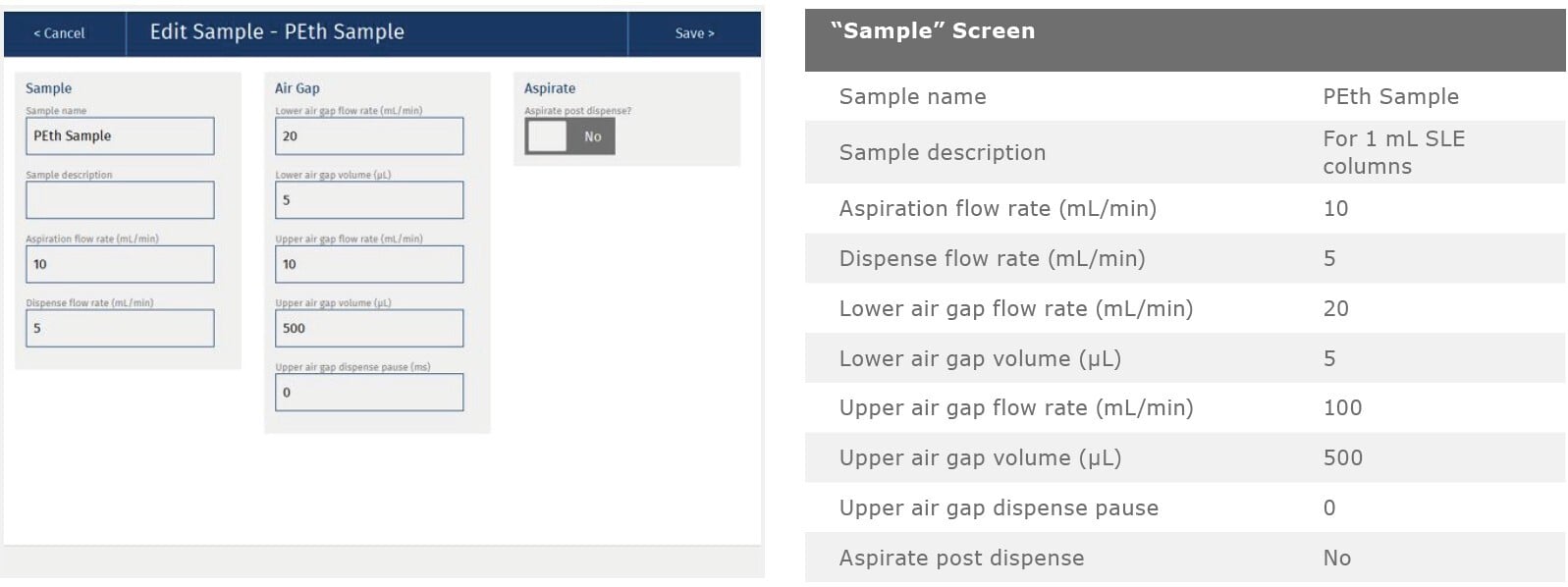
Appendix: Biotage® Extrahera™ settings
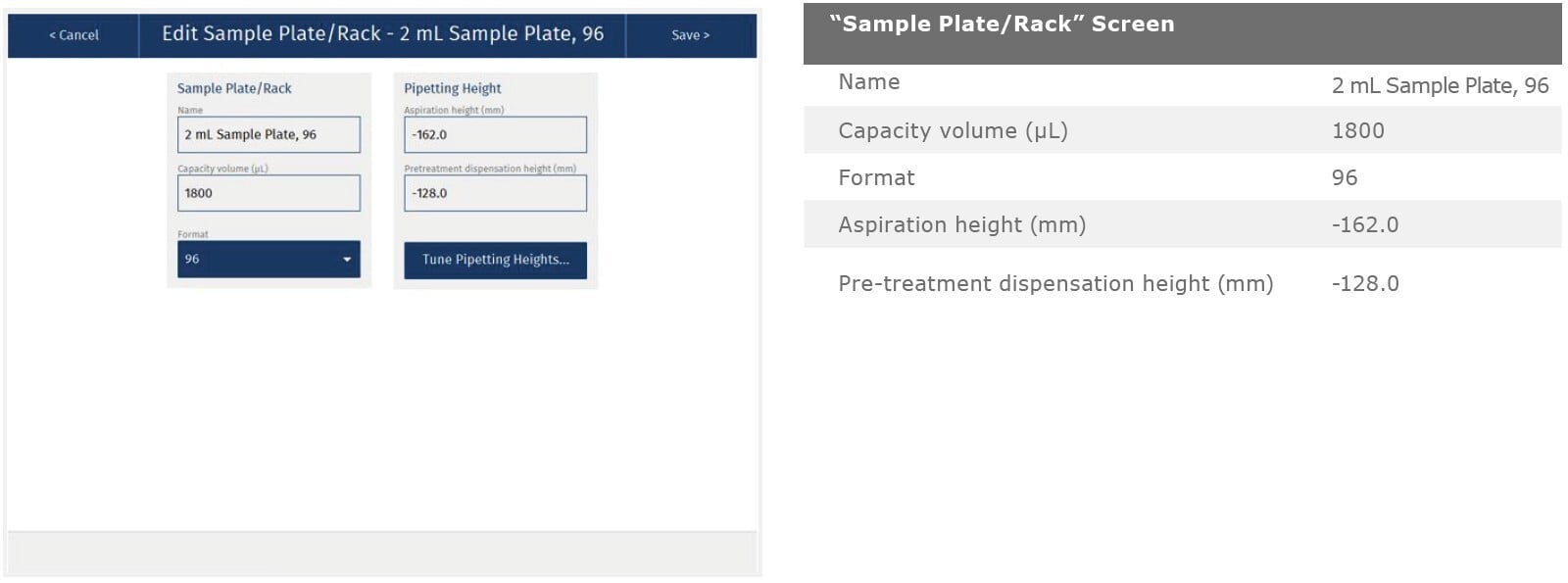
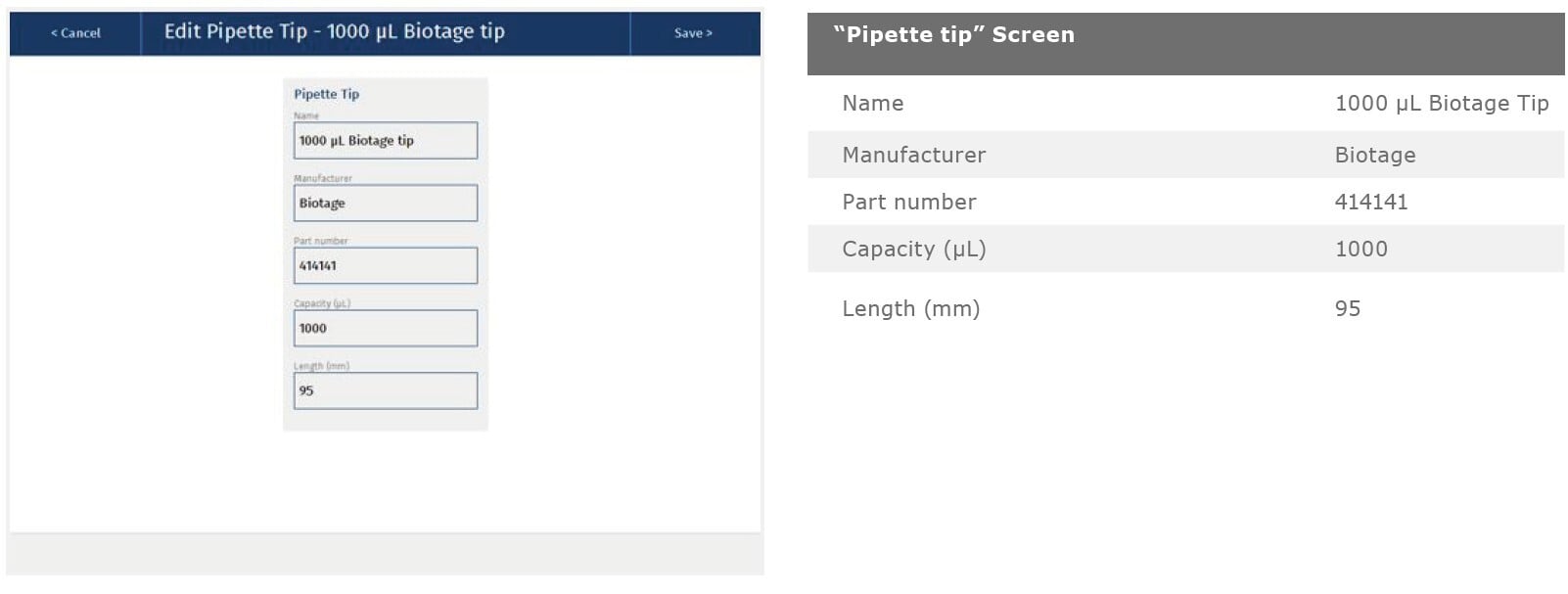
The method described in this application note was automated on the Biotage® Extrahera™, using ISOLUTE® SLE+ 200 µL plates. Method performance was comparable to manual processing: recovery 73% to 77%, RSD 4.0% to 4.4%, r² 0.995 to 0.997. This appendix contains the software settings required to configure Extrahera to run this method.
Using this automated procedure, 96 samples can be processed in 22 minutes 33 secs.
|
Method Name: |
TBD |
|
Sample Plate/Rack: |
2 mL Sample Plate, 96 |
|
Extraction Media: |
PEth SLE 200 |
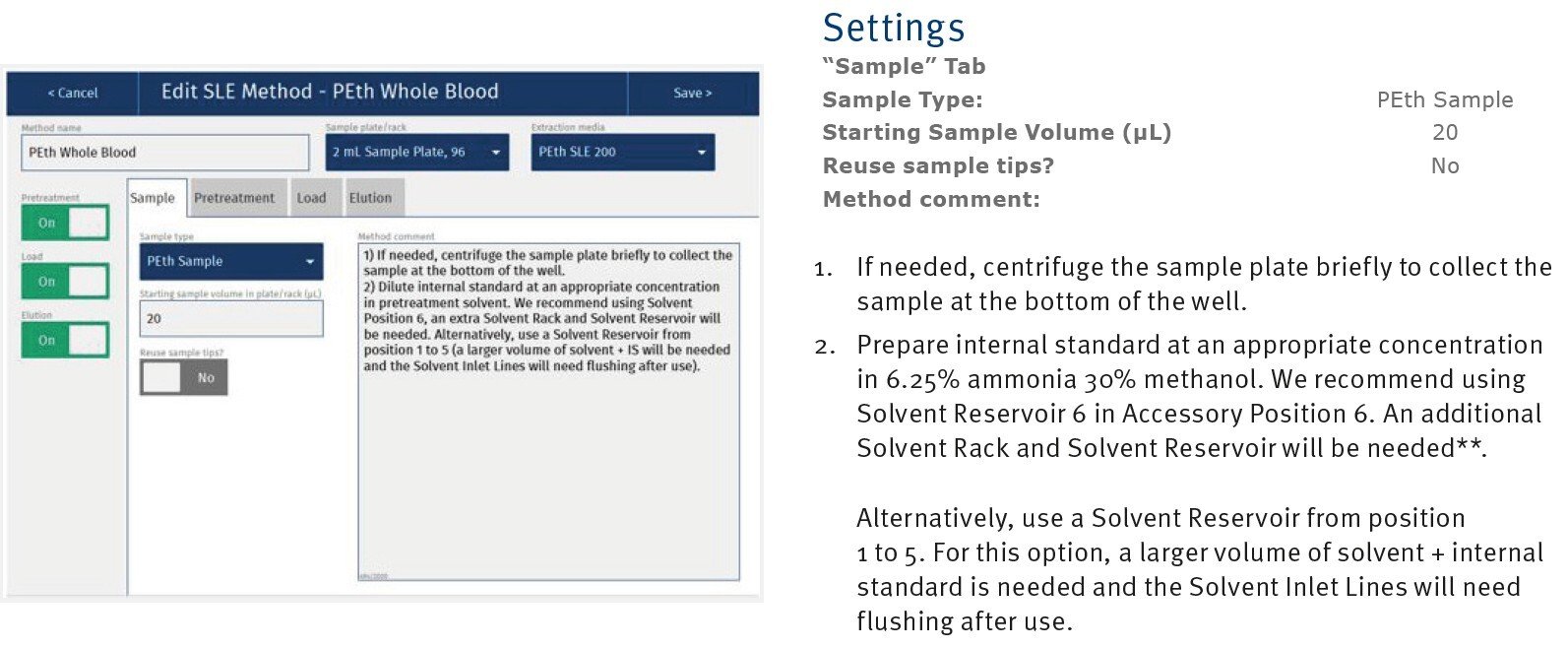 ** see ordering information for suitable solvent rack and reservoir options.
 Solvent properties
|
Solvent Description |
|
|
1 |
6.25% NH4OH 30% methanol in water |
|
2 |
Ethyl Acetate |
|
3 |
|
|
4 |
|
|
5 |
|
|
6 |
|
|
7 |
|
|
8 |
|
|
9 |
|
|
10 |
|
Solvent |
1 |
2 |
3 |
4 |
5 |
6 |
7 |
8 |
9 |
10 |
|
Reservoir Type |
Refillable |
Non Refillable |
||||||||
|
Capacity |
N/A |
N/A |
||||||||
|
Aspiration flow rate (mL/min) |
10 |
10 |
||||||||
|
Dispense flow rate (mL/min) |
20 |
20 |
||||||||
|
Lower air gap flow rate (mL/min) |
20 |
20 |
||||||||
|
Lower air gap volume (µL) |
5 |
5 |
||||||||
|
Upper air gap flow rate (mL/min) |
120 |
120 |
||||||||
|
Upper air gap volume (µL) |
100 |
100 |
||||||||
|
Upper air gap dispense pause |
300 |
300 |
||||||||
|
Conditioning? |
Yes |
Yes |
||||||||
|
Conditioning number of times |
3 |
2 |
||||||||
|
Conditioning flow rate (mL/min) |
20 |
10 |
||||||||
|
Conditioning volume (%) |
100 |
100 |
||||||||
|
Aspirate post dispense |
Yes |
Yes |
||||||||
|
Chlorinated |
No |
No |
||||||||
|
Serial dispense |
No |
No |
||||||||
Literature number: AN876
