
Introduction
There are 8 water soluble analogues of vitamin B that are relevant to the metabolic health of the human host. Of particular interest to this study is the determination of vitamin B3, a precursor to the synthesis of hormones that cascade through a number of biochemical systems in vivo. The development data presented in this report details sample preparation workflow strategies to facilitate population screening of the parent compound niacin (nicotinic acid, pkas = 2.2, 4.8) as well as 2 relevant metabolites niacinamide (pka = 3.54) and nicotinuric acid (pkas = 3.1, 3.5) in a single analysis. The structure of these analytes are shown in Figure 1. The analytes of interest were fortified into pooled mixed gender serum, and samples were extracted using a 25 mg format 96-well plate packed with ISOLUTE SCX-3, a silica-based, Strong Cation eXchange sorbent (see Figure 2). The reconstituted extracts were analysed using a gradient mixed-mode LC-MS/MS method.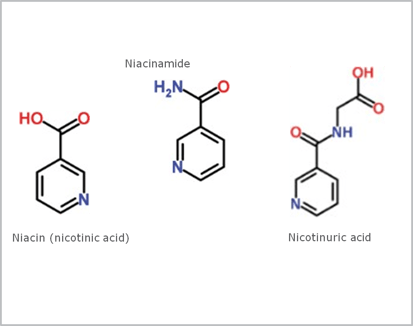
Figure 1. Structures of Vitamin B3 and metabolites
Analytes
Niacin (Nicotinic acid) , nicotinuric acid, niacinamide
Sample preparation procedure
Format:
ISOLUTE SCX-3 25 mg plate, part number 533-0025-P01
The SPE sorbent chemistry is a ethylbenzene sulfonic acid functionalized silica (non-end capped).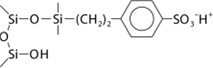
Figure 2. ISOLUTE® SCX-3 sorbent chemistry
Sample pre-treatment:
Dilute serum (50 µL) with aqueous acetic acid (2%, 150 µL). Mix thoroughly.
Conditioning:
Condition each well with methanol (1 mL)
Equilibration:
Equilibrate each well with aqueous acetic acid (2%, 1 mL)
Sample loading:
Load pre-treated sample (200 µL) at a flow rate of 1 mL/min using positive pressure (PRESSURE+96 Positive Pressure manifold PPM-96)
Interference wash 1:
Wash each well with water:methanol:acetic acid (68:30:2, v/v/v, 2 x 1 mL)
Interference wash 2:
Wash each well with methanol:acetic acid (98: 2, v/v, 2 x 1 mL)
Analyte elution:
Elute analytes with methanol: ammonium hydroxide (95:5, v/v, 2 x 400 µL)
Post-extraction:
Evaporate extracts to dryness and reconstitute in 0.1% formic acid (100 µL)
HPLC conditions
Instrument:
Agilent 1200 Liquid Handling System (Agilent Technologies, Berkshire, UK)
Column:
IMTAKT Scherzo SM-C18 cartridge (2 mm x 150mm, 3.0 µm) (IMTAKT USA, Philadelphia, USA)
Injection volume:
20 µL
Mobile phase:
Solvent A: 5mM ammonium formate / 0.1% FA (aq) Solvent B: Acetonitrile
Gradient:
|
Step |
Time (min) |
Flow Rate (µL/min) |
%A |
%B |
|
1 |
0.5 |
200 |
80 |
20 |
|
2 |
3.0 |
200 |
70 |
30 |
|
3 |
4.0 |
200 |
70 |
30 |
|
4 |
5.0 |
200 |
80 |
20 |
|
5 |
8.0 |
200 |
80 |
20 |
Mass spectrometry conditions
Instrument:
Applied Biosystems /MDS Sciex 4000 Q-Trap hybrid triple quadrupole / linear ion trap mass spectrometer (Applied Biosystems, Foster City, CA.) equipped with a Turbo Ionspray® interface operated in positive ion mode.
Ion source temperature:
600 °C
The MRM transitions used in this study were detailed in Table below. Data acquisition can stop collecting after 4.5 min. (to facilitate multiplexed cartridge switching methods).
|
Analyte |
g/mole |
MRM Transition (m/z) |
Declustering Potential (DP) |
Collision Energy |
Dwell Time (ms) |
|
Niacin |
123.1 |
124.1 → 80.1 |
30 |
27 |
16 |
|
Niacinamide |
122.1 |
123.1 →80.0 |
30 |
25 |
16 |
|
Nicotinuric acid |
180.0 |
181.0→79.0 |
30 |
28 |
16 |
Reagents
HPLC grade water, methanol, acetonitrile, nicotinuric acid, ammonium hydroxide, acetic acid and formic acid (FA) were purchased from Sigma-Aldrich Co. (Atlanta, GA.). Nicotinic acid and niacinamide standards were obtained from Cerilliant Corp (Round Rock, TX). The biological fluids were obtained from BioChemEd Services.
Results and discussion
The sorbent selection for this study proved interesting as nicotinic acid and nicotinuric acid have both acid and basic pKa values. A series of polymer-based cation exchange and anion exchange sorbents were evaluated; however, the ethylbenzene sulfonic acid functionalized silica demonstrated the best choice, inclusive of all three analytes. A representative chromatogram for a 20 ng/mL fortified serum sample is shown in Figure 3. A set of fortified serum specimens was also prepared at 40 ng/mL levels (n=6). The relative recovery plot is detailed in Figure 4. The method repeatability as %RSD was determined <15% for all analytes.
Optimization of the method conditioning step was conducted by testing the following solutions: 2% formic acid, 2% acetic acid, 4% acetic acid, 50 mM NH4Ac (pH=6) and 50 mM NH4Ac (pH=7). The peak area response for 2% acetic acid provided the best results, inclusive of all three analytes. A gradient mix of water and methanol was evaluated for analyte response. It was determined that incorporating 2% acetic acid into the optimized 70/30 water/MeOH solution was helpful in maintaining analyte recoveries.
Acetonitrile did not offer any advantage as wash solvent or an elution solvent. Evaluation of the second wash solvent did not show analyte response as breakthrough in the wash. There was a significant benefit in the quality of the data obtained when increasing the wash volumes in replicate aliquots. The analyte suppression values were observed at < 20% (Figure 5). A loss of analyte recovery was observed after 3 wash cycles so a balance of analyte recovery vs sample cleanliness should be considered when targeting clinically relevant LOQ values.
Alternative solvents for elution were considered in an effort to maintain adequate relative recovery for all of the analytes. The utility of ethyl acetate and ammonium hydroxide has been demonstrated in mixed-mode cation- exchange applications. To mitigate compatibility issues with ethyl acetate and water, a drying step was added after the wash 2 step. In this study, this combination of solvents eluted cloudy and was therefore excluded from consideration. The ISOLUTE SCX-3 96-well plate format demonstrated as a viable option for serum measurements over a relevant concentration range in clinical diagnostics.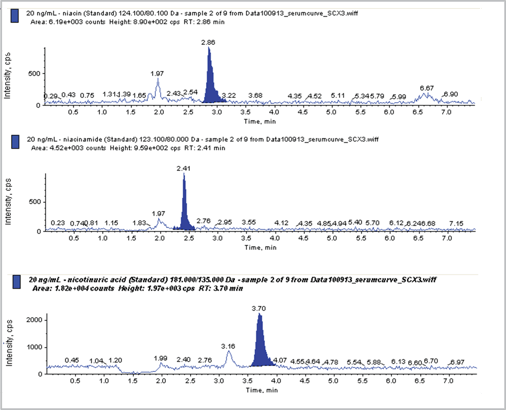
Figure 3. A typical chromatogram obtained from the extraction of a 20 ng/mL fortified specimen of plasma
-method-repeatability.png?width=403&height=337&name=biotage-an814-figure4-relative-recovery-(%25)-method-repeatability.png) Figure 4. Relative recovery (%) and method repeatability for the extraction of vitamin B3 and related metabolites from serum.
Figure 4. Relative recovery (%) and method repeatability for the extraction of vitamin B3 and related metabolites from serum.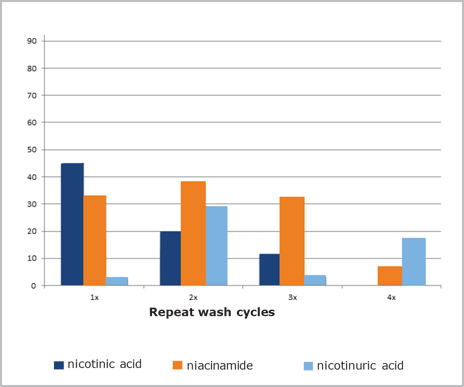
Figure 5. Matrix suppression determined from the extraction of vitamin B3 and related metabolites from serum.
Acknowledgment
Biotage would like to thank IMTAKT USA for providing the HPLC column for this study.
Ordering information
|
Part Number |
Description |
Quantity |
|
533-0025-P01 |
ISOLUTE® -96 SCX-3 25 mg plate |
1 |
|
SD-9600-DHS-EU |
Biotage® SPE Dry Sample Concentrator System 220/240 V |
1 |
|
SD-9600-DHS-NA |
Biotage® SPE Dry Sample Concentrator System 100/120 V |
1 |
|
PPM-96 |
Biotage® Positive Pressure Manifold 96 Position |
1 |
Literature number: AN814
