
Introduction
Preparative purification of synthetic peptides is commonly performed using reversed-phase chromatography, with analytical HPLC routinely used to assess crude purity and establish retention behavior before purification. However, translating analytical HPLC retention data into effective flash chromatography gradients often requires scouting runs and iterative gradient optimization. A predictable relationship between analytical HPLC retention and flash elution behavior would enable faster, more focused gradient design while reducing purification development time. In this application note, analytical HPLC retention data were used to directly design focused flash gradients on the Biotage® Selekt system for purification of crude synthetic peptides.
Methods
Peptides were synthesized on a Biotage® Initiator+ Alstra™ automated peptide synthesizer using Agilent AmphiSpheres™ 40 RAM PEG PS hybrid resin for 18A and PS Rink amide resin for ACP and Aib8-GLP-1(7-36)-NH2. All resins were purchased from ChemImpex and had loadings of 0.3-0.6 mmol/g (100-200 mesh). ACP and Aib8-GLP-1(7-36)-NH2 were synthesized using our “hotwash” strategies for rapid, low-solvent peptide synthesis, while 18A was synthesized using standard conditions. Resins were swelled in DMF at 70˚C for 20 min for all peptide sequences. Nα-Fmoc deprotection for ACP and Aib8-GLP-1(7-36)-NH2 was carried out at room temperature (RT) with 40% 4-methylpiperidine (pip.) in DMF in three stages by treating the resin once for 30 sec and two additional times for 1 min each time. Following deprotection, the resin was washed with DMF once at RT followed by a heated DMF wash at 75˚C. Peptide couplings for ACP and Aib8-GLP-1(7-36)-NH2 were performed using Nα-Fmoc amino acids (5.0 eq., 0.5 M), dissolved in 5.0 eq. OxymaPure at 0.5 M in DMF and DIC (5.0 eq., 0.5 M). Reagents were diluted in situ in DMF to maintain minimum volume requirements. Coupling reactions were performed at 85˚C for 5 min. No intermediate resin washes were performed between coupling steps as part of the hotwash protocol. For 18A, Fmoc deprotection was performed using 20% pip in DMF at RT for 3 min, followed by an additional 10 min reaction. The resin was then washed at RT with DMF 4×. Couplings for 18A were performed using standard Fmoc conditions (5.0 eq. AA, 5.0 eq. Oxyma, and 5.0 eq. DIC; each at 0.5 M) at 75˚C for 5 min, followed by 4 resin washes between each step. After synthesis completion, the resin was washed with DCM (3×) followed by diethyl ether (3×) to remove residual DMF and dry the resin. Peptides were cleaved from the resin using a cleavage cocktail consisting of 95% TFA, 2.5% TIPS, and 2.5% H2O for 3 hours at RT. The cleaved peptide was ether-precipitated and analyzed for elution composition and crude purity using an Agilent 1260 Infinity series HPLC equipped with a Restek Raptor™ ARC-18 (2.1 × 50 mm) column connected to an Advion expression™ CMS mass spectrometer. The crude analytical chromatograms are displayed below in figure 1.
Flash purification was performed using a Biotage® Selekt system equipped with a 10 g or 25 g Biotage® Sfär Bio C18 D - Duo 300 Å 20 µm column. The mobile phase consisted of MeCN/H2O with 0.5% TFA. Detection and fraction collection were monitored using UV detection at λall 200-220 nm, UV1 214 nm, and UV2 280 nm elution point.
Table 1: Evaluated peptide sequences with crude purity values and elution composition % from analytical HPLC.
|
Peptide |
Peptide sequence |
Crude purity % |
HPLC elution % MeCN |
|
ACP |
VQAAIDYING |
79 |
43-44 |
|
18A |
DWLKAFYDKVAEKLQEAF |
65 |
60 |
|
Aib8-GLP-1(7-36)-NH2 (GLP-1) |
HAaibEGTFTSDVSSYLEGQAAKEFIAWLVKGR |
68 |
57-59 |
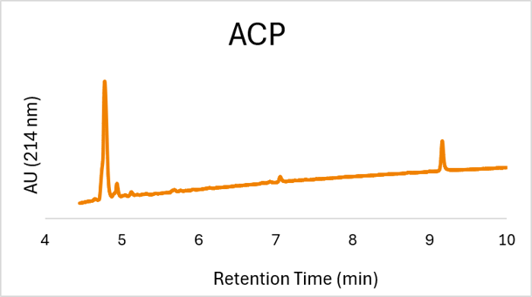
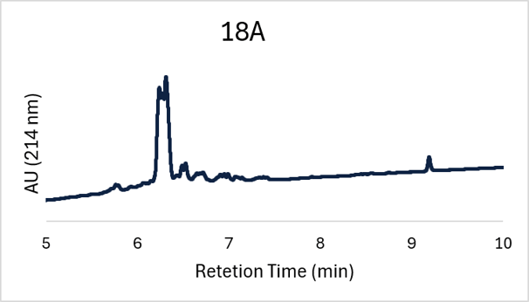
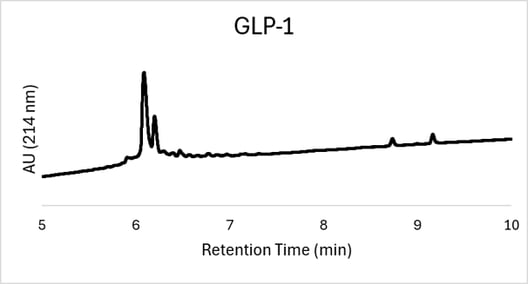
Figure 1: Analytical HPLC chromatograms of crude peptide samples: (top, orange) ACP, (middle, blue) 18A, and (bottom, black) GLP-1.
Table 2: Peptide loading conditions and column used for purification
|
Peptide |
Sample load in DMSO |
Sfär Bio C18 Duo Column |
|
ACP |
82.0 mg in 0.70 mL |
25 g |
|
18A |
45.8 mg in 0.38 mL |
25 g |
|
GLP-1 |
43.6 mg in 0.44 mL |
10 g |
Samples were injected directly onto the flash column and purified using focused gradients derived from analytical HPLC retention data.
Results
Results demonstrate that peptide elution during flash chromatography consistently occurred approximately 10% lower in % MeCN compared to analytical HPLC, enabling reliable gradient translation. Based on this observation, direct application of analytical HPLC elution conditions to flash purification is not sufficient, as peptides elute at lower % MeCN under flash conditions and the reduced chromatographic efficiency can lead to broadened peaks and increased co-elution with impurities. Traditionally, analytical HPLC retention is used to design a broad linear gradient, typically starting at 15-20% (or more) below the analytical elution point (held for 3 column volumes (CV)), followed by a 50% increase over 10 CVs, and ending with a 100% flush for 3 CVs. While this approach yields acceptable purity, it often results in broader peaks and increased co-elution of the product with its impurities, reflecting the lower chromatographic efficiency of flash media. In this application note, gradients were instead designed to focus the separation around the predicted flash elution region, introducing a narrower and more gradual change in % MeCN across the peptide elution window. This effectively creates a locally shallow gradient that improves resolution between the desired product and its eluting impurities without introducing excessive peak broadening. As a result, these focused gradients reduced fraction overlap and improved purification efficiency without the need for scouting gradients or additional optimization.
Flash elution behavior was predicted using the following empirical relationship: flash elution% MeCN = analytical % MeCN - 10%. For example, if a compound elutes at Z% MeCN analytically, the expected flash elution occurs at approximately Z-10% MeCN. Focused. gradients were generated using the following standardized design:
-
initial isocratic hold at Z - 40% MeCN, 3 CV
-
gradient region from Z - 20% to Z-10% MeCN, 10 CV
-
column flush at 100% MeCN for 3 CV
Figure 2 displays a comparison of a broad linear gradient and a focused gradient.
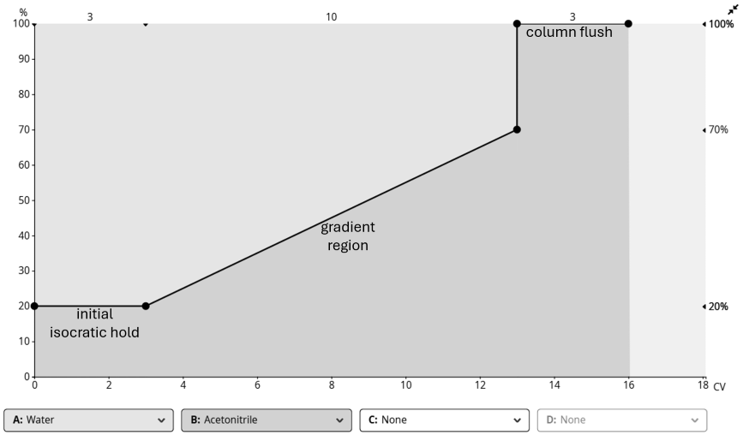
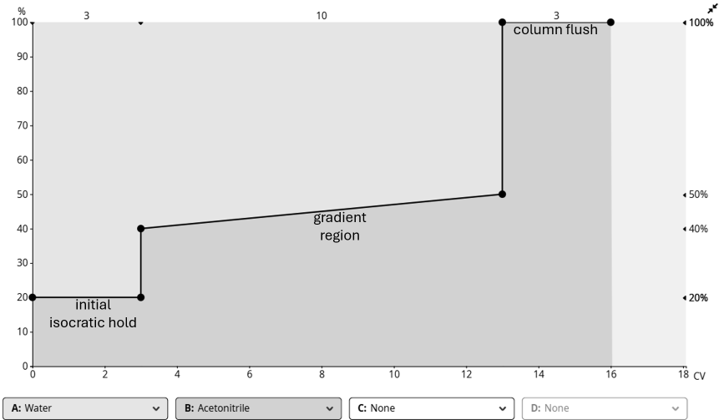 Figure 2: (top) broad linear gradient, (bottom) focused gradient
Using these guidelines, purification was performed on the Biotage® Selekt using the column sizes and loading conditions described in Table 2. This gradient design centers the separation around the predicted flash elution window.
Figure 3 shows a zoomed screenshot of the representative flash chromatograms obtained using the focused gradient approach centered at product elution.
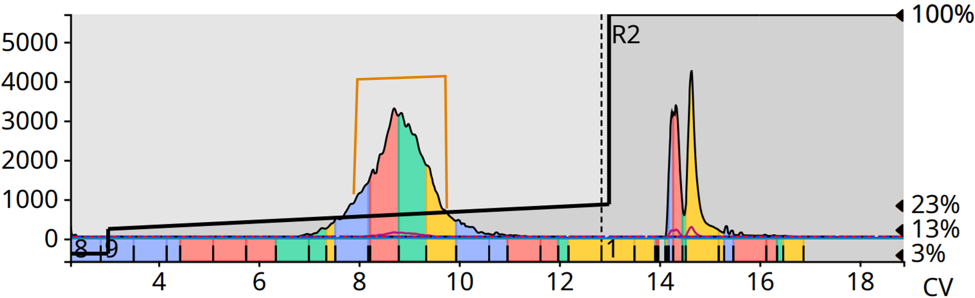
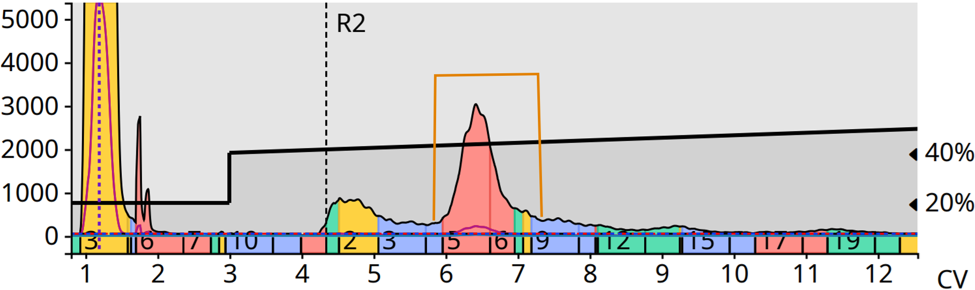
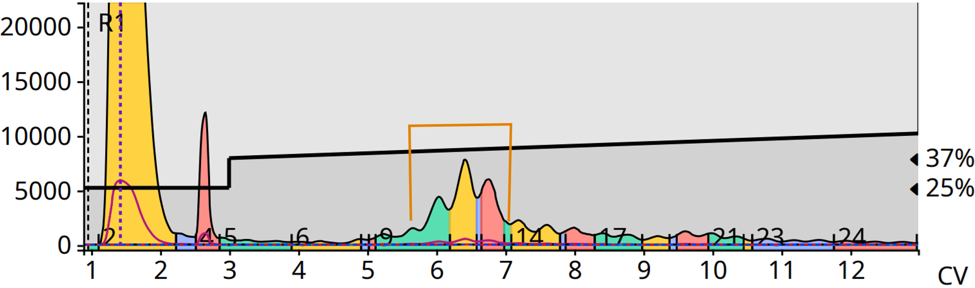 Figure 3: Representative reversed-phase flash chromatograms generated using a focused gradient for (top) ACP, (middle) 18A, and (bottom) GLP-1. In the GLP-1 example, the compound eluted at 41% MeCN. The orange bar indicates the test tubes combined for final purification analysis.
Fractions within the highlighted collection window were combined and evaporated using the HPLC Fractions method on the Biotage® V-10 Touch Evaporation System (orange, figure 2). The purified fractions were subsequently analyzed by analytical HPLC to confirm purity (figure 4).
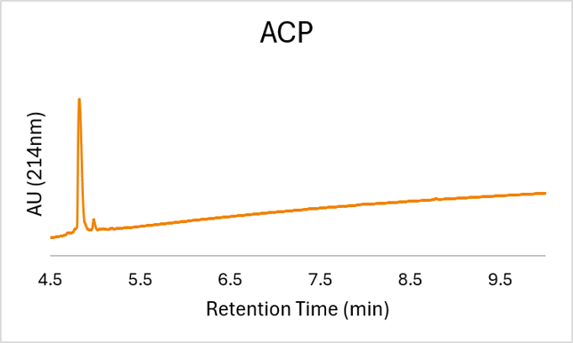
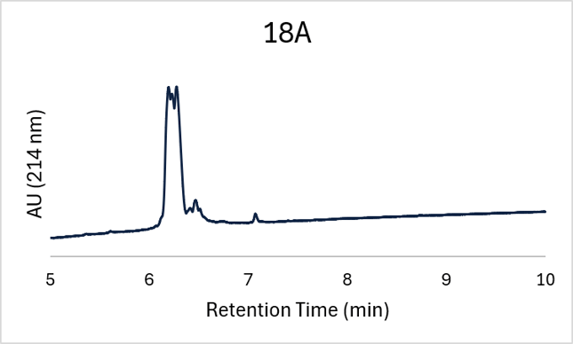
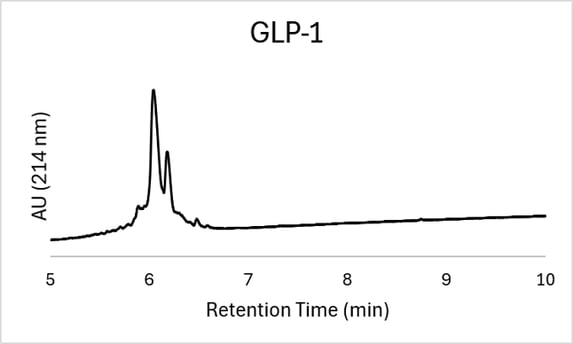 Figure 4: Analytical HPLC chromatograms of purified peptide samples (top, orange) ACP, (middle, blue) 18A, and (bottom, black) GLP-1.
GLP-1 purification provided the highest recovery with 31.2 mg isolated from 43.6 mg injected, corresponding to a 71% recovery. ACP purification yielded 50.3 mg from 82.0 mg injected (61% recovery), while 18A yielded 21.1 mg from 45.8 mg injected (46% recovery). Across all three peptides evaluated, focused flash purification provided an average recovery of 59%, with isolated purities ranging from 72-97% depending on the peptide sequence. When normalized to the theoretical maximum recovery based on crude purity, the observed recoveries further highlight the efficiency of the focused gradient approach. GLP-1 achieved the quantitative recovery at >90%, while ACP and 18A recovered 78% and 71%, respectively, indicating efficient isolation of the desired product relative to its initial abundance in the crude mixture.
Comparison to a traditional broad linear gradient further emphasizes this trend. For the same GLP-1 sample, the broad gradient yielded comparable purity at 73% but with significantly lower recovery of 44%. Specific gradient details are provided in the additional information section. In contrast, the focused gradient maintained similar purity at 72% while recovering >90% of the theoretical maximum purity. This specific example demonstrates that the primary advantage of focused gradients lies in maximizing recovery without compromising purity.
Focused gradients improved chromatographic resolution, reduced fraction overlap, and improved fraction purity compared with wide gradients spanning larger solvent composition ranges. These results demonstrate that analytical HPLC retention behavior provides a reliable predictor of flash chromatography elution conditions for synthetic peptide purification. Across peptides of varying sequences and polarity, flash elution consistently occurred approximately 10% lower in % MeCN than the analytical HPLC elution point (see additional information for one GLP-1 example). This predictable relationship enables focused gradients to be designed directly from analytical retention data. Focused gradients centered on the predicted flash elution window compressed the elution region and reduced peak dispersion relative to wide gradients covering large solvent composition ranges (i.e., 25-75% MeCN over 10 CV). Despite the lower chromatographic efficiency of flash media relative to analytical HPLC columns, analytical retention behavior remained predictive of flash chromatographic performance.
Conclusion
Analytical HPLC retention behavior can serve as a reliable predictor of flash chromatography elution conditions for peptide purification. Across all compounds evaluated, flash elution occurred approximately 10% lower in % MeCN than analytical HPLC elution, enabling direct translation of analytical retention data into focused flash purification gradients. By centering the gradient around the predicted elution window, this approach compresses the elution region, reduces fraction overlap, and improves isolation efficiency. Notably, focused gradients enabled high recovery of target peptides while maintaining comparable purity—and in some cases improving purity—relative to traditional broad linear gradient methods. This predictive workflow enables rapid translation from analytical HPLC to HPFC using the Biotage® Selekt system, significantly reducing method development time, solvent consumption, and trial-and-error optimization.
Chemicals and reagents
All materials were obtained from commercial suppliers: Sigma-Aldrich (acetonitrile, HPLC and ACS grade), formic acid (HPLC grade), trifluoroacetic acid (ACS grade), DMSO (ACS grade), and H2O (HPLC and DI).
Additional information
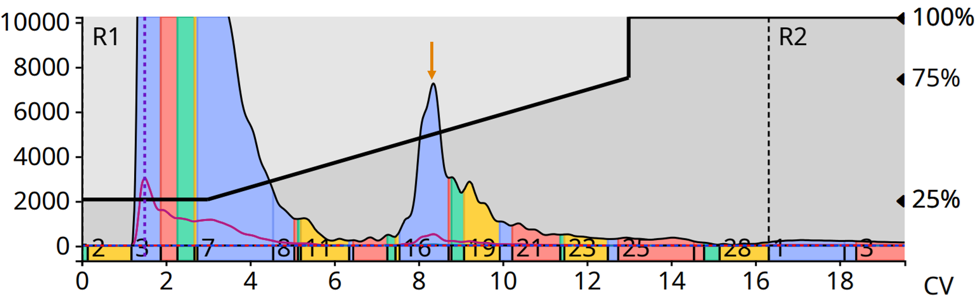 Figure of a zoomed screenshot of a broad linear gradient centered at product elution at 51% MeCN when 43.5 mg of GLP-1 in 0.45 mL of DMSO was injected onto a Sfär Bio C18 Duo 10 g column. The orange arrow indicates the test tube used for final purification analysis.
Literature number: AN1031
