
Introduction
Tobacco-specific nitrosamines, TSNAs, are carcinogens found in tobacco products, including e-cigarettes and smokeless tobacco. NNN (n-nitrosonornicotine), NNK (4-(methylnitrosamino)-1-(3-pyridyl)-1-butanone), and NNAL (4-(methylnitrosamino)-1-(3-pyridyl)-1-butanol) are the most analyzed TSNAs. NNK has been attributed to lung cancer in humans (1), NNAL is a metabolite of NNK, and NNN has been associated with the risk of causing esophageal cancer in smokers (2). TSNAs can be difficult to accurately detect due to false positives for second-hand and third-hand contamination. Second-hand contamination occurs through second-hand smoking, which can cause non-smokers to test positive for TSNAs at low detection limits. Third-hand contamination arises from residual material present on test tubes, extraction media, pipette tips, or other labware used throughout the sample extraction and analysis processes.
This application note demonstrates an optimized sample extraction procedure for NNN, NNK, and NNAL. The strongest basic pKa of the analytes are 4.79, 3.96, and 4.73 for NNN, NNK, and NNAL, respectively. The water-octanol coefficient, logP, values are 1.011, 0.579, and 0.492 for NNN, NNK, and NNAL, respectively.
Analytes
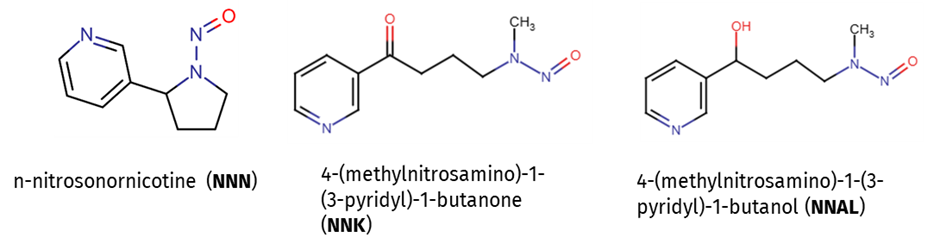
Figure 1. Molecular structures of N-nitrosonornicotine (NNN), 4-(methylnitrosamino)-1-(3-pyridyl)-1-butanone (NNK), 4-(methylnitrosamino)-1-(3-pyridyl)-1-butanol (NNAL).
Sample preparation procedure
Sample extraction experiments were conducted with non-smoker donor urine (pH 6.30) for the recovery of TSNAs. Synthetic urine (UriSub, pH 7.4) was used for calibration solutions to avoid interference from human urine which, may contribute to the TSNA signal.
Format
ISOLUTE® SLE+ 1 mL cartridge (Tabless), Part Number: 820-0140-CG.
Processing
Samples were processed using Biotage® PRESSURE+ 48 positive pressure manifold, (P/N PPM-48). Alternatively, processing can be automated using the Biotage® Extrahera™ automated sample preparation workstation.
Sample pre-treatment
Urine (1 mL) from a non-smoker human donor was fortified (pre-spike) with 200 pg/mL TSNAs (NNN, NNK and NNAL) for extraction recovery performance experiments. Untreated urine was used for blank, pre-spike, and post-spike experiments. Calibration solutions were prepared using UriSub fortified with different concentration range of TSNAs.
Extraction procedure
Load 1.0 mL of the urine (blank/fortified) sample onto the column and apply a pulse of vacuum or positive pressure (3–5 seconds) to initiate flow. Allow the sample to absorb for 5 minutes.
Apply 1.5 mL of ethyl acetate and allow to flow under gravity for 5 minutes. Apply a further aliquot of ethyl acetate (1.5 mL) and allow to flow for another 5 minutes under gravity. Apply vacuum or positive pressure to pull through any remaining extraction solvent (5–10 seconds).
Post-extraction
Dry the extract in a stream of air or nitrogen using a TurboVap® LV at a bath temperature of 50 °C and gas flow of 1.5 L/min for 20 minutes.
Reconstitute in Mobile Phase (200 μL).
Analytical conditions
U/HPLC conditions
-
Instrument: Shimadzu Nexera X2 (LC-30AD)
-
Column: Restek Raptor ARC-18 (2.7 µm, 100 x 2.1 mm, p/n 9314A12)
-
Mobile phase(s): acetonitrile/2 mM ammonium format (15:85, v/v)
-
Flow rate: 0.45 mL/min
-
Gradient details: isocratic method, 5.10 min
-
Column temperature: 50ᵒC
-
Injection volume: 5.00 µL
-
Sample temp (cooler temperature): 8ᵒC
MS/MS conditions
-
Instrument (SCIEX, 5500 MS/MS)
-
Polarity: Positive
-
Source temp: 500ᵒC
-
Curtain gas: 20
-
Collision Gas (CAD): 8
-
IonSpray Voltage (IS): 5500
-
Source gas(s): 50, 50
-
MRM parameters
Table 1. Analyte MRM transitions and ionization settings.
|
Q1 |
Q3 |
DP |
CE |
CXP |
|
|
NNN 1 |
178.009 |
148.100 |
56.000 |
15.000 |
8.000 |
|
NNN 2 |
178.009 |
120.100 |
56.000 |
25.000 |
6.000 |
|
NNN 3 |
178.009 |
119.100 |
56.000 |
39.000 |
8.000 |
|
NNK 1 |
207.906 |
122.100 |
61.000 |
17.000 |
6.000 |
|
NNK 2 |
207.906 |
106.100 |
61.000 |
31.000 |
6.000 |
|
NNK 3 |
207.906 |
80.000 |
61.000 |
53.000 |
12.000 |
|
NNAL 1 |
209.819 |
180.200 |
70.000 |
20.000 |
15.000 |
|
NNAL 2 |
209.819 |
149.000 |
70.000 |
20.000 |
15.000 |
|
NNAL 3 |
209.819 |
93.100 |
61.000 |
27.000 |
6.000 |
Results
Using the method presented in this application note, a panel of three TSNA compounds were spiked into human urine and extracted using ISOLUTE® SLE+ 1 mL cartridges. All analytes demonstrated excellent recovery (>80%) and good matrix effect (0.82-0.92) (Table 2, Figure 1). Extraction recovery for TSNAs were 81%, 92%, and 92%, for NNN, NNK, and NNAL respectively (Figure 1 (A)), which shows robustness of the method. Matrix effects for TSNAs were 0.87, 0.92, and 0.82 for NNN, NNK, and NNAL respectively (Figure 1 (B)) indicating relatively lower matrix suppression for the analytes representing clean sample extract.
Table 2: Analyte LOQ, linearity, recovery, and matrix effect.
|
Sample Name |
LOQ (pg/mL) |
R2 |
Recovery (%) |
Matrix effect |
|
NNN |
<7 |
0.999 |
81 |
0.87 |
|
NNK |
<15 |
0.999 |
92 |
0.92 |
|
NNAL |
<31 |
0.997 |
92 |
0.82 |
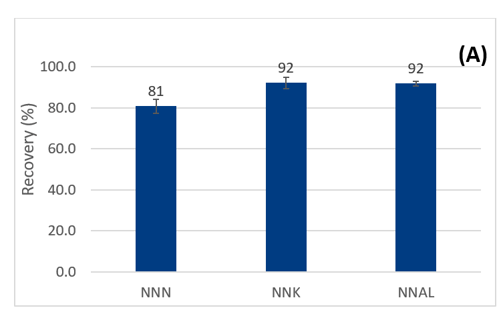
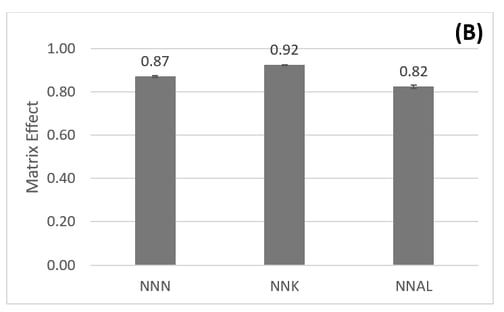
Figure 1. (A) Extraction recovery and (B) matrix effect for TSNAs in human urine. NNN (n-nitrosonornicotine), NNK (4-(methylnitrosamino)-1-(3-pyridyl)-1-butanone), and NNAL (4-(methylnitrosamino)-1-(3-pyridyl)-1-butanol). %RSD shown as error bars (n=3).
Linearity and LOQ
The concentration range for TSNAs calibration curves was 1.0, 10.0, 50.0, 100.0, 150.0, 200.0 pg/mL. Calibration curves for TSNAs showed good linearity with R2 values of 0.999, 0.999, and 0.997, for NNN, NNK, and NNAL, respectively (Figure 2 (A-C)). LOQs obtained from linear regression analysis were 7, 15, and 31 pg/m for NNN, NNK, and NNAL, respectively (Figure 2 (D)).
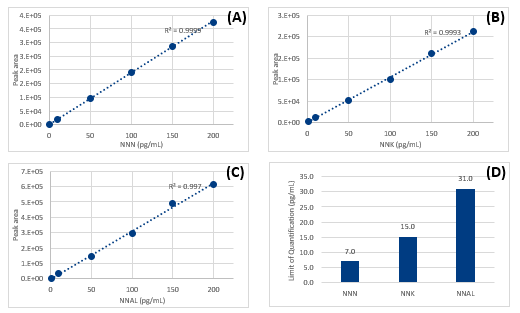
Figure 2. Calibration curves for (A) NNN, (B) NNK, (C) NNAL, and (D) limit of quantification for TSNAs in UriSub.
Conclusion
This method demonstrates a simple load-wait-elute extraction procedure for the quantification of TSNA from human urine at low LOQ levels. The method developed allows TSNAs to be quantified in clinically relevant quantification range (3-5). Due to the potential for contamination of control urine samples, spiked water or synthetic urine should be run to determine LOQ/LODs along with water or synthetic urine that has not been spiked. This will help determine at what concentration the negative samples may contain TSNAs. Running several donor urine samples from both smokers and non-smokers could help to determine reasonable cutoff concentrations. This method can be difficult to develop due to second-hand and third-hand TSNA contamination.
ISOLUTE® SLE+ Supported Liquid Extraction plates and columns offer an efficient alternative to traditional and time-consuming manual liquid-liquid extraction (LLE) process for bioanalytical sample preparation. SLE sample clean-up procedure provides high analyte recoveries, no emulsion formation, and significantly reduced sample preparation time.
Using an ISOLUTE SLE+ sample preparation method allows for a fast extraction method with sufficient sample clean up resulting in cleaner extracts.
Chemicals and reagents
-
TSNA standards are NNK (4-(methylnitrosamino)-1-(3-pyridyl)-1-butanone) (AccuStandard, 99.9%), NNAL (4-(methylnitrosamino)-1-(3-pyridyl)-1-butanol) (LGC Standards, 99.94%), and NNN (n-nitrosonornicotine) (LGC Standards, 99%).
-
The working standard solutions were prepared by diluting or dissolving in mobile phase through serial dilutions and stored in the refrigerator (<4ᵒC).
-
Synthetic urine (UriSub, pH 7.4) was used without further modification. Human urine was collected from a healthy non-smoker donor and used fresh without further modification.
Additional information
Extraction protocol was tested for urine sample pH variation by spiking TSNAs into pH adjusted urine samples. The pH adjustment was performed by adding small amount (less than 1% of sample volume) of formic acid or ammonium hydroxide to reach appropriate pH values. Adjusted urine sample pH was 4.0, 5.0, 6.0,7.0, and 8.0. The extraction recovery was within 80-100% indicating applicability of the method for a wide range of sample pH values.
Standard statements
All extract cleanliness data shown in this application note was generated using real, intact matrix, obtained from human volunteers or other sources, as stated.
References
-
Derby, K.S., Cuthrell, K., Caberto, C., Carmella, S., Murphy, S.E., Hecht, S.S. and Le Marchand, L. (2009), Exposure to the carcinogen 4-(methylnitrosamino)-1-(3-pyridyl)-1-butanone (NNK) in smokers from 3 populations with different risks of lung cancer. Int. J. Cancer, 125: 2418-2424.
-
Yuan, J.M.; Knezevich, A.D.; Wang, R.; Gao, Y.T.; Hecht, S.S.; Stepanov, I. Urinary levels of the tobacco-specific carcinogen N'-nitrosonornicotine and its glucuronide are strongly associated with esophageal cancer risk in smokers. Carcinogenesis 2011, 32, 1366–1371.
-
Stephen S. Hecht, Irina Stepanov, and Steven G. Carmella. Exposure and Metabolic Activation Biomarkers of Carcinogenic Tobacco-Specific Nitrosamines. Acc. Chem. Res. 2016, 49, 1, 106–114.
-
Delshanee Kotandeniya, Steven G. Carmella, Xun Ming, Sharon E. Murphy, Stephen S. Hecht. Combined Analysis of the Tobacco Metabolites Cotinine and 4-(Methylnitrosamino)-1-(3-pyridyl)-1-butanol in Human Urine. Anal. Chem. 2015, 87, 3, 1514–1517.
-
Nikam, S.S., Gurjar, M., Singhavi, H. et al. Simultaneous analysis of urinary total 4-(methylnitrosamino)-1-(3-pyridyl)-1-butanol, N′-nitrosonornicotine, and cotinine by liquid chromatography-tandem mass-spectrometry. Sci Rep 11, 20007 (2021).
Literature number: AN884
