
Introduction
Axitinib (Figure 1) is a type of molecularly targeted drug used in renal cell carcinoma. To avoid serious side effects and achieve maximal therapeutic efficacy, it is crucial to determine the correlation between side effects on blood levels and treatment efficacy. Therapeutic Drug Monitoring (TDM) is one of the measures to achieve this.
In this application note, ISOLUTE® SLE+ was used as a sample preparation cartridge for Axitinib determination in plasma using the principles of supported liquid extraction (SLE).
ISOLUTE® SLE+ Supported Liquid Extraction plates and cartridges offer an efficient alternative to traditional liquid-liquid extraction (LLE) for bioanalytical sample preparation, providing high analyte recoveries, no emulsion formation, and significantly reduced sample preparation time.
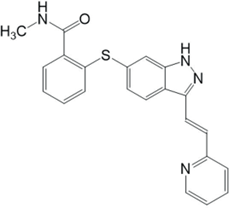
Figure 1. Structural formula of Axitinib
Analytes
Axitinib (Axitinib, CAS:319460-85-0)
Internal standards
Osimertinib (Osimertinib, CAS: 1421373-65-0)
Sample preparation procedure
Format
ISOLUTE® SLE+ 400 µL Sample Volume cartridges, (part number: 820-0055-B).
An equivalent 96-well plate format, (part number 820-0400-P01) is also available.
Sample pre-treatment
To plasma (200 μL), add 5.0 ng/mL of Osimertinib as an internal standard. Add water (HPLC grade or higher) (200 μL) and vortex mix for 30 seconds.
Sample loading
Load 400 μL of the sample solution onto the ISOLUTE® SLE+ cartridge and apply light pressure (3 psi) or vacuum (-0.2 bar) to initiate flow. Allow the sample to absorb for at least 5 minutes and wait for samples to stabilize. Ensure that all sample solution is absorbed onto the diatomaceous earth.
Sample elution
Add 900 μL of methyl tert-butyl ether (MTBE) and allow to flow under gravity for 5 minutes. Then, add another 900 μL of the solvent, and allow to stand for 5 minutes or more. If required, the extraction can be completed with application of gentle pressure (3 psi) or vacuum (-0.2 bar) (10 to 30 seconds).
Evaporation and reconstitution
Evaporate the extract with a nitrogen gas evaporator, and reconstitute the extract with water: methanol (1:1, v/v, 2 mL).
UHPLC conditions
Instrument
Nexera LC-30AD (Shimadzu)
Column
ACQUITY UPLC® BEH C18 1.7 μm (2.1 mm × 50 mm column; Waters)
Mobile phase
A: 10 mmol/L ammonium acetate aqueous solution
B: acetonitrile
Flow rate
0.4 mL/min
Gradient conditions
|
Time (mins.) |
% Mobile phase B |
|
0 |
5 |
|
3 |
95 |
|
4 |
95 |
|
4.1 |
5 |
|
6.5 |
5 |
Column temperature
40 °C
Injection volume
1 µL
Mass spectrometry conditions
Instrument
LCMS-8060 (Shimadzu)
Ionization mode
ESI positive
Nebulizer gas flow rate
3.00 L/min
Drying gas flow rate
10.00 L/min
Heating gas flow rate
10.00 L/min
Interface temperature
350 ⁰C
DL temperature
200 ⁰C
Heat block temperature
350 ⁰C
CID gas
270 kPa
SRM transitions
Axitinib: m/z 387.40 > 356.05, Rt 2. 14 min, Collision Energy -20
Osimertinib (IS): m/z 500.30 > 72.15, Rt 2. 43 min, Collision Energy -27
Results
SRM (Selected Reaction Monitoring) chromatograms of Axitinib and Osimertinib (IS) are shown in Figure 2. Under the LC conditions used in this application note, two peaks were detected in the Axitinib chromatogram. This was attributed to the separation of the isomers. In this study, we determined the peak area value for the peak at elution time of 2.14 minutes and used this to create the calibration curve*. The calibration curve generated is shown in Figure 3.
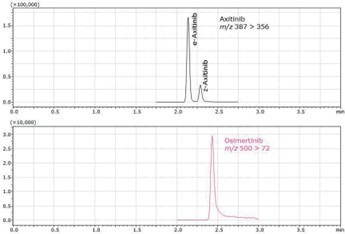
Figure 2. SRM chromatograms of Axitinib (top) and Osimertinib (IS) (bottom)
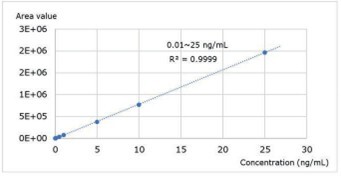
Figure 3. Standard curve for Axitinib
Axitinib has a wide dynamic range of 0.01 to 25 ng/mL covering the range of blood concentrations required for TDM (0.1 to 10 ng/mL) and has a good linearity with a multiple correlation coefficient (r2) of 0.9999 or more.
(* Reference: Biomedical Chromatography. 2018;32:e4147)
Confirmation of analyte recovery and matrix factors
Sample pre-treatment is very important in samples of biological origin. ISOLUTE® SLE+ supported liquid extraction cartridges were used to eliminate the effects of matrix components such as proteins, phospholipids, and salts and to allow improved quantitative analyses. Figure 4 shows the SRM chromatograms obtained by SLE pre-treatment of the control plasma spiked with 50.0 ng/mL axitinib. No interference from contaminants in the plasma was observed. Recovery rates and matrix factors after SLE pre-treatment for 3 axitinib plasma concentrations (0.5, 5.0, and 20.0 μg/mL) are shown in Table 1. Recovery was calculated by comparing the peak area of samples spiked with axitinib pre-extraction (A) with that of blank samples spiked after extraction (B).
Matrix factors were calculated by comparing the area values of (B) and the standard solution (S). As a result, a recovery rate of more than 95% was obtained at each concentration, and the values of matrix factors were sufficiently low. It was quantitatively confirmed that ISOLUTE SLE+ pre-treatment effectively eliminates matrix effects. In this application note, we recommend the use of Osimertinib as IS for axitinib, but use of stable isotope dilution as an internal standardization approach would also be appropriate.
|
Blood concentrations (ng/mL) |
Recovery rate (%) |
Matrix factor (%) |
|---|---|---|
|
0.5 |
111.3 |
-1.1 |
|
5.0 |
105.9 |
13.3 |
|
50.0 |
96.5 |
1.8 |
* Recovery rate = [A]/[B] × 100; Matrix Factor = 1-[B]/[S] × 100
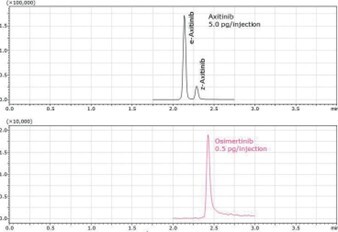
Figure 4. SRM chromatograms of 50.0 ng/mL Axitinib in plasma after ISOLUTE® SLE+ extraction.
Ordering information
|
Part Number |
Description |
Quantity |
|---|---|---|
|
820-0055-B |
ISOLUTE® SLE+ 400 µL Sample Volume |
50 |
|
820-0400-P01 |
ISOLUTE® SLE+ 400 µL 96-Well Plate |
1 |
|
PPM-48 |
Biotage® PRESSURE+ 48 Positive Pressure Manifold |
1 |
|
121-2016 |
Biotage® VacMaster™ 20 Sample Processing Station (with 16 mm Rack) |
1 |
This application note was prepared in collaboration with the Pharmaceutical Department of Gunma University Hospital, Japan.
Literature number: AN937
