
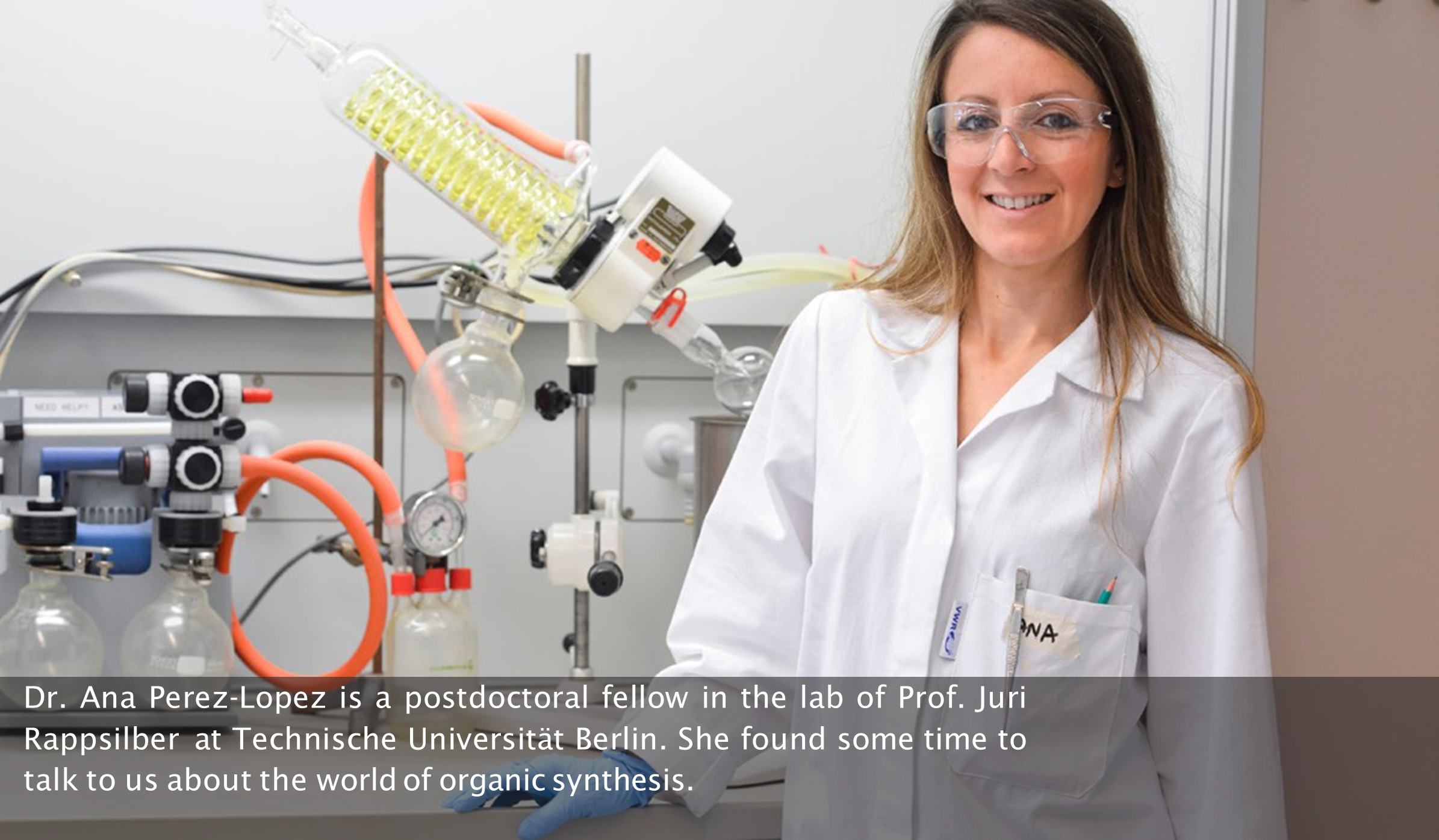
First, how did you end up where you are today?
“I have always been fascinated with the ability of chemistry to produce drugs, medicines and therapies. It was therefore natural for me to pursue my Ph.D. in Medicinal Chemistry, where I synthesised small peptide drugs designed to inhibit protein- protein interactions involved in numerous neurodegenerative diseases. During my Ph.D. I had the opportunity to work in Prof. Bradley’s group at the University of Edinburgh, producing fluorescence probes for better cancer diagnosis. This ignited my interest with cancer and introduced me to the coalface where the chemistry lab meets the clinic.
In 2014, I started working at Cancer Research UK developing metal catalysts for targeted anticancer therapies. Working within a hospital brought me even closer to clinicians, biologists and patients. I recently moved to TU Berlin with an IPODI fellowship, where I am learning proteomics in the group of Prof. Juri Rappsilber, and in the process I have just set up a fully-equipped organic chemistry lab in the Department of Bioanalytics.”
Tell me about your current work in Berlin.
“I am developing a biorthogonal catalyst prodrug therapy, especially targeting inoperable, currently terminal, brain tumours. Combining biotechnology and catalytic chemistry,
I am producing bioorthogonal catalysts that can mediate the local (only in the tumour) release of anticancer drugs, avoiding severe side effects and improving the efficiency of the current anticancer treatments. Studying the effect of catalytic chemistry on proteins in their native environments, using proteomics, allows me to develop better biocompatible metal catalysts for cancer therapies.”
What made you choose Biotage as your supplier?
“I was introduced to Biotage through working in Prof. Bradley’s group, who was pioneering microwave-assisted peptide synthesis at the time. While I worked in the group I used the Initiator microwave system and Isolera One flash chromatography system extensively. Not only is the equipment very versatile, user-friendly and reliable, but as a company Biotage is also reliable with a very professional sales and support team. This was validated by my recent experience setting up a satellite chemistry laboratory at the Department of Bioanalytics at TU Berlin. The team at Biotage helped me to very quickly acquire and install a Selekt with ELSD and Initiator+ with Robot 8 in our lab.”
How have these instruments helped you?
“The Initiator+Robot 8 is working very well for organic reactions with low reactivity or for amide couplings on solid phase. Using conventional heating, the reactions are incomplete with multiple by-products. The Initiator+Robot has had a positive impact on the reactivity of my reactions, the reaction yields are higher and the microwave heating greatly reduces reaction times. In the past, I faced peptide synthesis on solid-phase through difficult amide couplings at room temperature or with conventional heating, getting a reaction crude of multi- products. The Initiator+Robot 8 has greatly improved the yield of my amide couplings on solid phase, simplifying the purification process.
In addition, the automatic purification system Selekt can effectively separate the compounds in very complex mixtures in less than 10 minutes! It is an environmentally friendly system, avoiding the exposure to large amounts of solvents during manual purifications. Since even the most complex purifications can be easily programmed on the Selekt, it is easy to use by less-trained personnel, which is essential for having multiple users access the laboratory. Thus our increased throughput potential, with significant savings of time, cost and waste, is allowing us to progress with our projects. What used to take me almost an entire week can now be done in less than a day. For example, I am synthesising crosslinking reagents for proteomics. These molecules are very unstable in water and very insoluble in organic solvents. The purification process is impossible to achieve by manual procedures. Now, I have optimised the purification of these compounds on the Selekt using a reverse phase column with minimal decomposition.”
Rappsilber Laboratory
Situated in the Technical University of Berlin, the research group of Prof. Juri Rappsilber digs into the molecular machinery of life, which is mostly built from proteins. They have pioneered crosslinking mass spectrometry and bridge organic chemistry, protein & nucleotide chemistry, molecular biology, separation sciences, mass spectrometry, data visualisation, programming and machine learning, with the vision to reveal the dynamic structure and interactions of every protein in a cell, in a time-resolved manner.
rappsilberlab.org
References
Rappsilber et. al. Protocol for micro-purification, enrichment, pre-fractionation and storage of peptides for proteomics using Stage Tips, Nature Protocols, vol.2, n.8, p.1896–1906, 2007.
Literature number: PPS629
