
The Gakushuin University Nakamura Group is engaged in “new drug discovery” at the interface between organic chemistry and molecular biology, developing liposomal boron nanocapsule drug delivery systems (BDSs) for boron neutron capture therapy (BNCT). The group installed an Initiator microwave synthesizer in its laboratory in 2007. Prof. Nakamura has described the Biotage® Initiator as an essential tool for his group’s cutting-edge research.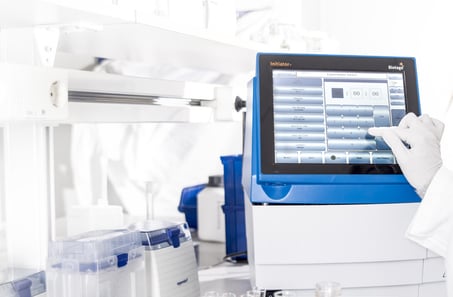 Biotage® Initiator Classic has been replaced by Initiator+ (seen above). All features mentioned in this article like ease of use, speed, and the safety related to a separate and isolated vial chamber are available on Initiator+.
Can you please explain the Elements Strategy Inistiative (ESI)?
The ESI is actively pursuing research in the fields of material science and nanotechnology. Its goal is the strategic advance- ment of research for the efficient utilization of scarce resources and for the development of alternative resources.
In the field of organic synthesis, research is ongoing, to be able to replace platinum, palladium, and other rare-metal catalysts with steel and other low-cost metals, but also to develop organic catalysts that do not contain any metals at all. This has become an important trend in the field of organic synthesis.
What specific research projects are active?
One example is the research led by Prof. Kenji Maruoka of Kyoto University on nonmetal catalysts, as part of the research effort for Advanced Molecular Transformations of Carbon Resources (fiscal years 2005 to 2008). This effort is funded by the Ministry of Education, Culture, Sports, Science and Technology (MEXT) program Scientific Research on Priority Areas (SRPA). The research by Prof. Maruoka is wide-ranging, and includes investigations on the use of nonmetal catalysts for advanced molecular transformation of functional carbon molecules.
Another example, from my own participation in this SRPA, is described in our report on the use of a copper catalyst and microwaves to synthesize allene compounds. As reported, the microwave process greatly shortened the reaction time. Professor Nakamura’s uses the Biotage® Initiator to investigate slow reactions in an oil bath quickly.
One of your fields involves nanoparticle drug delivery systems and particle accelerators
Cancer cell proliferation generally involves rapid angiogenesis. The walls of the newly formed blood vessels are immature, so their vasopermeability is high. Because of this, particles around 100 nm in size can move from the blood, across the blood vessel walls, and enter and accumulate in cancer cells. This is known as the enhanced permeation and retention (EPR) effect. If the EPR effect can be utilized in a drug delivery system, it would allow selective transport of the drug into the cancer cells.
The use of neutron beams from a particle accelerator will open up the way for widespread use of BNCT as a method of radiation therapy. This requires the development of a boron delivery system. In joint research with the University of Tsukuba, Osaka University, and the Japan Atomic Energy Agency, we have developed a boron delivery system based on liposomes. The boron particles are encapsulated in liposomes, embedded in liposome films or one method is to enable an active uptake of the boron particles by the target cells itself.
Why did you decide to investigate the use of microwave synthesis?
I had been interested in using microwave synthesis for some time, but couldn’t find any synthesis equipment I liked. But when I visited The Scripps Institute in 2006, the researchers there recommended the Initiator. When I actually tried using it, I was pleasantly surprised with its high-robustness and ease of use.
Has the Initiator changed your research in any way?
Before we used microwaves, investigating a slow reaction required a complex examination of the reaction temperature, pressure, and reaction times, as well as of the catalyst and the solvent. Using the Initiator, we can now investigate slow reactions in an oil bath quickly by microwaving the reaction. Microwave systems provides a new option for investigating reaction conditions.
The key advantage of microwaving is its high heating efficiency. This shortens the heating time and reduces the occurrence of side reactions and decomposition reactions. Some researchers have also observed that microwaving seems to affect the surface activity of metal catalysts.
And what is it like to use?
Operating the Initiator is easy. You can learn how to use it by simply using it, without having to read a big manual. The Initiator is also reliable. We’ve had no problems with it since installation, even though many students from other laboratories also use it. I am completely satisfied with its robust design.
Maintenance is easy. Once, when a vial broke and contaminated some components inside the cavity, we were able to replace the contaminated components immediately, by ourselves. Simple maintenance is important for doing experiments efficiently.
Lastly, what is the outlook for new applications of microwave synthesis in the field of organic synthesis?
I believe there has been progress in understanding the effects of microwaves on organic reactions, and that the technique is now established in the organic synthesis laboratory. Moving forward, research will focus increasingly on accelerating reactions that are slow using conventional heating techniques, and thus reducing reaction times.
I think microwave synthesis will be effective for speeding up the synthesis of labeled antibodies used in radiation therapy and in other areas.
As we discussed earlier, the ESI believes the possibilities for microwave synthesis are far-reaching and will help open up the way for major advances in the use of low-cost metals and organic compounds as catalysts.
Nakamura Group
Faculty of Science, Department of Chemistry Gakushuin University
Currently Prof.Nakamura transferred to Chemical Resources LaboratoruFaculty, Tokyo Institute of Technology University
Literature Number: PPS643
