
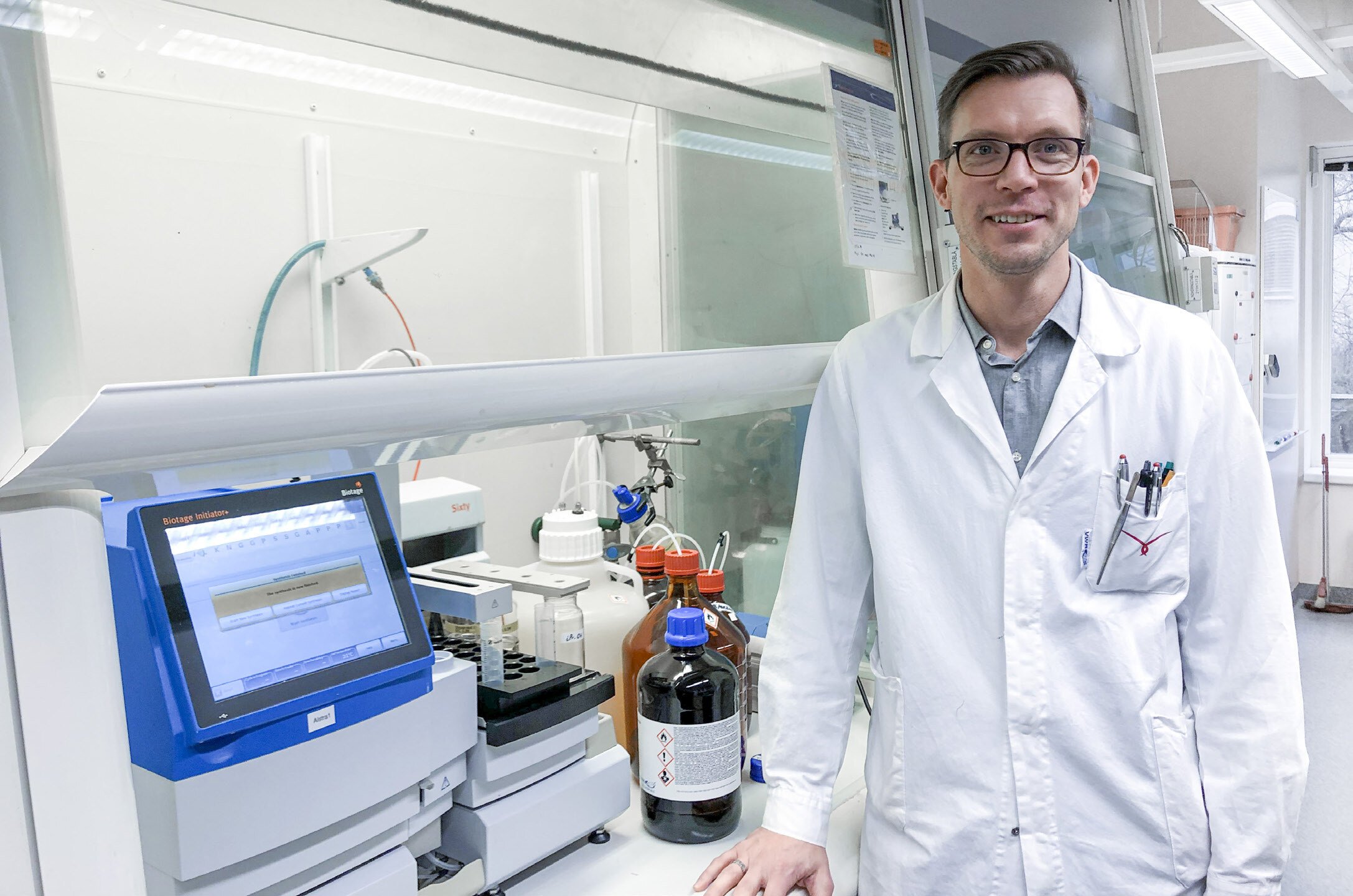
Richard E. Johnsson, Ph.D. is Head of Peptide Chemistry at Red Glead Discovery in Lund, Sweden.
Red Glead Discovery is a pre-clinical drug discovery CRO offering a broad range of services to Life Science clients. With a focus on small molecules and peptides, their drug discovery platform ranges from medicinal chemistry and synthesis to ADME and biology. In addition to the CRO business, they also perform research collaborations with various biotech and academic partners.
We met with Richard E. Johnsson, Ph.D., Head of Peptide Chemistry at Red Glead Discovery, Lund, Sweden, where he told us about using Biotage products in his workflow.
Can you describe what Red Glead Discovery is?
We are a CRO company, I would say mostly in early discovery. We have five parts: medicinal chemistry for small molecule synthesis, peptide synthesis, ADME analysis, in-vitro biology and the last part is fragment based lead discovery. We do work in all these five areas.
If we focus on your peptide synthesis area, how do you currently synthesize your peptides?
We have three peptide synthesizers of which two are Biotage Alstra peptide synthesizers. We bought one in 2013 and the second one in 2015. We have several projects running in parallel, ranging from two to over 60 amino acids. Currently our synthesizers run all week long from Monday through Sunday.
Our typical scale is usually 0.25 or 0.40 mmol using the 30 mL reactor vial. We do longer peptides depending on what the client requests. The longest we have done sequentially is 54 amino acids, but we do even longer peptides by ligation. We do the constructs on the synthesizers and the ligation off the machine. The 54 amino acid synthesis was not nice, and we couldn’t do ligation either on that peptide as there was not a good spot for it with the knowledge we had at the time. We use a lot of unnatural amino acids in these sequences, where one third are unnatural or unusual amino acids and the remainder are standard.
What kind of modifications can you do?
Post synthesis, we do everything! We do conjugation, chemical ligation, we do head-to-tail cyclizations, and C-terminal modifications with esters and secondary amides. We can of course do disulfide bonds and multiple disulfide bonds. The more challenging things we have done lately is parallel and anti-parallel dimers. I can see there is a need for much more conjugates, more PEG-peptide, more fatty acids, and more peptide-PEG or protein-peptide conjugates. We make all of these types of molecules today.
And how do you purify your peptides?
Usually we purify using the Isolera flash chromatography system with the SNAP* Bio columns using one injection with as much material as possible. We use the 25 and 50 g columns and we can usually inject the whole 0.4 mmol synthesis in one go.
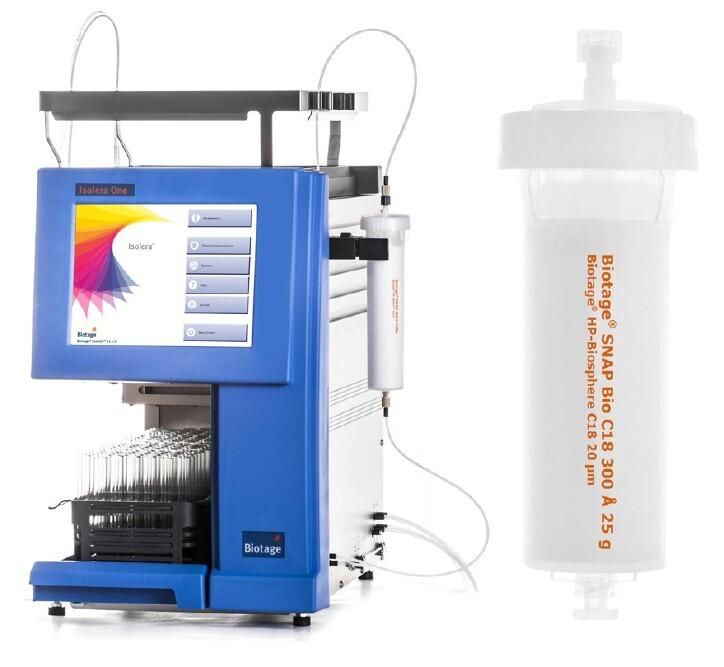 Isolera™ One flash purification system and a Biotage® SNAP Bio flash purification column.
*Biotage® SNAP chromatography columns have been discontinued and replaced by Biotage® Sfär chromatography columns. The Biotage® Sfär columns are available with the same media options as the Biotage® SNAP columns, delivering equivalent results.
Peptide chemists are normally trained to use RP-HPLC for peptide purification, were you skeptical about moving over to flash chromatography?
No, I was not. Everything that makes things easier is beneficial. Since I am a trained organic chemist, the change was very easy. I had used flash systems and SPE systems before. I would say that around 95% of everything we synthesize goes through the Isolera once. Some peptides are pure enough after that, whereas some peptides require further purification by RP-HPLC.
What was the problem with just using RP-HPLC?
We need to do more injections with HPLC. The runtime for the gradient between the HPLC and the Isolera is approximately the same, around 20 minutes. But when you have a longer peptide with 400–500 mg crude peptide, maybe 60% pure, that requires a lot of injections on HPLC, whereas we can inject that in just one or two shots on the Isolera and get down to 300 mg. So it saves us a lot of time on purification.
Did you find that the subsequent HPLC became easier?
No, I wouldn’t say it makes it easier, because the impurities that are left after the Isolera are usually impurities that are very close, so the purification is still tricky. However, instead of injecting 50 mg where only half of it is what you need, you can actually inject 50 mg and just fine polish all of it, because everything in the end and the beginning has already been removed on the Isolera. Since we have decreased the amount of crude material and increased the purity of what is injected, the RP-HPLC is quicker.
Do you use both the C18 and C4 stationary phases in the SNAP Bio columns?
No, we use C18 almost exclusively, because we haven’t seen a need for the C4 in the projects we have worked on so far. However, we do have some projects coming where I have been looking at C4 because they will probably never work with a C18 stationary phase. It comes back to what I said before, I think there will be a need for more peptide conjugates, more fatty acids and things like this, where C18 is going to be really tricky to use for purification and we will need C4 or something like that.
We know several peptide groups have been purifying peptides on our flash systems since 2010, but the SNAP Bio columns were developed later specifically for peptide purification. Would you recommend flash purification to peptide chemists?
Yes, I would say so. If your purification involves more than one injection on the HPLC, then absolutely. Maybe that should be the limit, either because it is a big scale synthesis, or alterna- tively it is a very tricky purification and you want to remove as much of the impurities as possible before going to HPLC.
Are there things that could be improved on our systems?
The Alstra is working well. I have to say it is very intuitive and easy to use in general, but of course there are things we would like improved. For example, there is no database for my peptides to save to like on the Isolera. You cannot save your run on the system, you just get a report at the end of the synthesis. It’s important because as a CRO sometimes we could get a request from a customer after two years and they say “these peptides were really good in our assay and we need more”. Of course we have everything written down in our lab notebooks and the information in the reports, but we need to reprogram everything to repeat the synthesis.
However, a workaround is to export and import synthesis setups from USB sticks, but we have two Alstra systems so it starts getting messy in the folders, especially when a new amino acid is programmed on one system and then transferred to the other system as we use a lot of unusual amino acids.
Are you aware of the Alstra™ Remote software?
Yes, when I heard about this, I was thinking “this is great”. We can sit at our own computer and program it, because that is the other problem we have; someone is running the Alstra, it will end at lunchtime for example and we need a new 40 amino acid synthesis. We then have to wait until it’s done before we can program the method and weigh out the reagents and amino acids, instead of programming, get the print out of reagents and weigh everything out and be ready to start when the synthesizer has finished. I was happy with this idea because you can save all your sequences on your computer and do the programming offline and have everything ready to go when the Alstra is free. With the Alstra Remote software you can also copy amino acid folders which gets around the issue of transferring them between our systems which is great.
Would you recommend our products to other peptide chemists?
Yes, I would. I feel confident using the machines. I have used a significant number of your systems and was first introduced to Biotage with your SP flash purification systems and microwave systems a long time ago. Now I use the peptide synthesizers a lot. I would say we are happy.
Literature Number: PPS524
