
When a drug candidate is going to be tested, volumes must be scaled up. This requires scalable solutions for purification. From traditional small molecules to peptides, natural product extraction, or targeted synthesis of targets in the latest high-tech HP-APIs, or novel lipids used in COVID-19 formulations, Biotage purification platforms and scavenging technologies are trusted and underpin efficient processes, from research to cGMP campaigns or commercial production, the world over.
Scaling up with Flash 400 for the purification of lipids used in mRNA vaccines
 Common examples of lipid purification using normal phase and reversed phase flash.
In 2020, Biotage collaborated with the specialty chemical company Croda on a project focused on the production of a potential key novel small-molecules used to stabilize mRNA in COVID-19 vaccine formulations, for global distribution.
The Biotage team contributed their expertise in large scale and commercial purification and with the help of Biotage Flash 400, Croda managed to scale up their processes from development to production in just four months. This not only resulted in a stable, commercial-grade manufacturing process, it also saved Croda valuable time and reduced their solvent consumption compared to existing, traditional methods.
”This is a success story that we are proud to share. Usually it takes 2–3 years to complete major projects such as this but in 6 months we got the technical solution in place. Using the Biotage Scale-Up platform saved enormous amounts of solvents. Croda designed and built a new factory in six months for this purpose. We are proud of the hard work our respective organizations have achieved and we feel proud of being part of solving a serious societal problem using Smart science to improve lives” – Steve Mellor, Research & Technology Director, Croda
Smart science to improve lives™
Croda is the name behind the high performance ingredients and technologies in some of the biggest, most successful brands in the world: creating, making and selling speciality chemicals that are relied on by industries and consumers everywhere.
Adopting Biotage® Flash 400 into an existing API manufacturing workflow
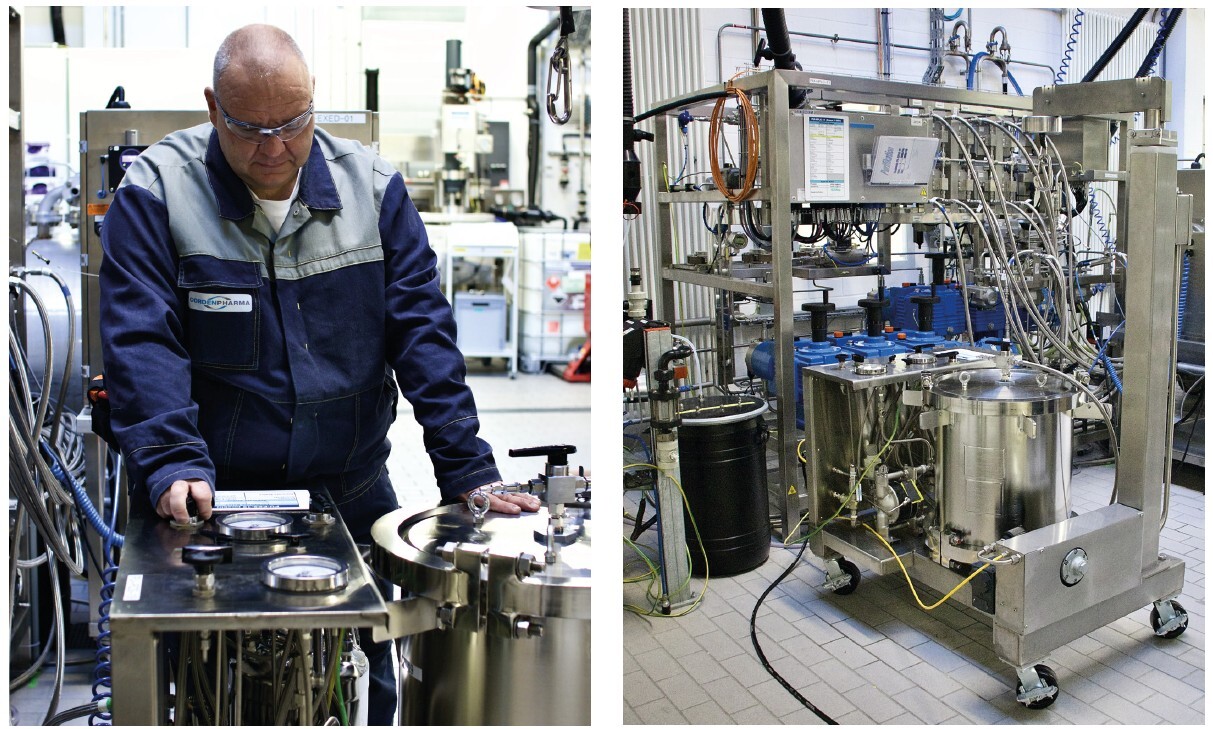 Biotage® Flash 400 system in use at CordenPharma.
Biotage Flash 400 large-scale chromatography system and pre-packed cartridges were evaluated alongside a custom-made alternative as part of a plan to increase the efficiency of the workflow. The purification was of a large multi-kg batch of crude API (the nature of the API was proprietary).
The original purification process custom-built for API manufac- ture involved using a filter as a housing for silica, and an external pump to move the solvent. New process using Biotage Flash 400 reduced the overall process time from 18 days (for 2 operators) to 6 days, retaining the same excellent purity of 89.8% by HPLC-UV, but with an increased mass recovery of 34.4 kg (89.8%). The overall operating costs of the process were reduced by 50%. There were other noted process advantages. Due to the higher column loading, the concentration of eluted product was much higher using Biotage Flash 400 silica, saving 5,400 L of solvent and therefore much less evaporation was required.
In total, 550 kg of loose silica was replaced by one Flash 400 column (40 kg) and 5.5 m3 less waste was produced by the more streamlined process, which was easier to integrate into the production environment, resulting in more efficient planning for resource needs in future projects.
CordenPharma
CordenPharma is a full-service CDMO for a global market, specializing in APIs, drug products, and associated packaging services operating through a growing network of cGMP facilities across Europe and the US organized under five technology platforms: Peptides, Lipids & Carbohydrates; Highly Potent & Oncology; Injectables; Small Molecules; Antibiotics.
Purifying 147 kg of natural product at
Satori Pharmaceuticals
Biotage® Flash 400 cartridges were used to purify large crude batches for an Alzheimer’s drug candidate.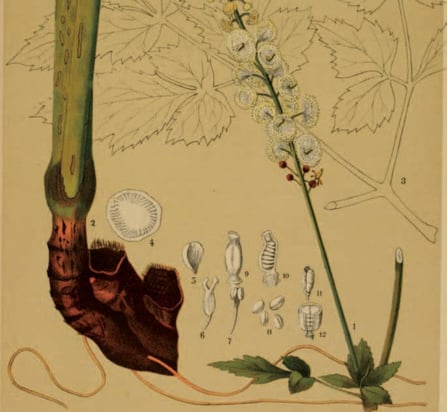 Root nodules of Actaea racemosa, a well known medicinal herb containing a candidate precursor for a novel Alzheimer remedy.
Gamma-secretase modulators (GSMs) are promising compounds for Alzheimer’s disease therapy. As part of the synthetic pathway to obtain the GSM SPI-1865, an international research group synthesized large quantities of two cycloartenol triterpenoid glycosides from roots of Actaea racemosa, known as black cohosh. In doing so, no less than 147 kg of extract solution was purified on a Biotage® Flash 400L KP-Sil cartridge, installed on a Biotage® Flash 400 system. The fractions contained 11.44 kg of extracted product.
Ruichao Shen, a leading scientist at Satori Pharmaceuticals Inc. explains: “The problem we faced was to find an efficient method to purify the crude mixture as fast as possible and maintain a good recovery at the same time. At that time Biotage had the largest pre-packed SiO2 cartridge available in the industry. We chose the product and it helped us solve the problem well.”
Read more
Ruichao Shen et al., 2014. Multikilogram-Scale Production of Cycloartenol Triterpenoid Glycosides as Synthetic Intermediates for a g-Secretase Modulator. Organic Process Research & Development 2014 18 (6), 676-682DOI: 10.1021/op5000732
17 kg sample over 2 Days
A major UK Major Pharmaceutical Company used Biotage Flash 400 for bulk drug purification.
A sample (17 kg made up in DCM), containing 4 kg of product was split and 3 x 5.7 kg injections performed. Using normal phase conditions (hexane/ethyl acetate) with a flow rate of 5 L/min, 3 kg of purified product was isolated in 95% purity, representing 75% recovery. Each injection was 50 minutes and the total time for batch purification was only 2 days.
Type 2 diabetes candidate
US major Pharmaceutical Company
A US Major Pharmaceutical Company developing a Type 2 Diabetes candidate (a G Protein-coupled receptor 119 (GPR119) agonist) had ~13 kg of racemic acetate, which was hydrolyzed in 2 batches to target one chiral form.
2 Flash 400 runs, with 6.5 kg injections was performed, using normal phase (KP-Sil 40–63, average 50 micron particle size) conditions and a 50/50 ethyl acetate/heptane isocratic solvent mix. Final mass yield was 4.1 kg (36.5%, theoretical 5.627 kg), and due to the chemical control in hydrolysis, an ee of 99.4%
- Overall mass yield 4.1 kg (36.5%, theoretical 5.627 kg)
- ee 99.4%
Read more
Organic Process Research and Development 2015, 19, 819–830
Process improvement with Biotage® Flash 400
US major Pharmaceutical Company
Biotage Flash 400M system was used to improve a pre-existing but inefficient process which used a stainless-steel self-packed column, and 26 x 1.5 kg injections in order to process a 40 kg batch.
The original SS column needed to be packed and unpacked between each run, and the overall cycle time of 3 days, with no silica re-use resulted in a final process that took 6 weeks to complete, using a 3-per-day shift pattern supporting 20 hour runs. Application of Biotage Flash 400M enabled 6 runs to be completed per day, during a single 8 hour working shift, and the surrounding optimization requiring only 1 week to complete the project. Only one cartridge was used, resulting in silica and labor costs being reduced by 75%.
Metal Scavenging at Nippon Shinyaku
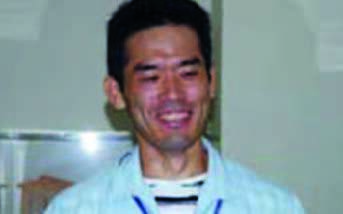 Mr. Toshio Fujiwara is working as head of Process Chemistry at CMC Research & Development Department, Discovery Research Laboratories. Nippon Shinyaku Co., Ltd has used Biotage metal scavengers for metals reduction within GLP/cGMP.
“Primarily, my role is to develop a synthetic process for pipeline compounds from exploratory studies. We are aiming to establish an efficient, inexpensive and safe synthetic approach in accordance with the production scale.
I heard about the metal scavenger kit of Biotage AB. Various evaluations were performed for each of the five types of scavengers included in the kit under a wide variety of solvents and temperature conditions. (Too many scavengers would make finding optimal conditions difficult because we must consider solvent conditions among other factors). Of course, we tested other makers’ products, but Si-Thiol of Biotage AB gave the best results in terms of removal rate.
After choosing Si-Thiol, we have proceeded with GLP/GMP productions and the API process is going well. A production scale of tens of kg gave the same results as the smaller production scale. There is no problem. Furthermore, we can place a large order in bulk to respond to demands for a larger scale production. That was the deciding factor.
Recently, the speed in developing new drugs has been emphasized. Therefore, a response to a scale-up in production is important.
I also supply drug samples for GLP studies and clinical studies (its production should be done according to the GMP Guide for APIs and a quality level as prescribed by the Guide), which are required for drug development. Medicinal products that are produced by a coupling reaction (i.e. Suzuki-Miyaura coupling) use such metals as palladium. Therefore, residual metals should be strictly controlled in the final drug substance. We usually use removal methods involving extraction or crystallization. However, characteristics of the target chemical may prevent removal. In such cases, we need to use a reagent such as metal scavenger. After elucidation of the chemical structure of the candidate compound, I participate in a project that involves GLP studies, clinical studies and finally registration application over a long period of time. I am sure the metal scavenger of Biotage will be our first choice when working on a future project in which palladium removal can be problematic.”
Literature Case: MP-TMT Best in Class
 In an early example, the Welch group screened a variety of metal scavengers and developed a new metric to consolidate the effect of metal removal and also product yield (loss).
The alpha factor metric that they created was the ratio of metal removed and product lost. High alpha is strongly preferred solution, with low levels of metal and high yield of product, and Biotage® MP-TMT demonstrated the highest alpha factor of all materials tested.
Read more
Welch, C.J.; Albaneze-Walker, J.; Leonard, W.R.; Biba, M.; DaSilva, J.;
Henderson, D.; Laing, B.; Mathre, D.J.; Spencer, S.; Bu, X.; Wang, T.; Org. Proc.Res.Dev. 2005, 9, 198-205
Metal Scavenging vs. Recrystallization
The use of a metal scavenger was compared with a traditional recrystallization technique.
Recrystallization is a powerful way to isolate product, but depending on the structure, metals may also be concentrated within the crystal structure and contaminate the product. Metal scavengers were seen to eliminate this concern.
A Sukuzi reaction was analysed and recrystallized. Applying the crude (1,300 ppm) product directly to a column plug of the metal scavenger Si-TMT, resulted in a reduction of Pd, with the final concentration measured being 5 ppm.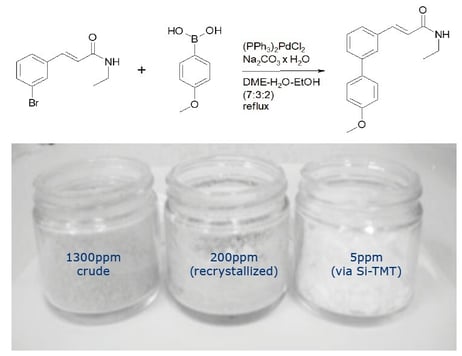 Suzuki reaction and crystallized product.
Read More
The Use of Polymer and Silica Supported Metal Scavengers in Scale Up/Process Chemistry, New Approaches to Todays Challenges: A Detailed Study. Poster P29, Biotage.
Metal Scavenging vs. Carbon
Carbon is a classic way to remove metals, palladium in particular. However, using carbon as a purification technique or decolourizing agent carries some risks. Depending on the product, carbon may permanently absorb the product of interest, not just the metal contaminant, resulting in unacceptable losses in mass yield and recoveries, and devasting effects on process economics.
The efficiency, metal removal and overall mass recovery of identical quantities of metal scavenger and carbon were compared. A solution containing 500 ppm Pd catalyst and 1 g of a benzoxazole was made up, and varying quantities (0.2 g, 1 g, 2 g) of metal scavenger or carbon was added. The solution was stirred and then concentrated to support metals and mass yield analysis. The metal scavengers Si-Thiol and MP-TMT removed over 98.2% of the initial Pd content, however, carbon was less effective, removing up to 88% at the maximum treatment level. Due to the density of carbon, implications for optimization the reaction to completion would have meant huge consumption of batch reactor space, and concordant difficulty in mass transport and stirring (and reactor washing). We also noted significant and unacceptable loss of organic product when used in conjunction with carbon, compared to quantitative recoveries when treated with the Biotage metal scavengers.
Literature Number: PPS679
