
The scale up is based on Kyowa’s extensive experience in process validation and investigational drug GMP manufacturing
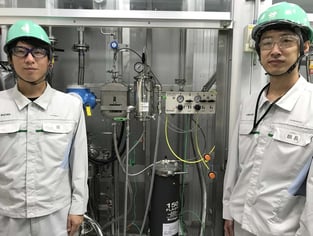

In this interview, Mr. Tomonaga and Mr. Tachi, who are responsible for manufacturing advancement within the production department of Kyowa Pharma Chemical Co., Ltd., share their insights regarding the implementation of Biotage® Flash 150 purification systems during the scale-up process in manufacturing.
Could you tell us about your company's business and research activities?
Mr. Tomonaga: Our company is a developing global business primarily focusing on pharmaceuticals and health sciences, including functional cosmetics. Within the active pharmaceu- tical ingredients (APIs) sector, we are the global market leader for tranexamic acid that can be used, for example, in medicines that control bleeding. Another key pillar of our business is prostaglandin (PG), a compound that is used in several applications, including labor induction. By leveraging our expertise in organic synthesis technology, we have developed various manufacturing methods for PG derivatives, ensuring safe and environmentally conscious production in compliance with good manufacturing practice (GMP) requirements.
In addition, we collaborate with pharmaceutical companies as a contract development and manufacturing organization (CDMO) with a comprehensive suite of services for compound develop- ment, spanning from research scale to production scale. We can conduct process development, analytical method development, and scale-up activities. By 2025, we are also considering the introduction of new manufacturing facilities for developmental products. Additionally, our robust GMP compliance capability is a notable strength, having successfully passed seven Food and Drug Administration (FDA) inspections in the past.
Our expertise extends to bioconversion, encompassing screening of strains, utilizing enzymatic processes for reactions, and applying these processes to synthesize compounds for production. A novel discovery has emerged from our research where plant-derived glycans function as chemical catalysts. We are actively advancing applied research on the expression mechanism of these catalytic functions and their physiological effects.
Additionally, we are focusing on sulfur-rich molecules (super-sulphide molecules) that have potential for anti-aging and anti-inflammatory effects. Our company is actively researching and has filed patents for multiple supersulphide molecules, and we have established industrial production methods for these compounds.
Within the cosmetics industry, our primary focus lies in formula- tion research, with a special emphasis on developing liposome- based drug delivery systems (DDS) and advancing cosmetics through our robust analytical and evaluative capabilities. Our research provides products designed to efficiently tackle customer concerns, including instability, poor skin penetration and challenges with ingredient solubility. Mr. Tomonaga
Could you provide insights on your company's endeavors in scaling up column chromatography purification, considering the array of innovative technologies integrated into your expansive business operations and process development?
Mr. Tomonaga: Purifying active pharmaceutical ingredients (APIs) or intermediates derived from synthetic reactions is a crucial step in API manufacturing. While crystallization is often preferred due to productivity and cost factors, chromatographic purification may become necessary for certain compounds due to their properties.
In such cases, we began by optimizing purification conditions in the laboratory using Biotage’s laboratory-scale equipment, Biotage® Isolera™, before scaling up to production-scale flash chromatography systems at our processing site.
By maintaining a constant linear velocity during scale-up or scale-down, we ensure effective compound separation both in the lab and at the production site. For handling highly potent APIs, we use Biotage® Flash 150 chromatography system, designed for contained environments. Our experience includes successful process validation (PV) and GMP manufacturing of Investigational Medicinal Product (IMP).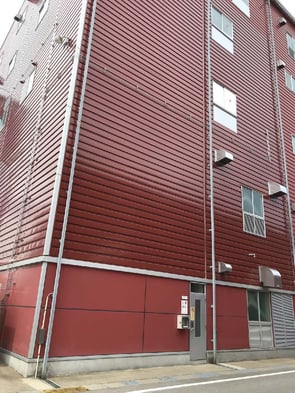 The production department of Kyowa Pharma Chemical.
What prompted your decision to use Biotage® Flash 150 flash chromatography system in your process?
Mr. Tomonaga: In our laboratory, we have been using Biotage® Isolera™ to enhance the efficiency of our initial evaluations. When assessing equipment for scale-up, we explored Biotage’s offering and identified Biotage® Flash 150 as a promising option. The decisive factor was its effectiveness in ensuring product containment, particularly important considering the nature of the substances we manage, which are highly potent APIs.
Prior to implementing Biotage® Flash 150, what purification methods did you use?
Mr. Tomonaga: At research scale, we used conventional open- column chromatography, dynamic axial compression (DAC) column, and automated purification systems sourced from other companies. As we transitioned to scaling up, we adopted larger open-column and gravity-flow columns, spanning from 30L to 500L, offering versatility across different scales. With our expertise in column purification technology, we want to further enhance our capabilities by expanding our range of purpose- built equipment.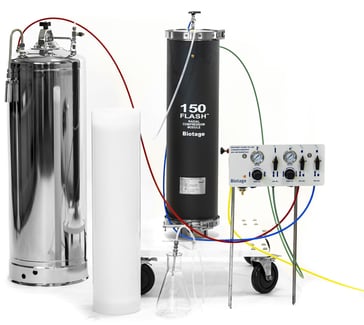 The Biotage® Flash 150 system, including its pre-packed cartridges.
I see that you have strong experience in column purification. Were there any limitations with your previous set-up and equipment?
Mr. Tomonaga: Dealing with highly potent APIs and compounds of unknown toxicity presents significant containment challenges. Recently, as the handling of highly potent APIs has become more prevalent, concerns have arisen regarding potential operator exposure when removing silica gel from open columns following purification. Additionally, challenges have emerged regarding the expertise necessary for silica gel packing and the substantial maintenance costs associated with DAC.
Fortunately, Biotage’s pre-packed flash chromatography columns are well-suited for containment, eliminating the requirement to extract silica gel for disposal. In practice, we possess expertise in purifying highly potent APIs in Category 6 (Occupation Exposure Limit – OEL: 0.1µg/m³ or less), enabling operational safety.
How did the implementation of Biotage® Flash 150 go? We are keen to hear your impressions and feedback.
Mr. Tomonaga: Initially, we noted outstanding separation reproducibility between the lab-scale equipment, Biotage® Isolera™, and the larger scale Biotage® Flash 150. The pre-packed columns eliminate the need for in-house packing expertise, mitigating user discrepancies and facilitating stable separation for consistent production.
Considering the high potency of prostaglandins, having a containment environment and the elimination of labor-intensive silica gel packing and extraction procedures have notably reduced our workload. In addition, the compact design of the equipment allowed for storage in confined spaces, such as within walk-in hoods, optimizing the use of space.
Your engineering team customized one of the systems. Has this impacted the system use?
Mr. Tomonaga: We have customized various elements, such as the fluid delivery system, sample injection module, and fraction collector to suit user requirements specifications (URS). Our layout facilitates continuous transfer of fractions all the way to the evaporator, designed with careful attention to optimizing workflow efficiency (Figure 1).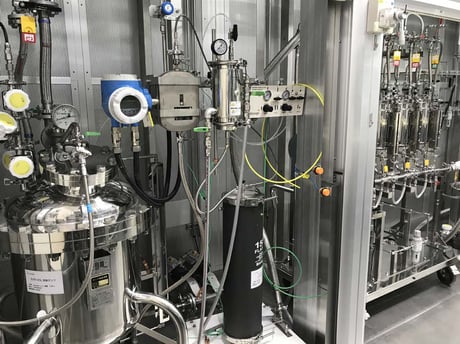 Figure 1. Purification system adapted for HPAPI handling with Biotage® Flash 150 system as the core. The system fits inside a draft and was designed by an engineering company.
What are your impressions of the data or results obtained from your actual usage of the equipment?
Mr. Tomonaga: We achieved purification results that were equivalent to the lab-scale evaluations, characterized by similar separation behavior, impurity removal rates, and yields (Figure. 2). The decision to procure equipment for both laboratory and production scales from the same manufacturer has proven advantageous. Our accumulated expertise in Biotage® Flash 150 customization and scale-up has contributed to achieving high reproducibility across lab equipment and production facilities, as well as maintaining consistency between batches during manufacturing.
This consistency is crucial for reducing evaluation time during scale-up, enhancing the success of IMP manufacturing or process validation (PV), and ensuring stable production. Looking ahead, the potential expansion to the larger Biotage® Flash 400 series holds promise for further enhancing efficiency and productivity.
Are there any specific points you would like to explore moving forward?
Mr. Tachi: We would like to explore cost-saving measures by implementing column or solvent reuse and their suitability for reverse- phase conditions. While our current usage primarily involves normal-phase conditions, we foresee potential future applications in reversed-phase conditions. In addition, we are also interested in the capabilities of the larger Biotage® Flash 400 system.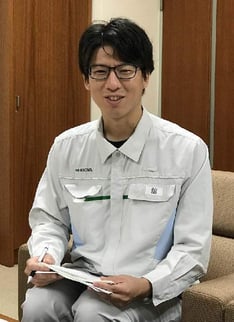
Mr. Tachi
If one is contemplating scaling up from lab scale, what key points would you recommend?
Mr. Tomonaga: Certainly, two key factors to consider are separation reproducibility and safety, particularly containment. The consistency in separation directly impacts the efficiency of scale-up process, the success rate of process validation, and the stability of APIs quality in commercial production.
With an expected rise in handling highly potent APIs and compounds with uncertain toxicity during development phases, ensuring robust containment capabilities becomes crucial for safety.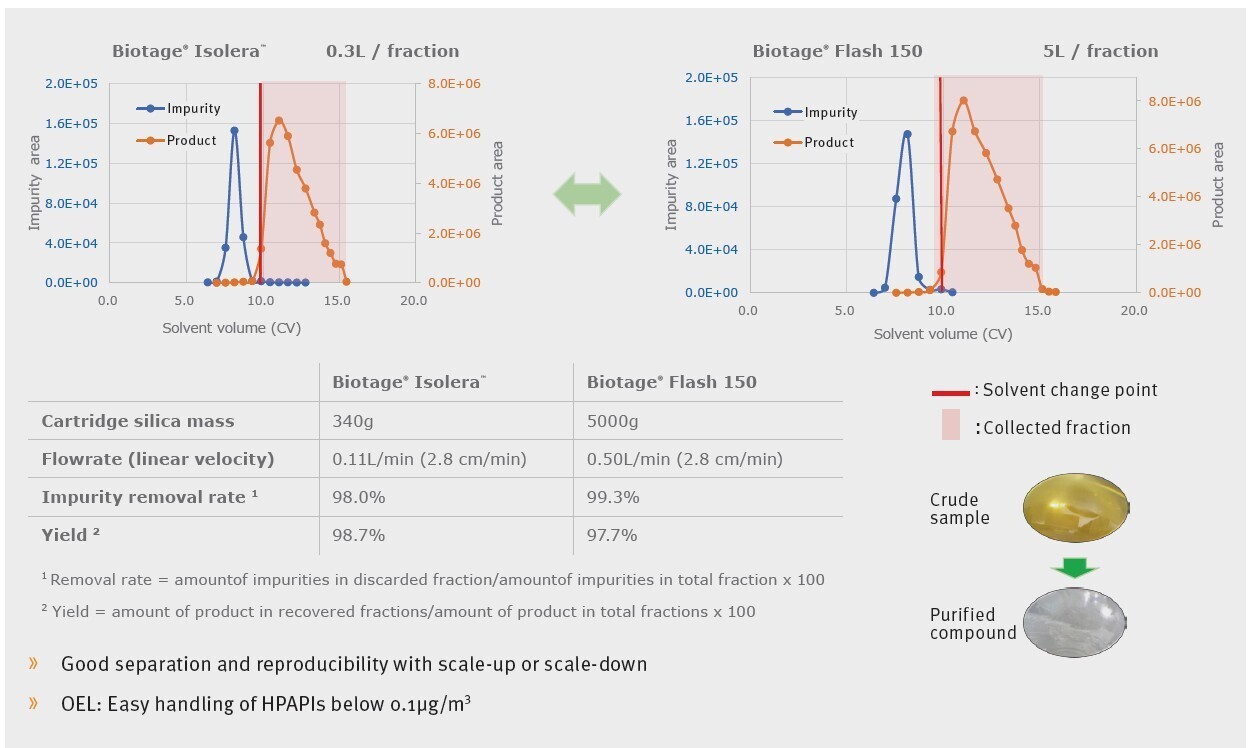 Figure 2. Linear velocity and chromatographic results during scale-up from Biotage® Isolera to Biotage® Flash 150 system. Easy scale-up is achieved by matching the linear velocity. The results and the quality of the purified product are good.
About Kyowa Pharma Chemical
In 1946, Kyowa Pharma Chemical started business in Takaoka, Toyama Prefecture. Ever since, the company has made full use of its proprietary organic synthetic technology to provide fine chemical products, including high-quality active pharma- ceutical ingredients and intermediates for medical drugs and vitamins. Since 2007, as a subsidiary of Kyowa Hakko Bio Co. Ltd. of the Kirin Group, Kyowa Pharma Chemical has been operating businesses in two domains: the pharmaceutical domain, where the company manufactures active pharmaceutical ingredients, and the health science domain (intermediate domain between Pharmaceuticals and Food & Beverages) that includes functional cosmetics. Also, from now on, we would like to contribute to people's health and society by focusing on the CDMO (Contract Development and Manufacturing Organization) business, which conducts contract manufacturing from the early stage of drug development.
The Kirin Group set the KV2027 long-term management vision in 2019 and is committed to a number of activities that would make the company a global leader in CSV (Creating Shared Value), creating value from Food & Beverages to Pharmaceuticals. Kyowa Pharma Chemical also continues to accept the challenges of creating solutions for environmental change and social issues and achieving the next-generation dreams, such as activities toward the SDGs (Sustainable Development Goals) and production process reformation to prevent global warming. Our mission is to give full attention to and carefully communicate with customers and patients to protect people’s lives and bring joy to people. Kyowa Pharma Chemical will refine and make full use of its proprietary technologies and expertise to consistently provide high-quality products to become an irreplaceable company needed by customers, patients, and people in the community.
Literature Number: PPS743
