
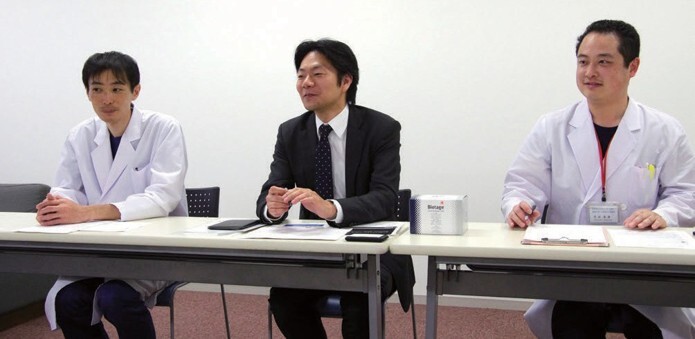
 Figure 1: The Japan Frozen Foods Inspection Corporation (JFFIC) made the transition from traditional mouse testing of shellfish toxins, to instrumental analysis by developing original methods. In the sample preparation procedure JFFIC uses EVOLUTE® ABN hydrophilic/hydrophobic SPE cartridges from Biotage. We interviewed Deputy Director Mr. Tadashi Kitta (middle), Supervising Director Mr. Hirokatsu Sasaki (left), and Mr. Takashi Hanada (right) from the scientific testing department in Yokohama.
First, please tell us about JFFIC.
Mr. Kitta: “JFFIC was established in 1949 to inspect and secure the quality of imported frozen seafood. The refrigeration technology at the time wasn’t all that developed, and the marine product industry was struggling with quality management.
Our work can be divided into inspection and testing. The inspection operation contains services like checking the quality of frozen and processed seafoods such as tuna for export, sampling of frozen foods for microbes, advice for hygiene management at factories and stores, and educational measures like training workshops and seminars. The testing operation is split into regular testing and specific testing of imported foods as ordered by the Minister of Health, Labour, and Welfare along with self-audit programs.
There are about 100 registered institutions for ordered examinations nationwide, but only a few of them have inspection labs throughout major ports like we do. JFFIC currently has labs at Sapporo, Sendai, Tokyo, Nagoya, Kobe, and Fukuoka, and a dedicated testing centre in Yokohama.”
What’s the focus of the Yokohama testing centre?
Mr. Kitta: “It was established in 2006 with departments for science, sanitation inspections, and technology development. The Sanitation Inspection Department conducts specific testing of food additives, packaging, and shellfish poison, which is our topic today. The shellfish poison testing method was developed by our technology development department.”
How did you begin testing for shellfish poison.
Mr. Kitta: “First of all, there are two types of shellfish poison with different symptoms. One is a paralytic poison and the other is diarrhetic. In the conventional official testing method, researchers extracted poison from a bivalve and injected it in mice to evaluate the poison. Although there is a dispersion of results with this method, it is very effective. There hasn’t been a single case of food poisoning for foods that passed this test and hit the market.
However, the animal rights perspective prompted a movement towards instrumental analysis in Europe about three years ago. This has given rise to regulations requiring instrumental analysis for diarrhetic shellfish poison for all mussels. Some of these changes came suddenly, so we had a pretty difficult time adjusting.
There aren’t many testing institutions working with shellfish poison in imported goods to begin with. In most cases, paralytic and diarrhetic poison tests are combined in one set, but the former uses mice while the latter uses instrumental analysis, and the number of labs that can handle both is limited. If we cannot perform the testing, the import of bivalves will stop, so there is a big responsibility.”
Why did you choose to use solid phase extraction and EVOLUTE ABN out of the numerous cartridges on the market?
Mr. Kitta: “In a notice issued by the Ministry of Health, Labour, and Welfare last March, they suggested using an ODS cartridge for sample preparation in an example analysis method. But in our method, we decided to replace the ODS cartridge with the EVOLUTE ABN solid extraction cartridge from Biotage. The EVOLUTE polymer based extraction cartridge has a larger capacity compared to ODS, so we could reduce the amount of sorbent. When we compared the results, the ODS cartridge required 200 mg, while EVOLUTE ABN required 25 mg of sorbent. Seeing this result and considering the balance of price and performance, we decided to go with Biotage.”
You had only one month from the notice to implement the test. Did you have to develop this method quickly?
Mr. Hanada: “The export testing for the EU market was the first to enforce instrumental analysis, so we started developing a method ahead of time. But even then, we had no time to waste.”
Mr. Kitta: “We first developed the measurement criteria, and then moved on to the solid phase extraction. There are many types of shellfish, so validating all of the necessary matrices was difficult. We grouped the matrix types and were ready by April last year.”
So what are the advantages of EVOLUTE ABN?
Mr. Hanada: “When we use a cartridge, we can see immediately that it performs a clean extraction without blocking. In my experience there are some products I don’t like, but with EVOLUTE ABN, there is no need for vacuum manifolds and everything flows naturally. It’s a pretty rare experience for me (laughs).”
Mr. Kitta: “It’s routine work, so being forced to use suction every time becomes inefficient. EVOLUTE ABN has good flow characteristics, so it is highly valued at our lab.”
Mr. Sasaki: “I’ve never run into trouble when using it. When I weigh out the shells and extract in methanol, the sample is dark brown, but what comes out of the cartridge is always clean and useful.”
I am very happy to hear that. Are there any problems?
Mr. Hanada: “I asked the members at the lab, but it really seems there isn’t a single problem with EVOLUTE ABN.”
Mr. Sasaki: “The fast shipment helps too.”
Tell us about your future plans. Is there going to be a shift towards instrumental analysis for paralytic poison as well?
Mr. Kitta: “One problem is the difficulty to set standards for analysis. For instance, we can no longer use a compound called saxitoxin because it was banned in regulations on chemical warfare agents. The government is working on a substitute standard method, so if that goes well we might see a shift towards instrumental analysis. Also, the standard for shellfish poison analysis can’t be chemically synthesized, so it becomes expensive. That is something we have to think about too.”
Japan Frozen Foods Inspection Corporation
JFFIC is a comprehensive food inspection institution that protects the security and safety of foods. JFFIC’s mission is to contribute to the wholesome development of the food industry and increase the security and safety of food safety by implementing “accurate testing” and “reliable inspections”. JFFIC meets the various demands of its clients with three major services, testing, inspection, and quality guarantee.
» Established: November 1949
» Employees: About 400
» Offices/testing centers: 7 locations nationwide in Japan http://www.jffic.or.jp/
Literature number: PPS433
