
Introduction
Flash chromatography using elution gradients of dichloro- methane and methanol (DCM/MeOH) are the go-to purification technique for chemists trying to purify polar compound mixtures. However, chlorinated solvents such as DCM have been determined to be hazardous1 and their use likely to be restricted by the EPA2. These issues have forced chemists to find alternative, safer solvent systems to replace commonly used DCM/MeOH.
Options
Beyond solvent changes, there are other alternatives that are safer and can be more effective than DCM/MeOH including reversed phase and a technique called HILIC (hydrophilic interaction liquid chromatography).
Reversed phase
Reversed phase uses a hydrophobic stationary phase column (C18) with water and either MeOH or acetonitrile (MeCN) as the eluting solvents. These solvents are safer to use and have a reduced environmental impact as compared to normal phase solvents, particularly DCM.
HILIC
HILIC uses a silica column with water and acetonitrile as mobile phase solvents. This technique works best with highly polar compounds that require a high proportion of MeOH with DCM or have no retention by reversed phase.
Comparing techniques
Two similar but different reaction mixture purifications are good examples of how these alternative purification strategies compare.
Reaction 1. Hippuric acid + α-methylbenzylamine

Figure 1. Hippuric acid + α-methylbenzylamine reaction using a Biotage®
Initiator+ microwave reactor.
For this mixture’s purification using a Biotage® Selekt Enkel with a 5-gram Biotage® Sfär HC column, a 0-10% MeOH in DCM gradient was needed but yielded a less than desirable separation, Figure 2. Figure 2. Reaction mixture purification using a DCM/MeOH gradient failed to completely separate the product from at least one byproduct.
In an effort to find a better, safer, and more environmentally sound purification method, reversed phase flash chromatog- raphy was used. The purification was achieved with a 30-70% H2O/MeOH gradient and a 6-gram Biotage® Sfär C18 column, Figure 3. This method proved successful at fully resolving the product from the by-products. Figure 3.Reversed phase flash purification of the hippuric acid + α-methylbenzylamine reaction mixture.
Reaction 2. Nicotinuric acid + benzyl amine
 Figure 4. Nicotinuric acid + benzylamine reaction using a Biotage® Initiator+ microwave reactor.
Polar reaction mixtures requiring increased methanol levels for purification (> 10% MeOH) are candidates for HILIC. This is not because of silica dissolution in methanol but because HILIC is often a superior method if reversed phase fails to provide an adequate separation.
With this reaction, to get the product to elute off silica, a 0-30% MeOH in DCM gradient was required, Figure 5. Figure 5. Normal phase flash chromatography of the nicotinuric acid + benzylamine reaction mixture.
While this method separated the product from less polar byproducts, scaling up this purification would not be environ- mentally sound or safe, from a chemist’s perspective.
Reversed phase flash chromatography was tried but failed to separate several byproducts with similar lipophilicities, Figure 6. Figure 6. Reversed phase flash chromatography of the nicotinuric acid + benzylamine reaction mixture separated more compounds but with less resolution.
In this situation, HILIC is a viable purification strategy. With HILIC, a silica column is used with an acetonitrile (MeCN) to water gradient. For this particular reaction mixture, a 5-gram Sfär HC silica column was used with a 0-30% water in MeCN gradient, Figure 7.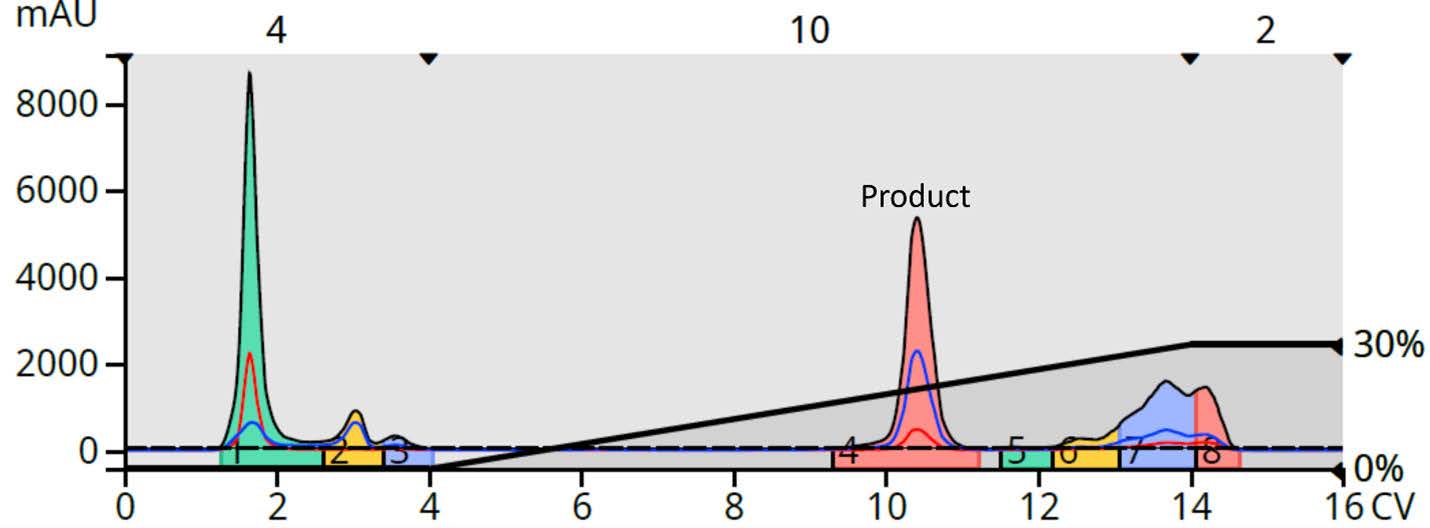 Figure 7. HILIC purification provided a complete separation of the product and all byproducts.
Conclusions
With environment, health, and safety issues with DCM and other chlorinated solvents increasing, alternative purification strategies are required. In this application note, two alternative purification methodologies, reversed phase and HILIC were provided as excellent alternatives to DCM/MeOH purifications.
Reference
- Vedantu.com
- EPA proposes methylene chloride ban. C&E News, May 1, 2023, p. 10.
Part Number: AN988
