
Introduction
This application note describes the use of the ISOLUTE® PLD+ Protein and Phospholipid Removal Plate for clean-up of a range of acidic, basic and neutral drugs from plasma.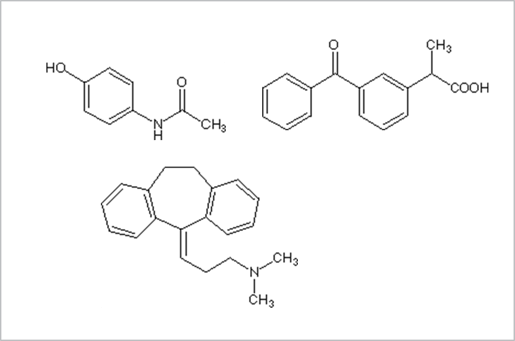
Figure 1. Structures of acetaminophen (neutral), ketoprofen (acidic) and amitryptiline (basic): examples of the broad range of analytes extracted in this application
ISOLUTE® PLD+ Protein and Phospholipid Removal Plates provide very effective but extremely simple sample clean- up for LC-MS/MS analysis. Requiring next to no method development, ISOLUTE PLD+ can be integrated quickly and easily into routine workflow, increasing productivity and reducing instrument downtime. ISOLUTE PLD+ plates remove >99% of plasma proteins and phospholipids, the main causes of ion suppression, leading to cleaner extracts and increased sensitivity (signal to noise) for a broad range of analytes.
Analytes
Acetaminophen, amitriptyline, atenolol, bretylium tosylate, brompheniramine, fluoxetine, metoprolol, mianserin, naltrexone, procainamide, quinidine, ranitidine, salbutamol, sulindac, p-toluamide and ketoprofen.
Sample preparation procedure
Format:
ISOLUTE® PLD+ Protein and Phospholipid Removal Plate, 50 mg, part number 918-0050-P01 Sample Pre-treatment: If required, spike plasma samples with appropriate internal standards (typically 10 µL volume) and mix thoroughly. Note: no internal standards were used in this study.
Sample clean up:
Ensure collection plate is in position before processing
Step 1:
Dispense acetonitrile (400 µL) into each well
Step 2:
Dispense plasma (100 µL) into each well. Mix thoroughly using vortex mixing for 30 s or repeat aspirate/dispense steps
Step 3:
Apply vacuum (–0.2 bar) or positive pressure (2–3 psi) until sample is fully eluted (5 min). For extremely viscous samples e.g. dog plasma, the vacuum/positive pressure required for adequate flows may be higher.
Post extraction:
Evaporate to dryness (SPE Dry, 40oC, 40 mins)
Reconstitution:
Reconsititute in 0.1% Formic acid aq/MeOH (80/20, v/v, 200 µL) prior to analysis
HPLC conditions
Instrument:
Waters 2795 Liquid Handling Unit
Cartridge:
Phenomenex Kinetex XB-C18 (50 x 2.1mm, 2.6 µ)
Mobile phase:
A: 0.1% Formic acid aq (v/v) B: MeCN
Flow rate:
0.3 mL/min
| Time |
% A |
% B |
Curve |
|---|---|---|---|
| 0 |
90 |
10 |
1 |
| 4 |
26 |
74 |
6 |
| 4.4 |
90 |
10 |
11 |
Injection volume:
10 µL
Sample temperature:
20 °C
Cartridge temperature:
Ambient
Mass spectrometry conditions
Instrument:
Waters Ultima Pt Triple Quadrupole Mass Spectrometer
Desolvation Temperature:
350 °C
Ion source temperature:
100 °C
Collision cell pressure:
2.7 e-3 mbar
Positive ions were acquired in the multiple reaction monitoring (MRM) mode.
| Function |
Compound |
MRM Transition |
Cone Voltage (V) |
Collision Energy (eV) |
|---|---|---|---|---|
| 1 |
Procainamide |
236.10 > 163.10 |
35 |
15 |
| Salbutamol |
240.00 > 148.00 |
35 |
15 |
|
| Atenolol |
267.20 > 190.20 |
55 |
18 |
|
| Ranitidine |
315.10 > 176.00 |
35 |
16 |
|
| 2 |
Acetaminophen |
152.10 > 110.10 |
40 |
12 |
| Bretylium |
242.10 > 169.00 |
35 |
15 |
|
| Quinidine |
325.10 > 160.00 |
35 |
25 |
|
| Naltrexone |
342.10 > 324.10 |
40 |
19 |
|
| 3 |
p-toluamide |
136.00 > 93.00 |
35 |
10 |
| Metoprolol |
268.10 > 116.10 |
35 |
17 |
|
| Brompheniramine |
319.10 > 274.00 |
35 |
15 |
|
| 4 |
Mianserin |
265.00 > 208.00 |
35 |
19 |
| 5 |
Amitriptyline |
278.10 > 233.00 |
35 |
15 |
| Fluoxetine |
310.00 > 148.00 |
35 |
8 |
|
| 6 |
Ketoprofen |
255.10 > 209.10 |
35 |
11 |
| Sulindac |
357.00 > 233.00 |
50 |
25 |
Results
Good analyte recovery, reproducibility and extract cleanliness were achieved for a broad range of analytes using ISOLUTE® PLD+ Protein and Phospholipid Removal Plates, allowing quantitation of analytes at low levels. Table 3 shows recovery and reproducibility (RSD generally <10%) for the range of analytes. Figure 2 illustrates the MRM chromatogram for amitryptilline at a concentration of 20 pg/mL in plasma (s/n 57:1).
Analyte recovery
| Analyte |
Functionality |
pKa* |
logP* |
% Recovery |
% RSD (n=7) |
| Ketoprofen |
Acidic |
4.2 |
2.8 |
67.8 |
6.7 |
| Sulindac |
Acidic |
4 |
3.59 |
74.5 |
4.1 |
| Atenolol |
Basic |
9.1 |
0.16 |
74.0 |
5.8 |
| Ranitidine |
Basic |
8.8 |
0.27 |
64.0 |
11.8 |
| Procainamide |
Basic |
9.4 |
0.88 |
67.8 |
4.1 |
| Salbutamol |
Basic |
9.4 |
1.31 |
73.9 |
6.2 |
| Naltrexone |
Basic |
9.2 |
1.8 |
85.6 |
5.2 |
| Metoprolol |
Basic |
10.8 |
1.88 |
77.3 |
4.8 |
| Quinidine |
Basic |
9.28 |
2.88 |
75.1 |
5.0 |
| Amitriptyline |
Basic |
9.4 |
3.1 |
75.6 |
4.5 |
| Mianserin |
Basic |
8.3 |
3.6 |
67.0 |
2.2 |
| Brompheniramine |
Basic |
9.2/3.6 |
4.06 |
61.1 |
3.0 |
| Fluoxetine |
Basic |
9.5 |
4.2 |
83.1 |
3.5 |
| Bretylium |
Quat |
N/A |
1.17 |
60.3 |
7.4 |
| Acetaminophen |
Neutral |
N/A |
0.34 |
82.6 |
3.7 |
*pK and logP values were obtained from the literature, or values were calculated if not available
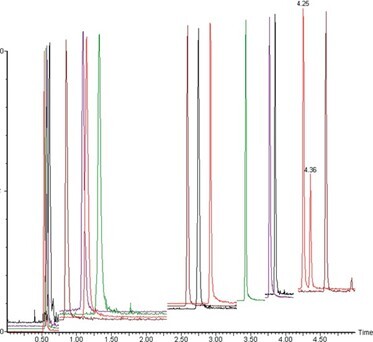 Figure 2. Offset MRM chromatogram of acidic, basic and neutral drugs spiked at 20 ng/mL into plasma and extracted using the protocol described on page 1. Analyte elution order and analytical conditions as described in Table 2.
Phospholipid removal
The effective protein and phospholipid removal obtained using ISOLUTE PLD+ Protein and Phospholipid Removal Plates provided clean extracts with very low matrix effects. Residual phospholipids were investigated to provide an indication of extract cleanliness. We investigated the most abundant phospholipids (selected from full scan, SIR and precursor ion scanning experiments) using MRM transitions monitoring the common 184 product ion. Figure 3 demonstrates phospholipid content comparing protein precipitated plasma, solvent blank and the final extraction protocol.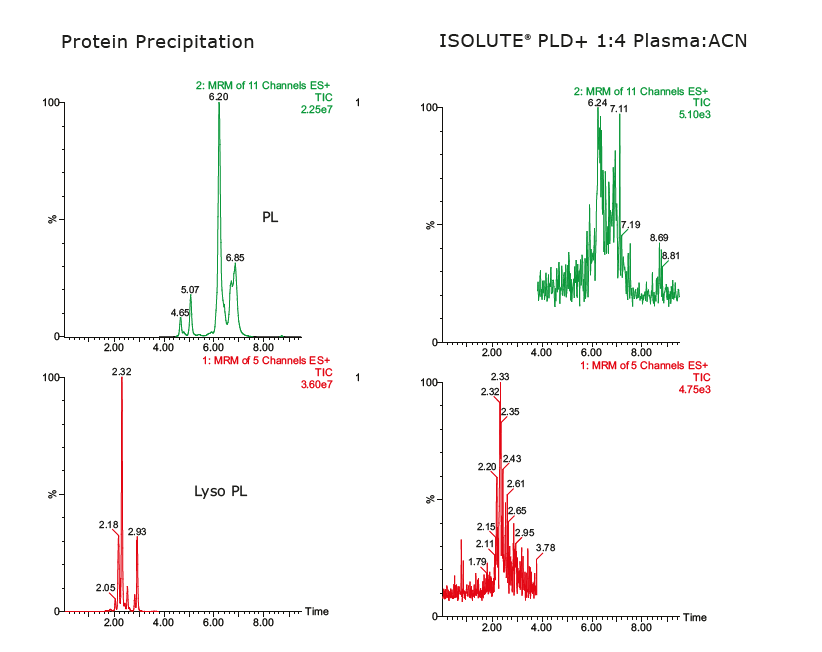 Figure 3. MRM TICs showing phospholipid content of plasma prepared by a) protein precipitation at a 1:4 ratio of plasma : acetonitrile and b) ISOLUTE® PLD+ under the same conditions. >99% of plasma phospholipids are removed, allowing low level quantitation of analytes.
Conclusion
ISOLUTE® PLD+ Protein and Phospholipid Removal Plates are suitable for clean-up of a range of analytes with widely differing functionality and polarity characteristics from plasma, giving high recoveries, good reproducibility and excellent extract cleanliness.
Ordering information
| Part Number |
Description |
Quantity |
| 918-0050-P01 |
ISOLUTE® PLD+ Protein and Phospholipid Removal Plate |
1 |
| Accessories |
||
| 121-5202 |
Collection plate, 1 mL |
50 |
| 121-5203 |
Collection plate, 2 mL |
50 |
| 121-5204 |
Piercable sealing cap |
50 |
| Vacuum Processing |
||
| 121-9600 |
Biotage® VacMasterTM-96 sample Processing manifold |
1 |
| 121-9601 |
VacMaster VCU-1 Vacuum Control Unit |
1 |
| 121-9602 |
VacMaster VCU-2 Vacuum Control and Generation Unit |
1 |
| Positive Pressure Processing |
||
| PPM-96 |
Biotage® PRESSURE+ Positive Pressure Manifold, 96 position |
1 |
Literature number: AN830
