
For research use only. NOT for use in diagnostic procedures.
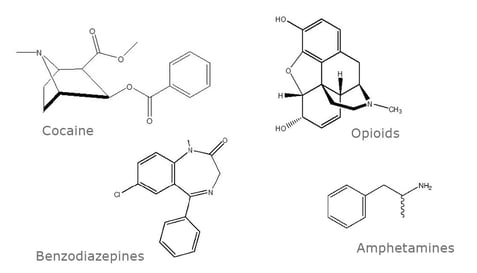 Figure 1. Example structures by class.
Introduction
This application note describes the extraction of 49 drugs of abuse from human urine using Biotage® Mikro ABN microelution plates, prior to LC/MS-MS analysis.
The simple sample preparation procedure delivers clean extracts and analyte recoveries mostly greater than 80% with RSDs lower than 10% for most analytes. Linearity of greater than 0.99 is achieved for all analytes from 1–1000 pg/mL.
Mikro plate extraction allows for very low elution volumes and enhanced workflow efficiency.
Analytes
Amphetamine, Methamphetamine, 3,4-Methylenedioxyamphetamine (MDA), 3,4-Methylenedioxymethamphetamine (MDMA), 3,4-Methylenedioxy-N-ethylamphetamine (MDEA), Hydromorphone, Morphine, Benzoylecgonine (BZE), Oxymorphone, Dihydrocodiene, Oxycodone, Mephedrone, Norfentanyl, 7-amino-flunitrazipam, 7-amino-clonazepam, Hydrocodone, Codeine, 6-Monoacetylmorphine (6-MAM), Cocaine, Norketamine, 2-Ethylidene-1,5-dimethyl-3,3-diphenylpyrrolidine (EDDP), Zaleplon, Zopiclone, Norbuprenorphine, Ketamine, Nitrazepam, Flunitrazepam, Clonazepam, α-OH -OH-triazolam, Oxazepam, Estazolam, Temazepam, Zolpidem, Alprazolam, Methadone, Lorazepam, Bromazepam, α-OH-alprazolam, 2-OH-ethyl-flurazepam, Triazolam, Nordiazepam, Diazepam, Midazolam, Fentanyl, Flurazepam, Buprenorphine, Phencyclidine (PCP), Lysergic acid diethylamide (LSD).
Internal standards
Amphetamine-D5, Morphine-D3, BZE-D3, 6-MAM-D3, Diazepam-D5
Sample preparation procedure
Format
Biotage® Mikro ABN Plate, 2 mg, part number 600-0002-LVP
Sample pre-treatment
Spike urine (1 mL) with internal standard solution and allow to equilibrate for 1 hour. Dilute sample with 100 mM NH4OAC pH 5 (950 µL ) and add -glucuronidase (50 µL). Incubate at 60 °C for 2 hours.
Internal standard solution consisted of a 10 pg/ µL methanolic solution. 100 µL of this was added to 1 mL of urine to give a 1 ng/mL spike concentration.
Condition (Optional)
Condition wells with methanol (100 µL)
Equilibration (Optional)
Equilibrate wells with 0.1% ammonium hydroxide (aq) (100 µL)
Sample loading
Load 400 µL of the pre-treated urine sample
Wash 1
Elute interferences with 0.1% ammonium hydroxide (100 µL)
Wash 2
Elute interferences with H2O:MeOH (90:10, v/v, 100 µL)
Elution
Elute analytes with DCM:MeOH (90:10, v/v, 30 µL)
Post elution and reconstitution
Dry the extract in a stream of air or nitrogen using a Biotage® SPE Dry at 40 °C, 20 to 40 L/min, or a TurboVap® at 40 °C, 1.5 L/min, for approximately 5 minutes.
Reconstitute evaporated samples with H2O:MeOH (90/10, v/v) containing 0.1% formic acid (30 µL).
Vortex mix and cover plate with a sealing mat prior to injection.
Processing conditions
Biotage® Mikro plates were processed using a Biotage® Pressure+ Positive Pressure Manifold.
Settings: Condition, equilibrate, load, wash and elute steps: 7–9 psi (fine control setting).
UHPLC conditions
Instrument
Shimadzu Nexera UHPLC
Column
Restek Raptor™ Biphenyl 2.7 µm (100 x 2.1 mm)
Mobile phase
A: 2 mM ammonium formate (aq) containing 0.1% formic acid
B: 2 mM ammonium formate (MeOH) containing 0.1% formic acid
Flow rate
0.4 mL/min
Injection volume
5 µL
Column temperature
30 oC
Table 1. HPLC gradient.
|
Time (min.) |
%A |
%B |
|
0 |
80 |
20 |
|
2.00 |
80 |
20 |
|
7.50 |
40 |
60 |
|
11.25 |
40 |
60 |
|
12.75 |
0 |
100 |
|
13.50 |
0 |
100 |
|
13.51 |
80 |
20 |
|
15.00 |
80 |
20 |
MS conditions
Instrument
Shimadzu 8060 Triple Quadrupole MS using ES interface
Nebulizing gas flow
3 L/min
Drying gas flow
3 L/min
Heating gas flow
17 L/min
Interface temperature
400 °C
DL temperature
250 °C
Heat block temperature
300 °C
CID gas flow
270 kPa
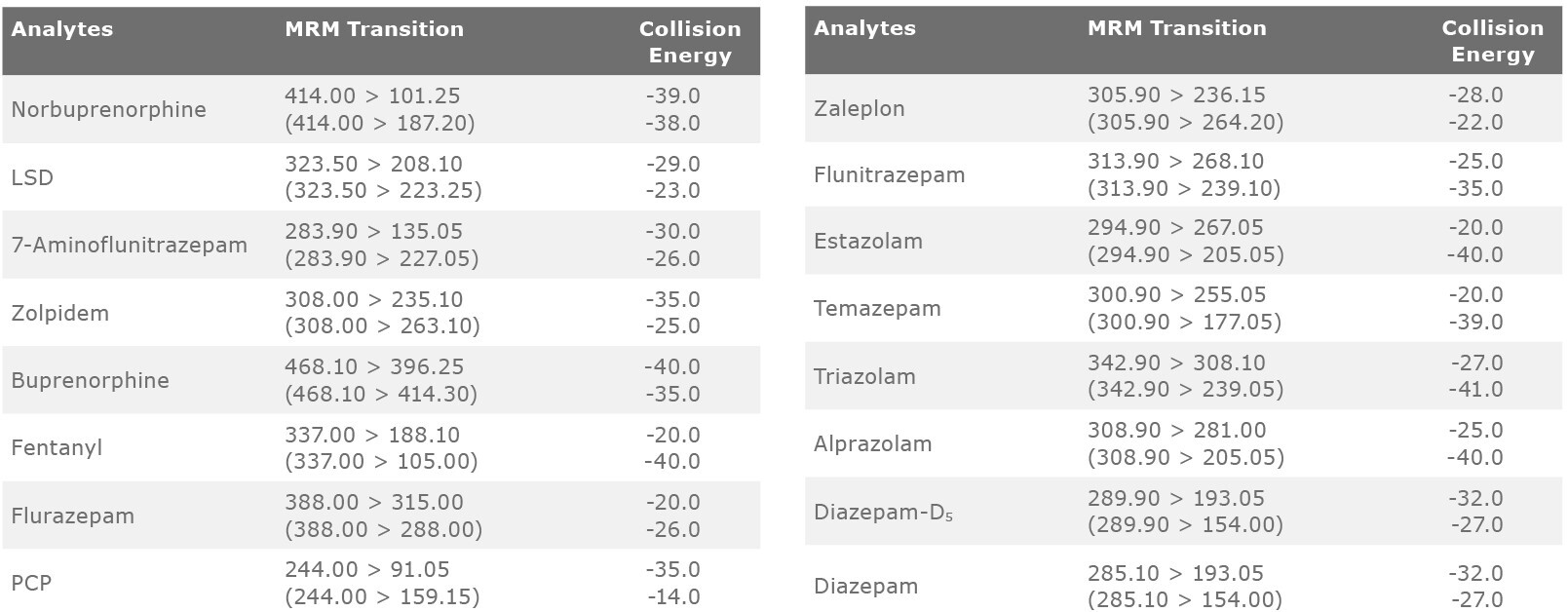
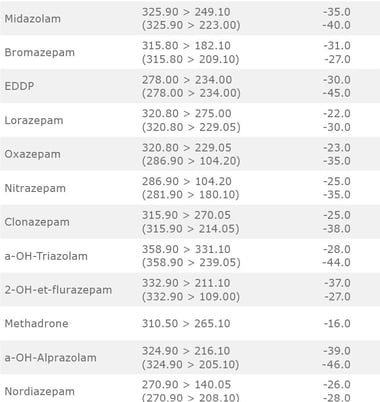
Table 2. MS conditions for target analytes in positive mode.
|
Analytes |
MRM Transition |
Collision Energy |
|
Morphine-D3 |
289.0 > 201.1 |
-26.0 |
|
(289.0 > 152.1) |
-50.0 |
|
|
Morphine |
286.0 > 152.1 |
-50.0 |
|
(286.0 > 201.1) |
-25.0 |
|
|
Oxymorphone |
302.00 > 227.1 |
-30.0 |
|
(302.00 > 198.1) |
-45.0 |
|
|
Hydromorphone |
286.0 > 185.0 |
-30.0 |
|
(286.0 > 157.0) |
-40.0 |
|
|
Amphetamine-D5 |
141.0 > 93.0 |
-15.0 |
|
(141.0 > 124.15) |
-20.0 |
|
|
Amphetamine |
136 > 91.05 |
-15.0 |
|
(136 > 119.1) |
-14.0 |
|
|
Methamphetamine |
150.0>90.95 |
-20.0 |
|
(150>119.1) |
-14.0 |
|
|
MDA |
180 > 105 |
-20.0 |
|
(180 > 77) |
-40.0 |
|
|
Dihydrocodiene |
302 > 119.05 |
-35.0 |
|
(302 >171) |
-45.0 |
|
|
Codeine |
300.0>215.1 |
-25.0 |
|
(300.0>165) |
-40.0 |
|
|
6-MAM-D3 |
331.0 > 165.1 |
-40.0 |
|
(331.0 > 211.1) |
-25.0 |
|
|
MDMA |
194.0 > 163.1 |
-15.0 |
|
(194.0 > 105.0) |
-25.0 |
|
|
Oxycodone |
316.2 > 241.2 |
-20.0 |
|
Mephedrone |
178.00 > 145.05 |
-20.0 |
|
(178.00 > 144.00) |
-30.0 |
|
|
Hydrocodone |
300.0 > 199.05 |
-30.0 |
|
(300.0 > 171.1) |
-40.0 |
|
|
MDEA |
208 > 163.05 |
-15.0 |
|
(208 > 105.05) |
-25.0 |
|
|
Nor-Ketamine |
223.9 > 125 |
-20.0 |
|
(223.9 > 179.05) |
-15.0 |
|
|
Nor-Fentanyl |
233.0 > 84.05 |
-20.0 |
|
(233.0 > 56.05 |
-26.0 |
|
|
BZE-D3 |
293.00 > 171.05 |
-20.0 |
|
(293.00 > 77.00) |
-50.0 |
|
|
BZE |
289.90 > 168.05 |
-20.0 |
|
(289.90 > 105.00) |
-30.0 |
|
|
Ketamine |
237.90 > 125.00 |
-30.0 |
|
(237.90 > 207.05) |
-14.0 |
|
|
7- Aminoclonazepam |
285.90 > 222.10 |
-25.0 |
|
(285.90 > 121.10) |
-29.0 |
|
|
Cocaine |
304.00 > 182.05 |
-20.0 |
|
(304.00 > 82.05) |
-30.0 |
|
|
Zopiclone |
388.90 > 245.05 |
-15.0 |
|
(388.90 > 217.00) |
-35.0 |
Results
High (mostly > 80%) reproducible (RSD < 10%) recoveries were achieved using the method described in this application note using the Biotage® Mikro plate format.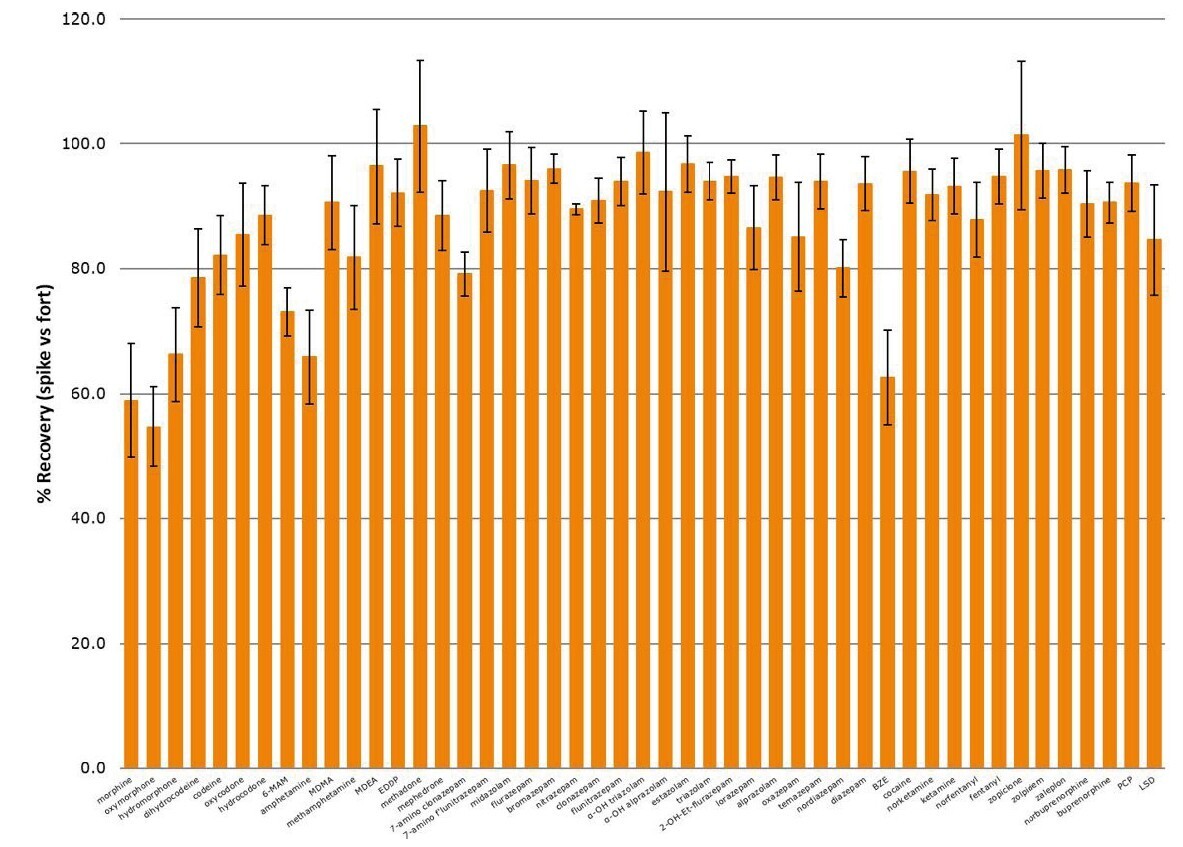
Figure 2. Shows analyte recoveries (1 ng/mL) using the optimized Mikro ABN protocol described in this application note. The time saving Load-Wash-Elute procedure gave similar analyte recoveries. See Discussion section for recovery data generated using the Load-Wash-Elute method.
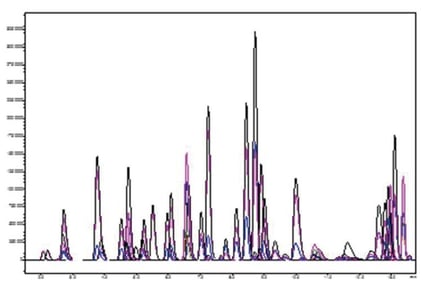
Figure 3. Representative chromatography for application analytes in urine spiked at 1 ng/mL.
Calibration curve performance was investigated from plasma spiked between 1–1000 pg/mL. Good linearity was observed for all analytes typically delivering r2 values greater than 0.99. Table 3. details linearity performance and associated LOQ for each analyte.
Table 3. Analyte calibration curve r2 and LOQ performance.
|
Analyte |
r2 200 µL Load |
LLOQ (pg/mL) 200 µL Load |
|
Morphine |
0.9990 |
100 |
|
Oxymorphone |
0.9991 |
25 |
|
Hydromorphone |
0.9996 |
50 |
|
Amphetamine |
0.9990 |
50 |
|
Methamphetamine |
0.9995 |
50 |
|
Dihydrocodiene |
0.9993 |
1 |
|
Codeine |
0.9990 |
25 |
|
6-MAM |
0.9993 |
50 |
|
MDMA |
0.9993 |
5 |
|
Oxycodone |
0.9996 |
25 |
|
Mephedrone |
0.9993 |
50 |
|
Hydrocodone |
0.9990 |
50 |
|
MDEA |
0.9993 |
10 |
|
Nor-Ketamine |
0.9993 |
10 |
|
Nor-Fentanyl |
0.9992 |
5 |
|
BZE |
0.9995 |
50 |
|
Ketamine |
0.9995 |
5 |
|
7-Aminoclonazepam |
0.9998 |
100 |
|
Cocaine |
0.9996 |
25 |
|
Norbuprenorphine |
0.9995 |
100 |
|
LSD |
0.9995 |
25 |
|
7-Aminoflunitrazepam |
0.9993 |
100 |
|
Zolpidem |
0.9992 |
5 |
|
Buprenorphine |
0.9991 |
10 |
|
Fentanyl |
0.9990 |
50 |
|
Flurazepam |
0.9990 |
1 |
|
PCP |
0.9994 |
10 |
|
Midazolam |
0.9997 |
50 |
|
Bromazepam |
0.9995 |
100 |
|
EDDP |
0.9990 |
1 |
|
Lorazepam |
0.9996 |
< 250 |
|
Oxazepam |
0.9990 |
250 |
|
Nitrazepam |
0.9990 |
500 |
|
Clonazepam |
0.9994 |
100 |
|
α-OH-Triazolam |
0.9992 |
50 |
|
2-OH-et-flurazepam |
0.9995 |
< 100 |
|
Methadrone |
0.9990 |
250 |
|
α-OH-Alprazolam |
0.9997 |
250 |
|
Nordiazepam |
0.9990 |
50 |
|
Zaleplon |
0.9991 |
5 |
|
Flunitrazepam |
0.9991 |
50 |
|
Estazolam |
0.9993 |
5 |
|
Temazepam |
0.9995 |
< 250 |
|
Triazolam |
0.9993 |
1 |
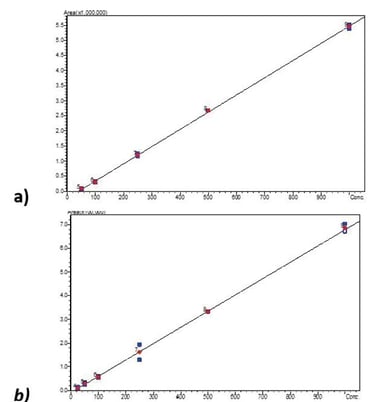
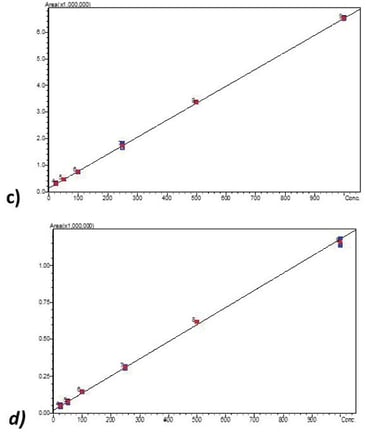
Figure 4. Calibration curves for Fentanyl (a), 6-MAM (b), Cocaine (c) and Methamphetamine (d) using the Biotage® Mikro plate to extract human urine.
Discussion and conclusion
The Biotage® Mikro solid phase extraction microelution plate provided robust extraction of a large drugs of abuse panel from hydrolyzed urine samples. High, reproducible recoveries were achieved, with an overall processing time of approximately 22 minutes (including the evaporation step). An evaporation step was required in this application, as the elution solvent (DCM/MeOH) which gave the highest analyte recoveries was not compatible with the reversed phase analytical UPLC system. However, due to the low elution volume, evaporation time for 96 samples was ~ 5 minutes.
Compared to the equivalent procedure using a 10 mg EVOLUTE® EXPRESS ABN plate, a reduction in total processing time (~22 mins vs ~33 mins) was possible. In addition, higher, more reproducible recoveries for some analyte types (such as benzodiaz- epines) were achieved.
Comparison with EVOLUTE® Load-Wash-Elute Methodology Elimination of the optional conditioning and equilibration steps in this method was investigated. A reduced overall extraction time (and solvent usage) was possible, and analyte recoveries were not adversely impacted (see figure 5).
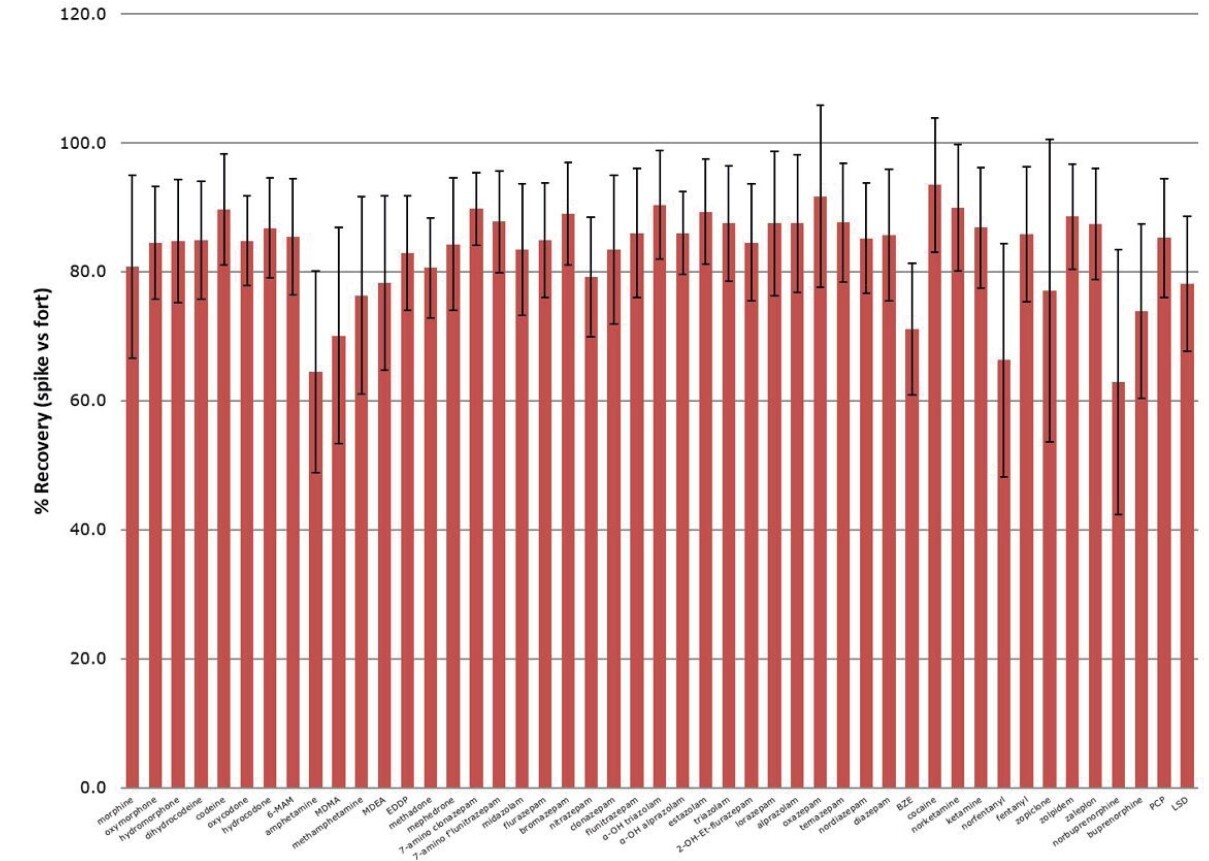
Figure 5. Analyte recoveries achieved using the Load-Wash-Elute methodology (where conditioning and equilibration steps are eliminated). This approach reduced the overall processing time by approximately 5 minutes (~17 mins for L-W-E method vs ~22 mins for full method).
Chemicals and reagents
- Methanol (LC-MS grade), Ultra-Pure Methanol (Gradient MS), and dichloromethane (99.8%) were purchased from Honeywell Research Chemicals (Bucharest, Romania).
- All analyte standards, deuterated internal standards, ammonium acetate, ammonium formate, formic acid and ammonium hydroxide (27–30%) were purchased from Sigma- Aldrich Company Ltd. (Gillingham, UK).
- Water used was 18.2 MOhm-cm, drawn daily from a Direct-Q5 water purifier.
- Mobile phase A (2 mM ammonium formate (aq), 0.1% formic acid) was prepared by adding 0.126 mg of ammonium formate to 1 L purified water with 1 mL formic acid.
- Mobile phase B (2 mM ammonium formate (methanolic), 0.1% formic acid) was prepared by adding 0.126 mg of ammonium formate to 1 L ultra-pure MeOH with 1 mL formic acid.
- Internal standards (100 pg/µL) were prepared from a 10 ng/µL stock solution by adding 10 µL of each of to 950 µL of MeOH. 10 µL of this solution was then added to each calibration solution.
- Hydrolysis buffer solution (100 mM ammonium acetate) was made by adding 0.3854 mg of ammonuim acetate to 50 mL of water (18.2 MOhm-cm).
- Hydrolysis enzyme α-Glucuronidase from Helix pomatia, Type HP-2; ≥100,000 units/mL purchased from Sigma- Aldrich Company Ltd. (Gillingham, UK).
- Equilibration and wash 1 solvent (0.1% ammonium hydroxide) was made by adding 100 µL of ammonium hydroxide to 99.9 mL of water (18.2 MOhm-cm).
- Wash 2 solvent (H2O:MeOH (90:10, v/v)) was made up by measuring out 90 mL of water (18.2 MOhm-cm) and 10 mL of methanol and adding both to a bottle.
- Elution solvent ((DCM:MeOH (90:10, v/v)) was made up by measuring out 90 mL of DCM (18.2 MOhm-cm) and 10 mL of methanol and adding both to a bottle.
- Reconstitution solvent was made by measuring out 90 mL of purified water (18.2 MOhm-cm) and 10 mL of MeOH and adding them to the same bottle with 100 µL formic acid.
Additional information
- All data shown in this application note was generated using human urine donated by healthy human volunteers.
Ordering information
|
Part Number |
Description |
Quantity |
|
600-0002-LVP |
Biotage® Mikro ABN Plate, 2 mg |
1 |
|
PPM-96 |
Biotage® PRESSURE+ 96 Positive Pressure Manifold |
1 |
|
SD-9600-DHS |
Biotage® SPE Dry Sample Concentrator System |
1 |
|
121-5202 |
Collection Plate, 1 mL Square |
50 |
|
121-5204 |
Pierceable Sealing Mat |
50 |
Literature Number: AN941
