
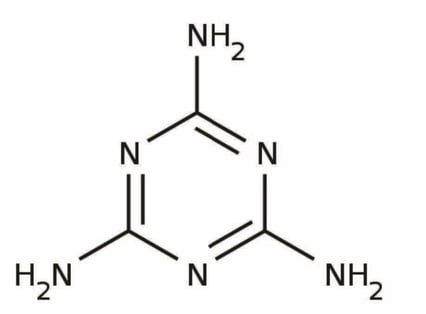
Figure 1: Structure of melamine
Introduction
This application note describes the extraction of melamine from infant formula using EVOLUTE® EXPRESS CX polymeric mixed-mode strong cation exchange SPE cartridges.
Melamine is traditionally used in making plastics, however, it’s low cost and high nitrogen content has led to exploitation in various sections of the food industry, most notably involving dairy products. The standard test for estimating protein content is based on measurement of nitrogen levels, therefore, addition of melamine to sub standard or watered down milk results in the protein levels appearing higher. Sustained melamine exposure can result in kidney stones and renal failure, with the young being most susceptible.
EVOLUTE® EXPRESS CX SPE cartridges and plates extract a wide range of basic analytes from biological fluids and other aqueous matrices. EVOLUTE® EXPRESS CX removes matrix components such as proteins, salts, non-ionizable interferences and phospholipids, delivering cleaner extracts with reproducible recoveries for accurate quantitation.
Analytes
Melamine
Sample preparation procedure
Format
EVOLUTE® EXPRESS CX 60 mg/ 3 mL (Tables) SPE cartridges, part number 611-0006-BXG.
[Note: This application was originally developed using EVOLUTE® CX 50 mg/3 mL SPE cartridges, p/n 611-0005-B. This format has now been replaced by the EXPRESS format, which provides improved flow characteristics].
Sample pre-treatment
For powdered formula: make up as per manufacturer’s instructions, and cool prior to extraction. Dilute all milk samples (1 mL) with ammonium acetate buffer (1:1, v/v, 50 mM, pH 5).
Cartridge conditioning
Condition cartridge with methanol (3 mL).
Cartridge equilibration
Equilibrate cartridge with ammonium acetate buffer (50 mM, pH 5, 3 mL).
Sample load
Load pre-treated sample (2 mL) at a flow rate of 3 mL /min.
Interference elution 1
Remove polar and ionic interferences with ammonium acetate buffer (50 mM, pH 5, 3 mL).
Interference elution 2
Remove non-polar interferences with methanol (3 mL).
Analyte elution
Elute melamine with methanol containing ammonium hydroxide (95:5, v/v, 3 mL).
Post extraction
Evaporate to dryness at 40°C and reconstitute in acetonitrile/ water (90:10, v/v, 500 μL) prior to analysis.
HPLC conditions
Instrument
Waters 2795 Liquid Handling System
Cartridge
Phenomenex Luna HILIC 3 μm analytical cartridge (100 x 2.0 mm id)
Guard cartridge
Phenomenex Luna Phenyl-Hexyl security guard cartridge
Mobile phase
Isocratic, acetonitrile:20mM Ammonium Formate pH 3.2 (75:25, v/v), flow rate of 0.3 mL/min.
Injection volume
20 μL
Temperature
Ambient
Mass spectrometry conditions
Instrument
Waters Ultima Pt triple quadrupole mass spectrometer equipped with an electrospray interface
Desolvation temperature
350 °C
Ion source temperature
100 °C
Collision gas pressure
2.4 x 10-³ mbar
Positive ions were acquired in the multiple reaction monitoring mode (MRM).
Quantifier ion transition
127 >85 (collision energy 12 eV)
Qualifier ion transition:
127 >68 (collision energy 14 eV)
Results
From the results it can be seen that recoveries from a range of infant formula products were above 85% with <10% relative standard deviations below 10.
|
Matrix |
Powdered Baby Milk |
Liquid Baby Milk 1 |
Liquid Baby Milk 2 |
Liquid Baby Milk 3 |
|
Melamine %recovery |
84 |
97 |
89 |
98 |
|
% RSD (n=6) |
<10 |
<10 |
<10 |
<10 |
References
This application note is based on the poster ‘Extraction of melamine from various matrices using resin based mixed-mode cation exchange SPE and analysis with LC-MS/MS’, L Williams et al, presented at ASMS, Philadelphia, May 31st June 4th, 2009.
Ordering Information
|
Part number |
Description |
Quantity |
|
611-0006-BXG |
EVOLUTE® EXPRESS CX 60 mg/3 mL (Tables) SPE Cartridges |
50 |
Literature number: AN732
