
Introduction
This application note describes the extraction of a suite of NBOMe designer drugs from oral fluid matrix with analysis by laser diode thermal desorption (LDTD)-MS/MS.
NBOMes (Figure 1) are a class of novel psychoactive substances (NPSs) marketed as “legal highs.” NBOMes are the N-Benzyl-Oxy-Methyl derivatives of previously known phenethylamines in the 2C series. The 2C series contain methoxy groups on the 2 and 5 positions of a benzene ring of the phenethylamine backbone structure. NBOMes also contain a 2-methoxybenzyl on the nitrogen backbone, which results in increased substitution and ultimately potency.
Oral fluid contains primarily the parent compound, which is most commonly associated with the pharmacological effects, making it an ideal matrix for the detection of NBOMe analytes. ISOLUTE® SLE+ Supported Liquid Extraction plates and cartridges offer an efficient alternative to traditional liquid- liquid extraction (LLE) for bioanalytical sample preparation, providing high analyte recoveries, no emulsion formation, and significantly reduced sample preparation.
|
Substitution |
Analyte |
|
R = Br |
25B-NBOMe |
|
R = Cl |
25C-NBOMe |
|
R = CH3 |
25D-NBOMe |
|
R = C2H5 |
25E-NBOMe |
|
R = H |
25H-NBOMe |
|
R = I |
25I-NBOMe |
|
R = N2O |
25N-NBOMe |
|
R = SC2H5 |
25T2-NBOMe |
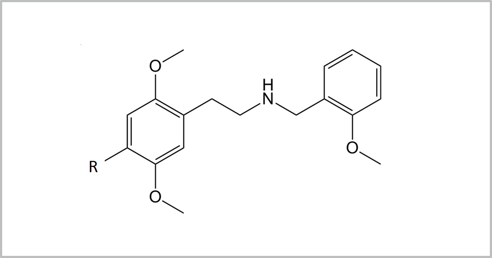
Figure 1. Structures of the NBOMEs studied
Analytes
25B-NBOMe, 25C-NBOMe, 25D-NBOMe, 25E-NBOMe, 25H-NBOMe, 25I-NBOMe, 25N-NBOMe, 25T2-NBOMe
Sample preparation procedure
Optimized methodology for extending the dynamic range of the analysis is provided below.
Concentration Range 1: 25–1000 ng/mL
Sample Pre-treatment: To 150 µL of sample, add 25I-NBOMe-D3 internal standard (15 µL, (1000 ng /mL in MeOH), and ammonium hydroxide (NH4OH, 0.1%, 10 µL). Mix.
Format: ISOLUTE® SLE+ 400 μL Sample Volume cartridges, part number 820-0055-B
Sample loading: Load pre-treated oral fluid (175 μL, as above) onto the cartridge and apply a pulse of vacuum or positive pressure (3–5 seconds) to initiate flow. Allow the sample to absorb for 5 minutes.
Analyte extraction: Apply methyl-tert-butyl-ether (MTBE, 4 x 500 µL) and allow to flow under gravity for 5 minutes. Apply vacuum or positive pressure (5–10 seconds) to complete elution.
LAZWell Spotting: Deposit 3 µL of elution phase onto the LazWell plate and let dry.
Concentration Range 2: 0.5–100 ng/mL
Sample Pre-treatment: To 300 µL of sample, add 25I-NBOMe-D3 internal standard (30 µL, (100 ng /mL in MeOH), and ammonium hydroxide (NH4OH, 0.1%, 20 µL). Mix.
Format: ISOLUTE® SLE+ 400 μL Sample Volume cartridges, part number 820-0055-B
Sample loading: Load pre-treated oral fluid (350 µL, as above) onto the cartridge and apply a pulse of vacuum or positive pressure (3–5 seconds) to initiate flow. Allow the sample to absorb for 5 minutes.
Analyte extraction: Apply MTBE (4 x 500 µL) and allow to flow under gravity for 5 minutes. Apply vacuum or positive pressure (5–10 seconds) to complete elution.
LAZWell Spotting: Deposit 6 µL of elution phase onto the LazWell plate and let dry.
Mass spectrometry conditions
Following sample preparation, a small volume is transferred and dried into a well cavity (see LAZWell Spotting, above). The analytes of interest were vaporized indirectly by thermal action and ionized by APCI. The time required was less than 9 seconds per sample.
The LDTD-MS was coupled to a SCIEX 5500 QTRAP (Figure 4). The MS/MS instrumentation was operated in multi-reaction monitoring mode (MRM). The optimized compound selective parameters are provided in Table below.
|
MRM |
Q1 m/z |
Q3 m/z |
Dwell ms |
Compound |
Collision Energy eV |
|
1 |
302.2 |
120.6 |
5 |
25H-121 |
22 |
|
2 |
302.2 |
165.1 |
5 |
25H-165 |
22 |
|
3 |
316.0 |
120.6 |
5 |
25D-121 |
22 |
|
4 |
316.0 |
179.0 |
5 |
25D-179 |
22 |
|
5 |
330.1 |
120.7 |
5 |
25E-120 |
22 |
|
6 |
330.1 |
192.9 |
5 |
25E-192 |
22 |
|
7 |
336.1 |
120.7 |
5 |
25C-121 |
22 |
|
8 |
336.1 |
90.9 |
5 |
25C-91 |
22 |
|
9 |
347.2 |
120.6 |
5 |
25N-121 |
22 |
|
10 |
347.2 |
90.8 |
5 |
25N-91 |
22 |
|
11 |
348.2 |
120.7 |
5 |
25T2-121 |
22 |
|
12 |
348.2 |
211.1 |
5 |
25T2-211 |
22 |
|
13 |
380.2 |
120.8 |
5 |
25B-121 |
22 |
|
14 |
380.2 |
91.0 |
5 |
25B-91 |
22 |
|
15 |
428.1 |
120.7 |
5 |
25I-121 |
22 |
|
16 |
428.1 |
272.1 |
5 |
25I-272 |
22 |
|
17 |
431.1 |
124.0 |
5 |
25I-D3-124-IS |
22 |
Results
Linearity was determined for two of the analytes of interest (R=Br, I) to verify method performance. The results are reported in Figures 2 and 3.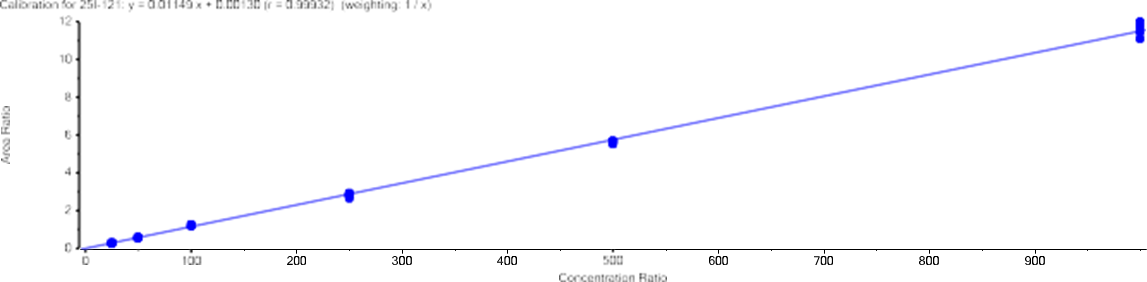
Figure 2. Calibration curve for 25B-NBOMe (calibration range 1: 25-1000 ng/mL)
Figure 3. Calibration curve for 25I-NBOMe (calibration range 2: 0.5-100 ng/mL)
A set of oral fluid specimens was prepared at the Centre for Forensic Science Research and Education. The samples were collected with Salivettes and fortified to different concentration levels. The samples were submitted blind for analysis. Results are shown in Figure 4.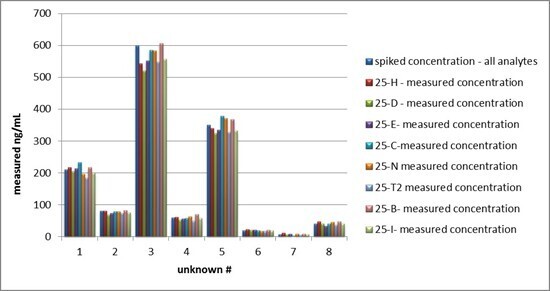
Figure 4. Unknown sample set fortified to 8 concentration levels for a panel of NBOMe designer drugs, and extracted using the method detailed in this application note.
Conclusions
In this application note, SLE-LDTD-MS is demonstrated to be a viable workflow solution for the screening of NBOMe designer drugs in oral fluids. ISOLUTE® SLE+ cartridges proved effective in minimizing matrix effects by producing clean extracts and subsequent LDTD-MS/MS allowed ultrafast high throughput analysis at 9 seconds per sample.
The method demonstrated good sensitivity with LLOQ values determined at 0.5 ng/mL for 25B-NBOMe and 25I-NBOMe. This method demonstrated acceptable precision and accuracy across the calibration range of interest, with linearity of r2> 0.99 for both analytes and reproducibility with CV < 10% (n=4) (<15% at LLOQ).
Ordering information
|
Part Number |
Description |
Quantity |
|
820-0055-B |
ISOLUTE® SLE+ 400 μL Supported Liquid Extraction Cartridges |
50 |
|
PPM-48 |
Biotage® Positive Pressure Manifold 48 Position |
|
|
|
1 |
Literature number: AN834
