
For research use only. NOT for use in diagnostic procedures.
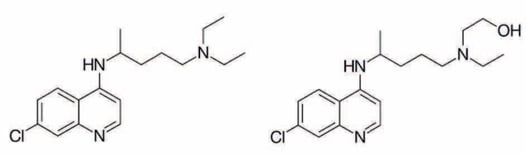 Figure 1. Structures of Chloroquine (CQ) and Hydroxychloroquine (HCQ).
Introduction
The objective of this study was to develop a fast and reliable extraction for Chloroquine (CQ) and Hydroxychloroquine (HCQ) from different human matrices (whole blood, serum and urine) using ISOLUTE® SLE+ Supported Liquid Extraction plates prior to LC-MS/MS analysis.
The simple sample preparation procedure delivers clean extracts and analyte recovery greater than 90% for CQ and greater than 80% for HCQ with minimal matrix effects and high process efficiency.
Analytes
Chloroquine (CQ), and Hydroxychloroquine (HCQ)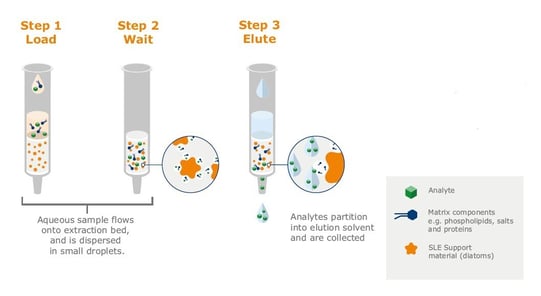 Figure 2. Typical ISOLUTE® SLE+ procedure.
Sample preparation procedure1
Format
ISOLUTE® SLE+ 400 µL Supported Liquid Extraction Plate (P/N 820-0400-P01)
Sample pre-treatment
Dilute the biological sample (100 µL) with 0.5M ammonium hydroxide (300 µL). Vortex briefly and let stand for 5 mins.
Sample loading
Load pre-treated samples (375 μL) onto the ISOLUTE® SLE+ 400 µL plate. Using a Biotage® PRESSURE+96 Positive Pressure Manifold (P/N PPM-96), apply a pulse of pressure to load samples onto the sorbent. Wait 5 minutes for the sample to equilibrate on the sorbent.
Elution
Apply ethyl acetate (750 μL) to each well, and allow to flow by gravity for 5 minutes. Apply a second aliquot of ethyl acetate (750 μL). Wait 5 minutes. For complete solvent recovery apply a pulse of positive pressure at 10 psi (10–20 seconds).
Evaporation
Dry the extract under a stream of nitrogen using a Biotage® SPE Dry at 40 °C, 20 to 40 L/min for approximately 25 minutes.
Reconstitution
Reconstitute with mobile phase A (100 µL) and mix thoroughly.
UHPLC conditions
Instrument
Agilent 1260 Infinity II LC System
Column
Restek Ultra AQ C18 3.0 um 100 X 2.1 mm. Cat # 9178312
Flow rate
0.4 mL/min
Column temperature
25 °C
Injection volume
5 µL
HPLC gradient
Table 1. HPLC gradient.
|
Time (min.) |
%A |
%B |
|
0.0 |
80 |
20 |
|
1.9 |
25 |
75 |
|
2.0 |
2.0 |
98 |
|
3.0 |
2.0 |
98 |
|
4.0 |
80 |
20 |
MS Sciex 4000 QQQ
Table 2 Mass spec source parameters.
|
Curtain Gas |
35 |
|
Collision gas |
Medium |
|
Ion Spry Voltage (IS) |
5500 |
|
Temperature |
650 |
|
Ion Source Gas (GS1) |
60 |
|
Ion Source Gas (GS2) |
60 |
|
Interface Heater |
On |
Table 3 Transitions and retention times for target analytes in positive mode.
|
ID |
Q1 |
Q3 |
DP (Volt) |
CE (Volt) |
RT |
EP (Volt) |
CPX(Volt) |
|
CQ 1 |
320.0 |
247.0 |
41,43 |
27 |
1.3 |
14 |
14 |
|
CQ 2 |
320.0 |
142.0 |
53,43 |
30 |
1.3 |
14 |
10 |
|
HCQ 1 |
336.1 |
247.0 |
49 |
30 |
1.6 |
14 |
12 |
|
HCQ 2 |
336.1 |
158.1 |
43,70 |
33 |
1.6 |
14 |
12 |
Results and discussion
Figure 3 shows an extracted ion chromatogram of a 10 ng/mL mixed standard solution of chloroquine and hydroxychloroquine. Two transitions for each analyte were used and total chromatographic separation was achieved.
Figure 4 shows an extracted ion chromatogram of a 10 ng/mL mixed solution of chloroquine and hydroxychloroquine spiked into blank human whole blood and extracted using the method described.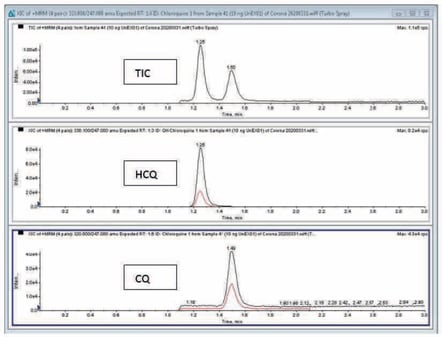 Figure 3. TIC and XIC for unextracted HCQ and CQ @10 ng/mL.
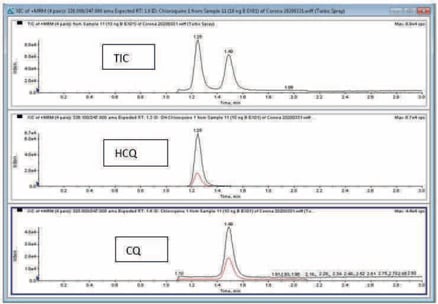 Figure 4. TIC and XIC for HCQ and CQ @10 ng/mL extracted from whole blood.
Figure 5 shows an extracted ion chromatogram of a 10 ng/mL mixed solution of chloroquine and hydroxy- chloroquine spiked into blank human serum and extracted using the method described.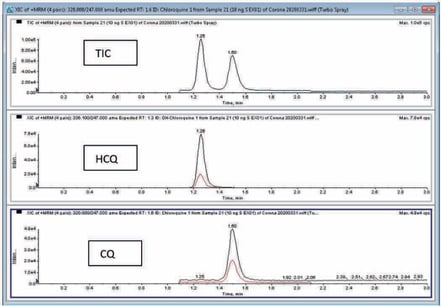 Figure 5. TIC and XIC for HCQ and CQ @10 ng/mL extracted from serum.
Figure 6 shows an extracted ion chromatogram of a 10 ng/mL mixed solution of chloroquine and hydroxychloro- quine spiked into blank human urine and extracted using the method described.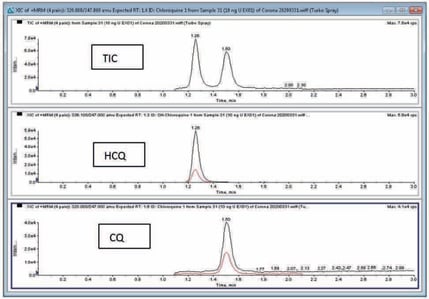 Figure 6. TIC and XIC for HCQ and CQ @10 ng/mL extracted from urine.
Matrix effects, analyte recovery and process efficiency were determined. Figures 7, 8, and 9 display matrix effects, recovery, and process efficiency respectively, obtained for chloroquine and hydroxychloroquine using the ISOLUTE® SLE+ 400 µL extraction plates. The study represents 3 sets of samples.²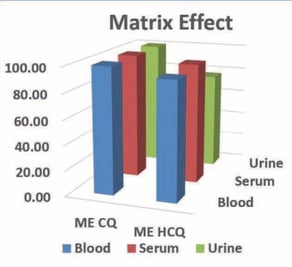 Figure 7. Matrix effect.
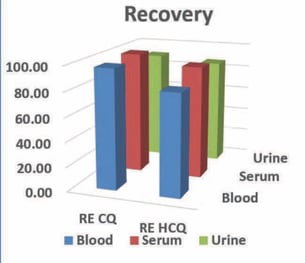 Figure 8. Recovery.
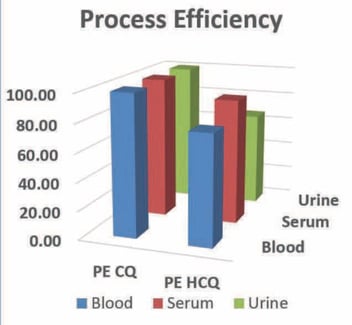 Figure 9. Process effect.
Conclusion
ISOLUTE® SLE+ provides the selectivity and sensitivity required to extract and quantitate chloroquine (CQ) and hydroxychloroquine (HCQ) in a variety of biological fluid samples. The combination of a simple unified extraction for different matrices and the short run time will maximize the sample throughput and allow implementation of methods in high-throughput laboratories.
Additional information
- It is recommended to maintain column temperature at 25 ˚C with a 400 µL/min flow rate to allow the analytes to elute later in the gradient
- Carryover can be observed at higher concentrations. To reduce this:
- It is recommended to make mobile phase A as a mixture of aqueous and organic
- It is recommended to use a needle wash mix of acetonitrile, methanol, isopropanol and water (1:1:1:1, v/v) and smaller volume injections 2–5 μL
- Extending the column rinse step with 98% organic for 1 min and a re-equilibration time of 1 min. will also help reduce carryover
- The assay can be automated using the Biotage® Extrahera™
- When using deuterated internal standard, it should be prepared in 0.5 M ammonium hydroxide diluent
Ordering information
|
Part Number |
Description |
Quantity |
|
820-0400-P01 |
ISOLUTE® SLE+ 400 µL Supported Liquid Extraction Plate |
1 |
|
PPM-96 |
Biotage® PRESSURE+ 96 Positive Pressure Manifold |
1 |
|
SD-9600-DHS-EU |
Biotage® SPE Dry Sample Concentrator System 220/240 V |
1 |
|
SD-9600-DHS-NA |
Biotage® SPE Dry Sample Concentrator System 100/120 V |
1 |
Chemicals and reagents
- Chloroquine diphosphate salt, hydroxychloroquine sulfate, methanol (LC-MS grade), acetonitrile (LC-MS grade), ammonium formate, water (LC-MS grade), formic acid (LC-MS grade), ethyl acetate (anhydrous, 99.8%), ammonium hydroxide were purchased from Sigma Aldrich (St. Louis, MO).
- Blank matrices (human whole blood, serum, and urine were purchased from UTAK labs (Valencia, CA)
- Mobile Phase A: ACN:20 mM Ammonium formate (15:85, v/v) + 0.2% formic was prepared in a 1 L bottle by combining 1.26 g of ammonium formate +150 mL of Acetonitrile + 850 mL of water + 2 mL of formic acid and mixed well, pH approximately 2.6
- Mobile Phase B: Methanol: ACN (75:25, v/v) was prepared in a 1 L bottle by combining 750 mL of methanol and 250 mL of acetonitrile and mixed well.
- 0.5M ammonium hydroxide was prepared by dissolving 1.75 g in 100 mL of water and mixed well.
References
- Kaewkhao, Karnrawee, et al. “High Sensitivity Methods to Quantify Chloroquine and Its Metabolite in Human Blood Samples Using LC–MS/MS.” Bioanalysis, vol. 11, no. 5, 2019, pp. 333–347., doi:10.4155/bio-2018-0202.
- Silvestro, Luigi, et al. “Matrix Effects in Mass Spectrometry Combined with Separation Methods - Comparison HPLC, GC and Discussion on Methods to Control These Effects.” IntechOpen, IntechOpen, 29 May 2013, www.intechopen. com/books/tandem-mass-spectrometry-molecular-characterization/matrix-effects-in-mass-spectrometry-combined-with-separation-methods-comparison-hplc-gc-and-discussi.
Literature Number: AN936
