
Whether for pharma, fine chemical, agrochemical, electronic or natural product research, in recent years, there has been increasing pressure to achieve and deliver higher purity products. Chemical products derived from various synthetic chemistry approaches carry with them an inherent risk of by-products and therefore contamination can be a big problem, unless fully purged. Potential contaminants are numerous but can be solvent, reagent or catalyst derived.
In recent years, there has been great focus and emphasis on greener solutions for chemistry. The use of atom efficient and environmentally friendly catalysts has increased, resulting in the explosion in use of transition metal catalysts. One of the most common synthetic transformations in this respect is the creation of the C-C bond. Advances in catalysis research, leading to more efficient transition metal reactions have led the most successful proponents of this chemistry to the highest acclaim, in the form of recognition from the Nobel Prize committee. One such reaction is the Suzuki-Miyaura1 reaction, which is now one of the most commonly employed C-C bond forming reactions, using Palladium catalysts (Figure 1).
Being highly effective and used in only trace amounts is a double-edged sword because those metals can be difficult to remove from the products that they are creating, after the reaction. There is a plethora of classical techniques such as distillation, recrystallization, carbon adsorption etc. that can be deployed to clean up products such as APIs, however in recent years, regulation has tightened and achieving purity levels for metal contamination has becoming increasingly challenging for those classical techniques. Some existing processes for example now fail to output product of the required purity standards, and so the industry has had a major issue on its hands.
In our work, we investigated the use and application of solid supported metal scavengers. These are completely insoluble adsorbents that may be added to reactions, which can bind metal, and can be removed cleanly and easily afterwards (Figure 1). To look at this in greater detail, we initially focused our attention on a powerful scavenger for palladium, called Biotage® MP-TMT.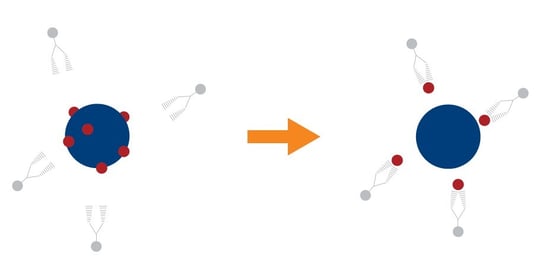 Figure 1. Metal scavenger principle. The contaminated product (left) is mixed with a metal scavenger, which binds to the metal contamination and removes it from the target product.
Materials and methods
Scavenger
Biotage® MP-TMT (Figure 2)
Structure
Macroporous cross-linked polystyrene/divinylbenzene polymer
Chemistry
functionalized with a dimercaptotriazinethiomethyl group
Conditions
Add a defined amount to a reaction, stir and filter
Equilibration
not necessary in a batch stir process
Assay
ICP (Pd) – external analysis, independent UKAS accredited to ISO 17025:2017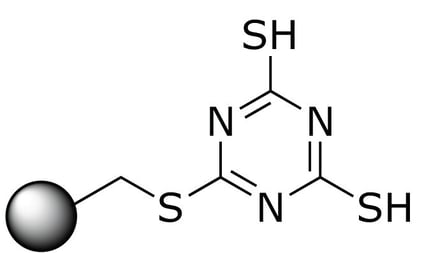 Figure 2. Biotage® MP-TMT resin.
Results and discussion
Using the classical Suzuki reaction as a probe (Figure 3) we coupled an aryl-bromide with a boronic acid. Nothing too exceptional there, chemistry-wise, this was going to work, however we didn’t know the impact and resulting distribution of the palladium catalyst. Using a very highly loaded catalytic system, we obtained our product, conducted a typical work-up, washed with brine and extracted in organic to isolate organic bi-aryl coupled product. Using elemental analysis as an analytical tool, we measured levels of palladium before and after a scavenging protocol, in which we simply added five equivalents of the MP-TMT metal scavenger to the reaction, and stirred the reaction at RT overnight. Our heavily loaded system started out at 33,000 ppm, and after one treatment, we saw that Pd levels had been reduced to less than 200ppm.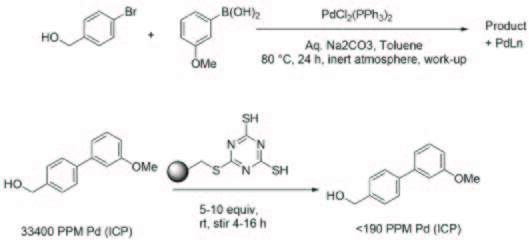 Figure 3. Suzuki reaction.
Repeating the experiment using a more typical 0.5% wt of the palladium catalyst (we used about 2% initially), we have consis- tently seen palladium levels pre metal scavenging treatment of 500–800 ppm and post treatment, under 10 ppm.
Conclusion
MP-TMT added in stoichiometric quantities to the product of our Suzuki reaction (5 eq wrt free palladium) reduced the palladium contamination in our product by a factor of between 100 and 1000 fold, enabling us to achieve pure product, with less than 10 ppm Pd, in a simple overnight stir treatment*
*We have since optimized scavenging protocols for both time, and equivalency, please see our other blogs and technical materials for more information.
References
- Miyaura, Norio; Yamada, Kinji; Suzuki, Akira (1979). A new stereospecific cross-coupling by the palladium-catalyzed reaction of 1-alkenylboranes with 1-alkenyl or 1-alkynyl halides. Tetrahedron Letters. 20 (36): 3437–3440.
Literature Number: AN154
