
ALC-0315 attracted global attention as a lipid component of the SARS-CoV-2 vaccine [BNT162b2, from BioNTech and Pfizer]. Lipids stabilize and increase the useful bioavailability of the mRNA therapies. These lipids can be difficult to purify with classical methods due to their non-crystalline, high boiling, colourless nature and weak UV absorbance. This makes chromatography the only viable option. However, developing and scaling this process can be challenging. Our simple methodology provides a directly scalable route from milligram to kilogram scale quantities of ACL-315 via flash purification1.
Synthesis
In this study we performed the previously published synthesis of ALC-0315, Figure 12.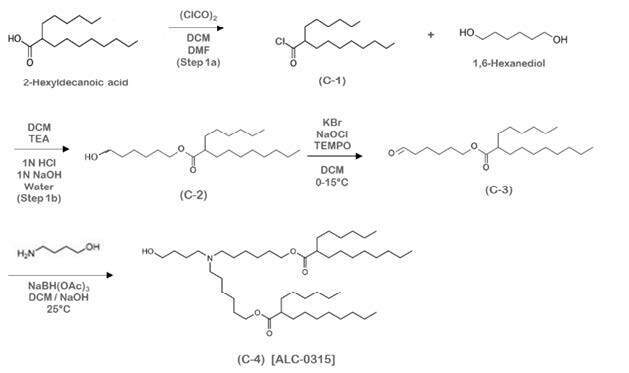 Figure 1. ALC-0315 synthesis from WO 2022/2150024
No purification steps were conducted during the synthesis (apart from extraction and washing) so we expected to find the crude ALC-0315 to contain a range of impurities. Two identical syntheses were performed showing large batch to batch variation, Figure 2.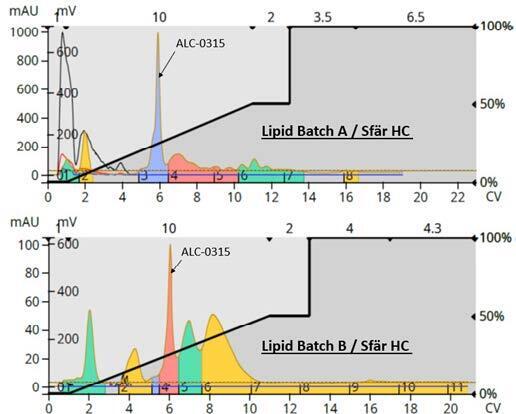 Figure 2. Purification of ALC-0315 from two batches. 200 mg loading onto Biotage®
Sfär HC, 5g cartridges. Running 0-50%, DCM/MeOH(in black) at a flow rate of 7 mL/min, UV λ-all 198-810 nm, ELSD tan line.
The crude ALC-315 was first purified using the Biotage® Selekt system in conjunction with Biotage® Sfär HC columns. The ACL-315 was detected with the integrated Biotage® Selekt ELSD and the identity of the ACL-315 was confirmed by mass spectrometry.
Purification method development
To increase the loading and separation of ALC-0315 from its impurities and use more sustainable solvents, we chose to use amino function- alised silica (Biotage® Sfär KP-Amino ), Figure 3.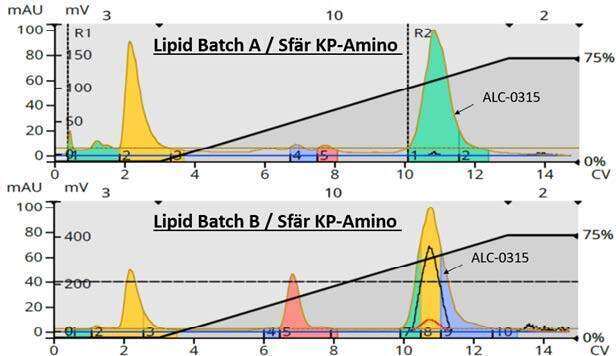 Figure 3. Purification of lipid sample A and B using an amino functionalized silica. [Silica (Sfär KP-Amino, 11g), linear gradient, 0-75%, heptane/MTBE, 7 mL/min ELSD (tan line)]
The use of these columns avoided the need to add a basic modifier and demonstrated an enhanced separation between ALC-0315 and the impurities from this synthesis.
The method was then transferred to a scalable step gradient with a more traditional solvent composition. We then compared both amino stationary phases from our scale up portfolio, Biotage® Sfär KP-Amine (spherical silica) and Biotage® Sfär Amine (irregular silica) and both showed an improved separation with a scalable step gradient method, Figure 4.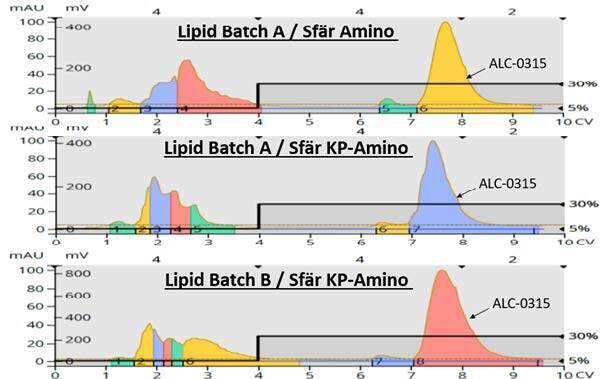 Figure 4. Comparison of Biotage® Sfär KP-Amino and Biotage® Sfär Amino with ALC-0315 Batch A. [Silica (Biotage® Sfär KP-Amino, Isoute NH2, 5g), step gradient, 5% then 30% EtOAc/heptane (black line), 7 mL/min, (4.33cm/min). Collect: ELSD (tan line)]
Due to the large baseline separation, we looked at whether normal phase silica (without a modifier) could provide an acceptable separa- tion using step gradients. In any process development activity, it is important to determine the optimum process economics for a system, so we are comparing separation efficiency or yield vs type of silica particle.
After screening several mobile phase conditions, the best separation was obtained using a heptane/2-propanol step gradient with Biotage® Sfär 60 Silica. The chromatographic method provided a large separation (ΔCV =4) between various lipophilic byproducts, Figure 5.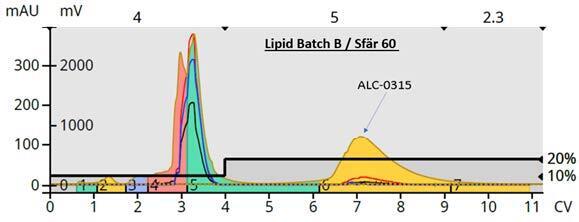 Figure 5. Batch B purification 4 % wt/wt Silica (Biotage® Sfär 60, 5g), step gradient, 10% then 20% heptane / propanol, 7 mL/min, UV λ-all 198-810 nm (blkack line), 200 nm (red line), 205 nm (blue line), ELSD (tan line)
To confirm our purification method’s robustness, we increased the sample load 2.5 -fold (to 10% wt/wt silica,) and re-ran the purification under identical conditions, Figure 6.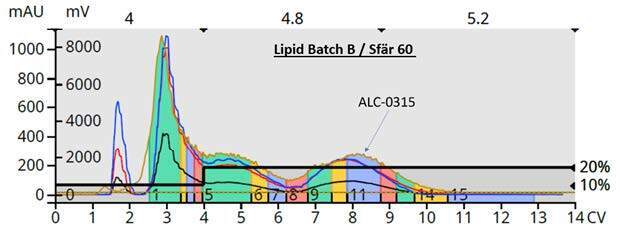 Figure 6. Batch B 10% wt/wt Silica (Biotage® Sfär 60, 5g), step gradient, 10% then 20% heptane / propanol, 7 mL/min, UV λ-all 198-810 nm (blkack line), 200 nm (red line), 205 nm (blue line), ELSD (tan line)
The results show ALC-0315 was still well resolved from its less polar byproducts, even at a high 10% sample load.
Biotage flash purification was designed to and has been shown to be seamlessly transferable from Selekt (mg to G) to larger Biotage platforms such as Biotage® Flash 150 (supporting up to 500g) and Biotage® Flash 400 (supporting up to 6Kg)3.
The same linear flow velocity can be used across all platforms, which means that products elute in the same way no matter which Biotage platform is used.
Conclusion
This document show that purification of lipids can be performed with a range of different mobile and stationary phases. The purification can be optimised for both the small- and large-scale. In our study, a step gradient was added to support optimized purification and reduce solvent use for the purification of lipid ALC-0315) at 10% sample loading
If the target molecule lacks a meaningful UV chromophore, method development and optimiza- tion using alternative detectors such as Biotage® Selekt ELSD can be applied at small scale with those purification method characteristics trans- ferred to larger scale.
References
- For full details see Application Note AN1008, Process development / purification of ALC-0315 and related lipids using flash chromatography, 2024
- WO 2022/215002, Methods of Producing of Lipids, Pfizer, granted 2022.
- For more information, please see Literature Note PPS654, Collaborating with Croda to help supply lipids for the global response to COVID-19 and mRNA vaccine development, 2021.
Literature Number: AN1015
