
Introduction
Molasses is commonly used in equine feed manufacturing as a palatability enhancer or feed binder. However, it may occasionally be contaminated with pharmacologically active substances. Tramadol, a synthetic opioid analgesic, along with its primary metabolites, pose a risk of anti-doping rule violations if inadvertently introduced via feed.
This application note presents a robust and automated solid-phase extraction (SPE) method using EVOLUTE® EXPRESS CX (30 mg) plates, combined with LC-MS/MS analysis, for the detection and quantification of tramadol and its key metabolites in molasses. The method is designed to support doping control and regulatory compliance in the equine industry.
Analytes
The analytes targeted for quantification include:
- Tramadol (TRM)
- O-Desmethyltramadol (O-TRM)
- N-Desmethyltramadol (N-TRM)
- N,O-Didesmethyltramadol (N,O-TRM)
- 1,6-Dehydrotramadol (1,6-TRM)
Sample preparation procedure
Molasses samples were processed to reduce matrix complexity and viscosity. Each sample was subjected to acidic aqueous dilution and centrifugation before SPE.
Sample pre-treatment
- Weigh 3.00 ± 0.05 g of molasses into a 50 mL polypropylene centrifuge tube.
- Add 20.0 mL of 50 mM H2SO4 (aq)
- Vortex to mix thoroughly.
- Place in ultrasonic bath at room temperature for 15 minutes.
- Centrifuge at 4000 rpm, for 20 minutes, at room temperature.
- Transfer 1.7 mL of supernatant to a 96-well plate.
Extraction using the Biotage® Extrahera™ Classic sample prep workstation
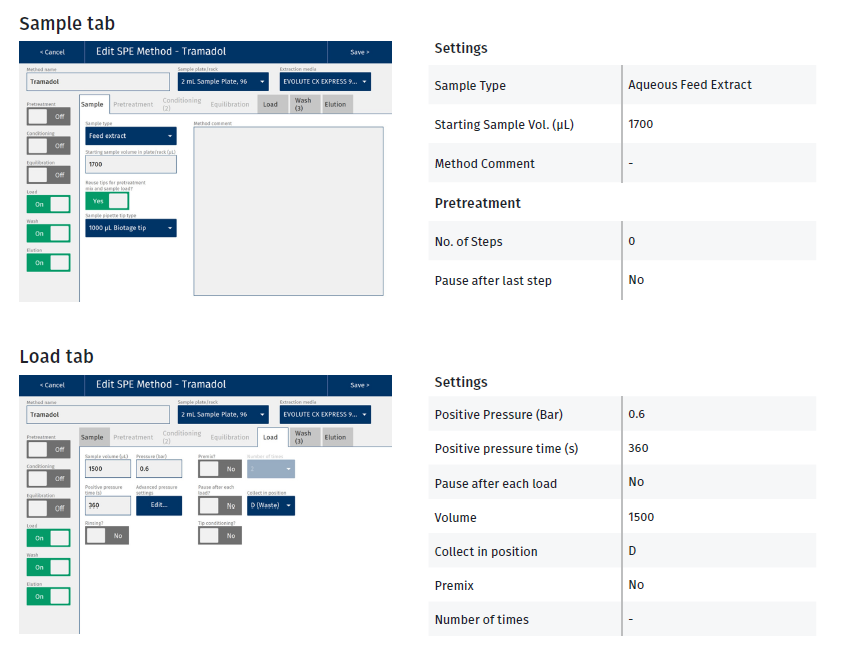
- Sample load: add 1.5 mL of sample onto the SPE plate.
- Wash 1: 2 × 1 mL of 50 mM H2SO4 (aq).
- Dry plate for 10 minutes.
- Wash 2: 2 × 1 mL of MeOH.
- Dry plate for 6 minutes.
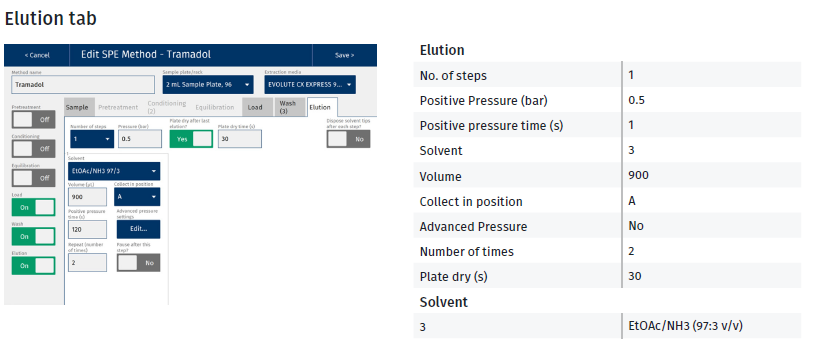
- Elution: 1.8 mL EtOAc/NH3 (97:3 v/v).
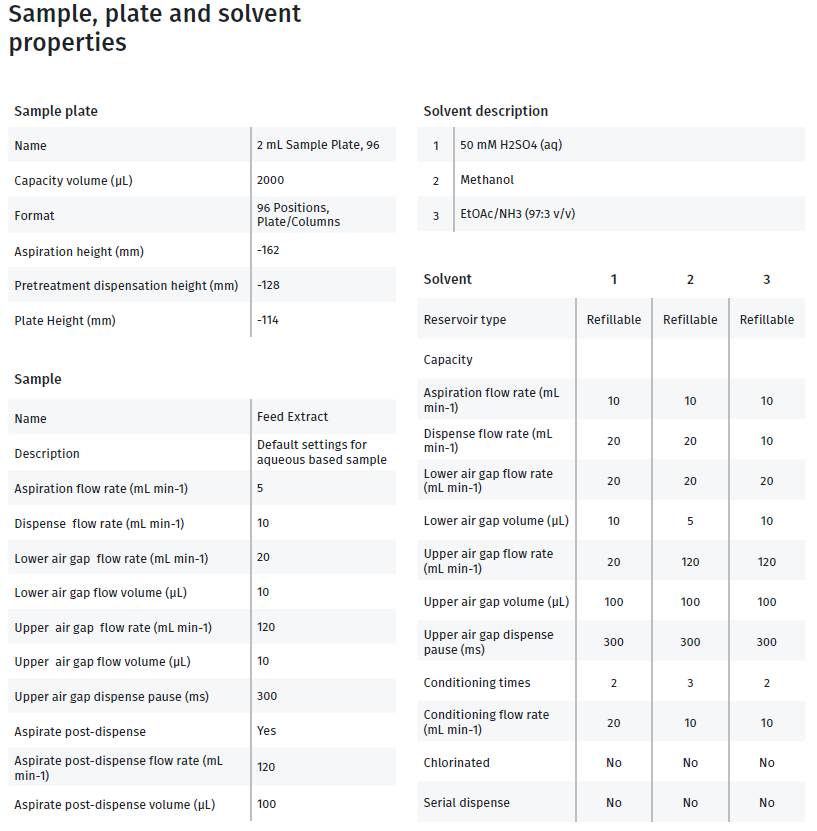
Note: The exact parameters used on the Biotage® Extrahera™ Classic workstation can be found in the appendix.
Post-extraction
- Evaporation was performed using TurboVap® 96 Dual evaporator. Both the gas (N2) and the plate temperatures were maintained at 30 °C; flowrate was set to 45 L min-1; and the plate height set to 55 mm. The eluates were evaporated to dryness for 30 minutes.
- The residues were reconstituted using 200 µL of mobile phase (0.1% Formic Acid, 10% MeOH in water).
- The plate was subsequently shaken for 5 minutes, transferred to an autosampler
and stored at 4 °C until analysis.
UHPLC conditions
Instrument
Thermo Scientific Dionex UltiMate 3000 UHPLC+.
Column
Supelco® Ascentis Express C18 (50 mm × 2.1 mm, 2.7 μm; P/N: 53822-U) with an Ascentis Express C18 guard cartridge (5 mm × 2.1 mm, 2.7 μm; P/N: 53501-U).
Mobile phase
A: 0.1% Formic acid in water.
B: 0.1% Formic acid in methanol.
Flow rate
0.5 mL min-1.
Injection volume
10 μL.
Column temperature
40 °C.
|
Step |
Time (min) |
Flow rate (mL min-1) |
A (%) |
B (%) |
|
1 |
0.00 |
0.5 |
95 |
5 |
|
2 |
1.00 |
0.5 |
95 |
5 |
|
3 |
2.00 |
0.5 |
5 |
95 |
|
4 |
3.00 |
0.5 |
5 |
95 |
|
5 |
3.50 |
0.5 |
95 |
5 |
|
6 |
6.00 |
0.5 |
95 |
5 |
MS/MS conditions
All experiments were conducted using a Thermo Scientific TSQ Quantum Access MAX triple quadrupole mass spectrometer. Detection was facilitated via electrospray ionisation (ESI) in positive ion mode, operating under multiple reaction monitoring (MRM) conditions. The spray voltage was set to 5000 kV; the vaporiser and capillary temperatures were at 300 and 320 °C, respectively; and the CID gas (argon) flow at 135 kPa.
|
Analyte |
MRM Transition |
Collision (eV) |
|
TRM |
264.11 → 58.42 |
15 |
|
O-TRM |
250.09 → 58.39 |
15 |
|
N-TRM |
250.09 → 44.49 |
15 |
|
N,O-TRM |
236.04 → 44.46 |
15 |
|
1,6-TRM |
246.09 → 58.37 |
15 |
Results
Selectivity and specificity
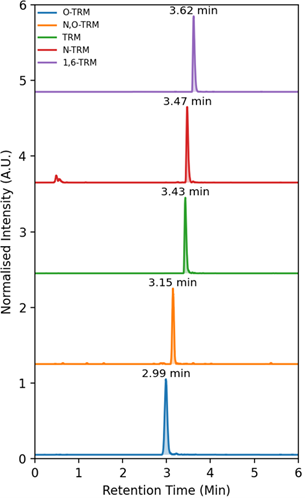
Selectivity of the assay was checked by injecting a blank matrix sample and a spiked matrix sample. Tramadol and the metabolites thereof were quantified accurately without interference. Exemplar chromatograms of extracted calibration standards are presented in Fig. 1.
Figure 1. Separation of tramadol and its metabolites. Chromatograms are normalised and offset for clarity.
Accuracy and precision
Accuracy was checked via the analysis of blank samples spiked with 3 ng mL-1 tramadol and the metabolites thereof. Recovery, expressed as a percentage, was calculated for each injection. Analyte recoveries were acceptable for the concentrations used and were in the 78-101 % range. Precision is expressed as percentage relative standard deviation (%RSD). Samples spiked with 3 ng mL-1 tramadol and its metabolites were injected seven times and the RSD values calculated (2.99-15.00 %) were appropriate for the concentrations used. Average recoveries and %RSD values (indicated by error bars) are presented in Fig. 2.
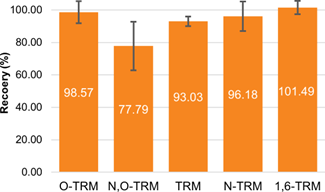 Figure 2. Average recoveries of tramadol and its metabolites. % RSDs are shown as error bars.
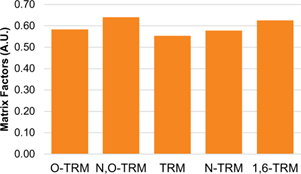 Figure 3. Matrix factors.
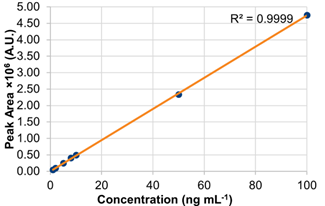 Figure 4. Extracted calibration of O-Desmethyltramadol using 7 concentrations.
Range and linearity
The method demonstrated good linearity across the 1 – 100 ng mL⁻¹ concentration range. To account for moderate ion suppression, arising from matrix effects (Fig. 3), standards were extracted prior to analysis. Linearity was assessed via linear regression of seven concentrations of extracted standards (1, 2, 5, 8, 10, 50, and 100 ng mL⁻¹), each injected in duplicate. All calibration curves achieved R² values greater than 0.99. An exemplar calibration curve is shown in Fig. 4.
Limits of detection and quantification
Sensitivity of the assay is expressed as the limit of detection (LOD) and the limit of quantification (LOQ), with signal-to-noise ratios of 3 and 10, respectively. The LODs and LOQs for each analyte are presented in Table below.
|
Analyte |
LOD (ng mL-1) |
LOQ (ng mL-1) |
|
TRM |
0.05 |
0.20 |
|
O-TRM |
0.05 |
0.20 |
|
N-TRM |
0.20 |
0.50 |
|
N,O-TRM |
0.50 |
1.00 |
|
1,6-TRM |
0.10 |
0.50 |
Conclusions and summary
This study presents a sensitive method for quantifying tramadol and its primary metabolites in molasses, with the aim of supporting anti-doping efforts in equine health and competitive sports.
The use of EVOLUTE® EXPRESS CX, mixed-mode cation exchange sorbent in a 96-well plate format produced clean extracts with consistent analyte recovery across all target analytes. Utilising the Biotage® Extrahera™ Classic automated sample preparation workstation, the method enables efficient extraction of up to 96 samples in 75 minutes, making it suitable for routine use in regulatory and feed-testing laboratories. Although moderate matrix effects were observed, which are typical of complex substances like molasses, the method maintained strong analytical performance with high sensitivity, selectivity and reproducibility.
These features, along with effective SPE clean-up and matrix correction, making this approach a reliable tool for detecting unintended pharmaceutical contamination in equine feed, which is an important factor in ensuring fairness and integrity in equine health and competitive sports.
Chemicals and reagents
Water used was ultrapure (18.2 MΩhm-cm) and drawn daily from a Milli-Q® IX7003 water purifier.
Methanol, formic acid, sulfuric acid and ethyl acetate were from Honeywell research chemicals and were all LC-MS grade.
25 % Ammonium hydroxide solution was of obtained from Fisher Scientific: also LC-MS grade.
Analytical standards (of tramadol and its metabolites) were purchased from Sigma-Aldrich and were diluted with LC-MS-grade methanol to prepare the calibration and spiking solutions.
Mobile phases A and B were prepared by adding 500 μL of formic acid to 500 mL of water and methanol, respectively.
Reconstitution solution was prepared by adding 500 μL of formic acid and 100 mL of methanol to a 500 mL volumetric flask. The solution was then made up to the mark using ultrapure water.
50 mM sulfuric acid solution was prepared by adding 1.39 mL of concentrated H2SO4 to a 500 mL volumetric flask and made up to the mark using ultrapure water.
SPE elution solution was prepared by adding 3 mL of 25% ammonium hydroxide solution to 97 mL of ethyl acetate.
Additional information
This application note was developed using intact, non-stripped, representative molasses matrix. Further optimisation may be required for other similar matrices (for example, to compensate for regional dietary variation).
Acknowledgements
Dr Mark Dunnett is the scientific director at Independent Equine Nutrition near Newmarket, Suffolk, UK. He is responsible for feed contaminant analysis, and also acts as an expert witness in legal proceedings concerning equine anti-doping rules violations.
Ordering information
|
Part number |
Description |
Qty |
|
601-0030-PX01 |
EVOLUTE® EXPRESS CX 30 mg Fixed Well Plate |
1 |
|
121-5203 |
Collection Plate, 2 mL Square |
2 |
|
414001 |
Biotage® Extrahera™ Classic |
1 |
|
41441 |
1000 µL Clear Tips |
960 |
|
418000 |
TurboVap® 96 Dual |
1 |
Appendix
Biotage® Extrahera™ settings
The method outlined in this application note was automated on the Biotage® Extrahera™ Classic, using EVOLUTE® EXPRESS CX plates. This appendix provides

 Literature number: AN1019
