
Introduction
Large-scale chromatography is often the only solution to the purification of valuable drug compounds in the pharmaceutical industry. For many manufacturers, bespoke chromatography solutions seem the simplest and most efficient way of implementing such techniques, utilizing the specialist knowledge of the in house chemical engineers to create a custom solution. However, there are numerous drawbacks to such an approach – someone has to support the service, invariably it involves handling and disposal of large amounts of silica, and although chromatography is relatively simple in terms of material requirements, optimizing such a system is not trivial. In many cases, a commercially available purification system specifically designed for a manufacturing environment represents an attractive alternative.
This paper describes a case study at CordenPharma Switzerland where the Biotage® Flash 400 large-scale chromatography system and pre-packed cartridges were evaluated alongside a custom-made alternative as part of a plan to increase the efficiency of the workflow. The purification was of a large multi-Kg batch of crude API (the nature of the API is proprietary).
Existing custom purification process
The purification process custom-built for API manufacture involved using a filter as a housing for silica, and an external pump to move the solvent. The filter is shown in Figure 1.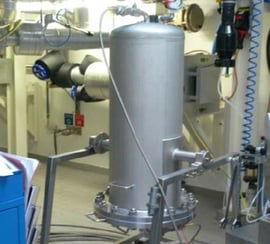 Figure 1. Re-purposed filter for purification chromatography.
The process performance was as follows:
- Process consisted of 5 runs with ca. 4 – 7.2 kg crude/ run; including a requirement for re-chromatography of any incompletely purified batch
- The time needed for ~41 kg crude would be around 18 days of operation including column packing /unpacking
- The yield was 18.6 kg (73.8%), which proved to be 88.9% pure by HPLC-UV.
Although these results were reasonable, the process was still an expensive component of the workflow, and upkeep of the filter equipment could be time consuming. So an alternative method was sought using a commercially-available system.
About CordenPharma: Full-service CDMO for a global market
CordenPharma, the global pharmaceutical service & manufacturing platform of International Chemical Investors Group (ICIG), is a full-service partner in the Contract Development & Manufacturing (CDMO) of APIs, Drug Products, and associated Packaging Services. Through a growing network of cGMP facilities across Europe and the US organized under five Technology Platforms – Peptides, Lipids & Carbohydrates, Injectables, Highly Potent & Oncology, and Small Molecules – CordenPharma experts translate complex processes and projects at any stage of development into high-value products.
Biotage® Flash 400 systems and cartridges
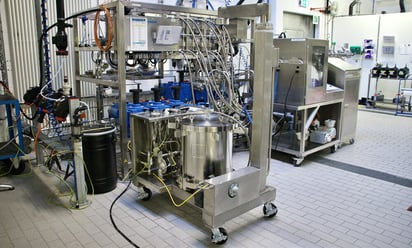 Figure 2a. Biotage® Flash 400 system incorporated in a custom process workflow for efficient purification chromatography at CordenPharma Switzerland.
Biotage has a range of large scale flash chromatography systems designed for use in the manufacturing environment, the Biotage® Flash 75, 150 and 400 systems. In terms of addressing the difficulties of a manufacturing environment, these systems are designed specifically for this purpose:
- Solvents – each system pumps solvent utilizing compressed gas, with no electrical parts. Step gradients can be developed that allow the user to adjust elution conditions to perfectly match those created in the laboratory.
- Media – each system makes use of pre-packed columns in a range of media types, in this way the handling of dangerous loose powder is not required, and disposal of the used cartridges is simple. Pre-packed cartridges also results in consistent media packing from batch to batch and the units are available in smaller sizes for method development purposes.
- Method development – scaling up methods developed on Biotage flash systems such as the Biotage® Selekt and Biotage® Flash 150 using the same stationary phase means high reproducibility in scale-up. Predictability of elution is such that it is not always necessary to employ detectors during the large scale run, (although systems are available).
- ATEX – removal of electrical pumps and detectors means that the systems require only compressed gas to run, and therefore present no explosion risk in the manufacturing environment. The optional UV detector is supplied with long fiber-optic cables to
allow installation of electrical components outside of the ATEX area. In our application the Biotage® Flash 400 was connected to an ATEX preparative HPLC system. - Safety – All large scale Biotage flash systems are CE marked, ASME/PID certified and ATEX rated. The solvent flow-path is defined and manufactured from FDA approved materials. As such, adherence to GMP guidance is made simple with the documents supplied with the system.
- Integration - the system is skid mounted, so can be easily stored when not in use and all fittings are standard push fit or Swagelok™ for easy integration into existing equipment and lab services.
Biotage’s line of large-scale flash chromatography systems are specifically designed to take methodologies directly from the laboratory to the manufacturing plant. They are also fully supported by a dedicated service team.
Due to the scale of the API purification process were required, the Biotage® Flash 400 system and cartridges evaluated as a replacement for the bespoke filter solution. The Flash 400 system offers several advantages over bespoke in-house solutions:
- The system is designed to fit into a ‘family’ of instruments with common media types, meaning that scale up processes are simpler and more robust.
- Designed specifically for the manufacturing environment, so for example ATEX explosion-proof rating is designed into the system, as are ways of pumping solvent and handling the stationary phase media.
- Expertise in implementing such a solution is provided by the supplier.
- Service support is assured, so that expensive system downtime is minimized.
- Silica media is supplied in pre-assembled cartridges, for easy storage, use and disposal.
This makes for a much more commercially viable solution with long-term support (Figure 2).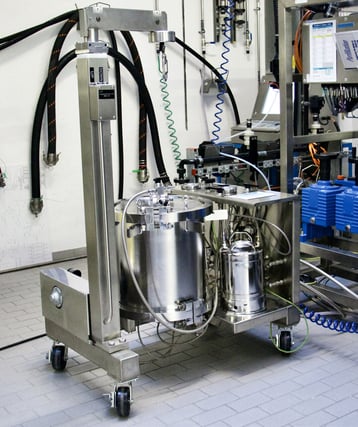 Figure 2b. Biotage® Flash 400 system incorporated in a custom process workflow for efficient purification chromatography at CordenPharma Switzerland.
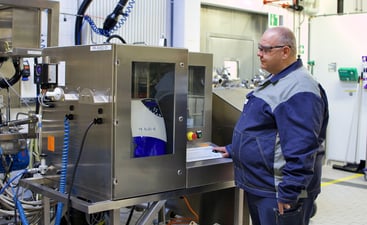 Figure 3. CordenPharma uses online UV and ELSD for detection of compounds.
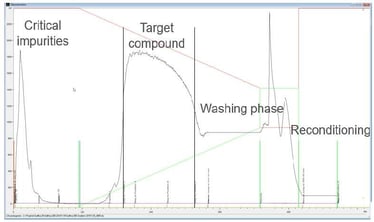 Figure 4. Example chromatogram for the production scale purification of the API.
Small-scale optimization
Before the Biotage® Flash 400 system was run, chromatography was first optimized using the same media as available in the Flash 400 pre-packed cartridges. One of the advantages of a commercially available chromatography system designed for large scale is that significant focus can be dedicated to purification optimization and scaled up. Running a small-scale optimization means that the best and most efficient operating conditions can be determined for the desired separation, with the knowledge that scaling up from this point will be an easy task.
On the laboratory scale, process optimization was performed to determine:
- The appropriate loading.
- The robustness of the separation.
- The selectivity that could be achieve (i.e. the removal of the impurities).
- How easy it was to handle the pre-packed columns.
After the optimization experiments, the main process changes that were implemented were as follows:
- Operation of the separation in gradient mode utilizing third party pumping system HPLC skid with online UV triggered fraction collection.
- Use of Biotage cartridge system as opposed to slurry-packed media.
- Reuse of the cartridge was confirmed.
After this work, purification was performed on the Flash 400 system and the results evaluated.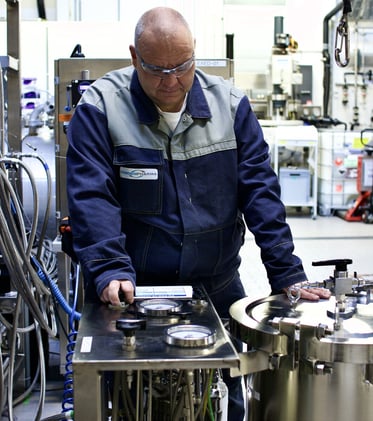 Figure 5a. Preparing the Biotage® Flash 400 system for use.
Purification of the API on the Flash 400 cartridges
The purification was repeated using the optimized protocol on the Flash 400 system using the pre-packed columns designed for the system.
The process performance was found to be as follows:
- 6 runs were performed with 4.1 –8.3 kg of crude material loaded per run.
- The time needed for the whole process was 6 days as opposed to 18 days.
- Multiple runs could be performed on one cartridge as observed in the optimization experiments, there was no need to replace the column (or empty and repack as was the case in the original process).
- The yield from the process was 34.4 kg or 89.8%, with the same purity of 89.8% by HPLC-UV.
In comparison to the original process, the following improvements were observed:
- 13 days saved in operator time;
- Yield improved by 15.2%
- Operating cost for the process was reduced by 50%.
Comparative cost savings with the Biotage® Flash 400
When comparing the efficiencies of the two processes, the following cost savings were observed when replacing the self- packed column with the Flash 400 and pre-packed columns:
- Due to the higher loading achieved, product concentration at the end of the run was twice that of the old process, so 50% less evaporation was required.
- The purification was significantly faster and required 13 days less time for 2 operators compared to the old process (550 kg of loose silica media was replaced with one Flash 400 cartridge).
- Due to the more concentrated fractions, 5400 L of solvent was saved.
- Total cost saving was approximately 50%.
Further efficiencies were also observed from the perspective of the manufacturing suite and production site:
- 5.5 m3 less waste was generated by Biotage® Flash 400 process, making this significantly greener and reducing purchasing and storage requirements.
- More streamlined operation compared to the filter system, which allowed easier integration into the production environment.
- A more robust and reproducible purification meant that better planning could be implemented, resulting in more efficient use of resources.
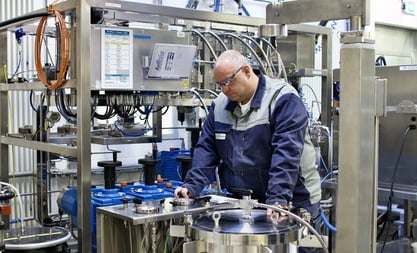 Figure 5b. Biotage® Flash 400 System in use at CordenPharma, Switzerland.
|
Status |
Existing Process (using a filter) |
Improved CORDEN Process using Biotage Flash 400L cartridges |
|
Number of runs |
5 |
6 |
|
Product output per run / Kg |
4-7.2 |
4.1-8.3 |
|
Total process time for crude sample |
18 days |
6 days |
|
Final Yield / Kg |
18.6 |
34.4 |
|
Final Purity / HPLC-UV |
88.9% |
89.8% |
|
Reduction in overall operating costs |
- |
50% |
|
Reduction of solvent |
- |
5400L |
|
Reduction of waste |
- |
5.5m3 |
|
Mass of silica used |
550Kg |
40Kg |
Conclusions
In this case study, evaluation of Flash 400 with pre-packed cartridges as an alternative to a custom-built purification device in an API workflow showed considerable cost savings and increased efficiencies. A more robust, optimized and reproducible purification, plus the reduction in man-hours and solvent consumption had considerable knock-on effects within the plant and made for a better approach to the API workflow.
Clearly this example shows the benefit of using equipment specifically designed for large scale purifications, and how optimizing in the laboratory and scaling up through robust procedures can make such a system superior to in-house solutions.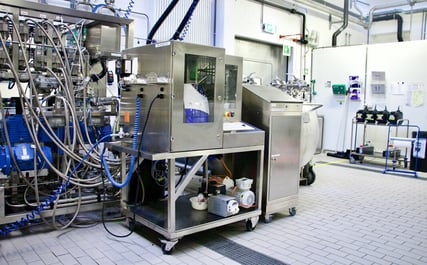
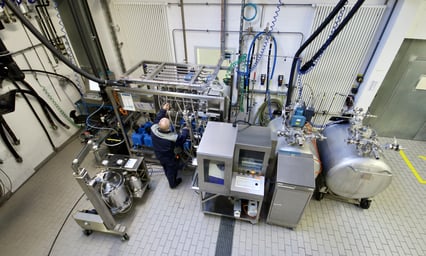 Figure 5c (top) and 5d (bottom). Biotage® Flash 400 System in use at CordenPharma, Switzerland.
Literature Number: PPS647
